Hi Stefanie,

My apologies, I missed that you were talking about a different attack.
Regardless, I agree that the presented solutions are not ideal.

Thanks,
Michael

On Wed, Apr 20, 2016 at 2:48 PM, Michael Grube <[email protected]>
wrote:

> Hi Stefanie,
>
> I'm just clarifying for my own sake - you're talking about pitch black,
> correct? There are some implications which may involve capturing routing
> requests, but essentially the attack destroys the small world routing
> efficiency of Sandberg's work by propagating fixed locations throughout the
> network by lying about the locations of neighbors. It does not matter
> terribly much if the attacker is highly connected or not - 2 attackers can
> cripple a network of about 1000 or so nodes given adequate time.
>
> For the record I agree completely that the solutions demonstrated by my
> simulation work are not ideal. I'm still working on some countermeasures
> which I hope to release the code for soon.
>
> Let me know if you have any questions, I'd be happy to answer them.
>
> Thanks!
> Michael
>
>
> On Wed, Apr 20, 2016 at 2:31 PM, Stefanie Roos <
> [email protected]> wrote:
>
>> Hi,
>>
>> if I remember correctly, the thought behind i) was that the attacker has
>> a very high probability
>> to capture routing requests that pass one of its neighbors, so the
>> strength of the attacker should depend on the ttl of the routing and the
>> connectivity/degree of the attacker (=factors influencing the likelihood
>> that a neighbor is on the route), I guess.
>>
>> Yes, as stated, it is definitively an improvement over the current
>> algorithm. Just pointing out that it might still have some issues and I
>> am currently unsure if they are serious threats or can be disregarded :)
>> My guess would be that the problem only arises if the attacker has a lot
>> of neighbors, but any concrete results reinforcing that guess would of
>> course be better.
>>
>> Regards,
>>
>> Stef
>>
>>
>>
>>
>> On 19.04.2016 21:57, Arne Babenhauserheide wrote:
>> > Hi Stef,
>> >
>> > Thank you for your answer!
>> >
>> > I’m sorry that it took me long to answer back. I somehow missed a lot of
>> > messages the past three months… (I’m only now catching up bit by bit)
>> >
>> > i) only works when the attacker is directly connected to the target,
>> >    right? That would allow them to fix one node per active connection to
>> >    a bad position, and for that they have to be already connected via
>> >    darknet, so they have to social engineer their way to the nodes.
>> >
>> > I would think that both problems are much weaker in impact — though
>> > that’s easy compared to the pitch black attack which effectively allowed
>> > poisoning the network with negligible cost.
>> >
>> > Best wishes,
>> > Arne
>> >
>> > Stefanie Roos writes:
>> >
>> >> Hi Arne,
>> >>
>> >> looks fine in general and seems to prevent the PitchBlack Attack in its
>> >> current form.
>> >> I am slightly worried about some modified versions of the attack, which
>> >> take the protection scheme into account.
>> >>
>> >> Does the following attack work?
>> >> Pitch Black Attack: attacker(s) always provide location l1
>> >> In addition, they
>> >> i) pretend to have location l2, reasonably far from l1
>> >> ii) whenever nodes route for a location loc, an attacker on the route
>> >> replies with an loc' close to loc
>> >>
>> >> i) should encourage neighbors to forward to the attacker (because it
>> >> seems to be one of the few nodes not close to l1) and ii) ensures that
>> >> nodes don't swap to random location
>> >>
>> >> => I don't think this is a probably as long as the attacker has few
>> >> connections (and is thus unlikely to be on the route) but will be a
>> >> problem for more powerful attackers, so it might be good to check how
>> >> much it changes your results and determine how strong an attacker has
>> to
>> >> be (in terms of connections to honest nodes or so).
>> >>
>> >> A second problem might be presented by an attacker who does not perform
>> >> a PitchBlack Attack, but upon receiving a routing request for the
>> >> closest node to location loc always replies with a fake location at a
>> >> large distance to loc, in order to achieve a randomized network (since
>> >> the node changes its location to the random location loc while its
>> >> current location might actually be very good).
>> >>
>> >> However, I think both attacks are certainly less of a problem than
>> >> PitchBlack.
>> >>
>> >> Cheers,
>> >>
>> >> Stef
>> >>
>> >>
>> >>
>> >> On 08.02.2016 12:13, Arne Babenhauserheide wrote:
>> >>> Hi,
>> >>>
>> >>> ## Preface
>> >>>
>> >>> I fixed a small bug in the simulator of thesnark. With that, the
>> >>> simulator shows that the defense against the Pitch Black Attack works:
>> >>> A small number of attackers can no longer kill parts of the keyspace
>> and
>> >>> can also no longer make certain parts of the keyspace inaccessible.
>> >>>
>> >>> Attackers can still limit the convergence of the network towards a
>> >>> reproduction of the small world network, but since we know that
>> Opennet
>> >>> works quite well with 30% backoff, this limited convergence should
>> >>> suffice for efficient routing.
>> >>>
>> >>> I also identified two possible ways to make the algorithm more
>> efficient.
>> >>>
>> >>> The fix does not need to know the size of the network. The only global
>> >>> information it needs is routing to random locations.
>> >>>
>> >>> In this mail I first describe simulator and Pitch Black Attack.
>> >>> Afterwards I describe the fix. The fix was originally proposed by
>> Oskar
>> >>> Sandberg. He did all the hard work, I just describe it here.
>> >>>
>> >>>
>> >>> ## Graphics
>> >>>
>> >>> -
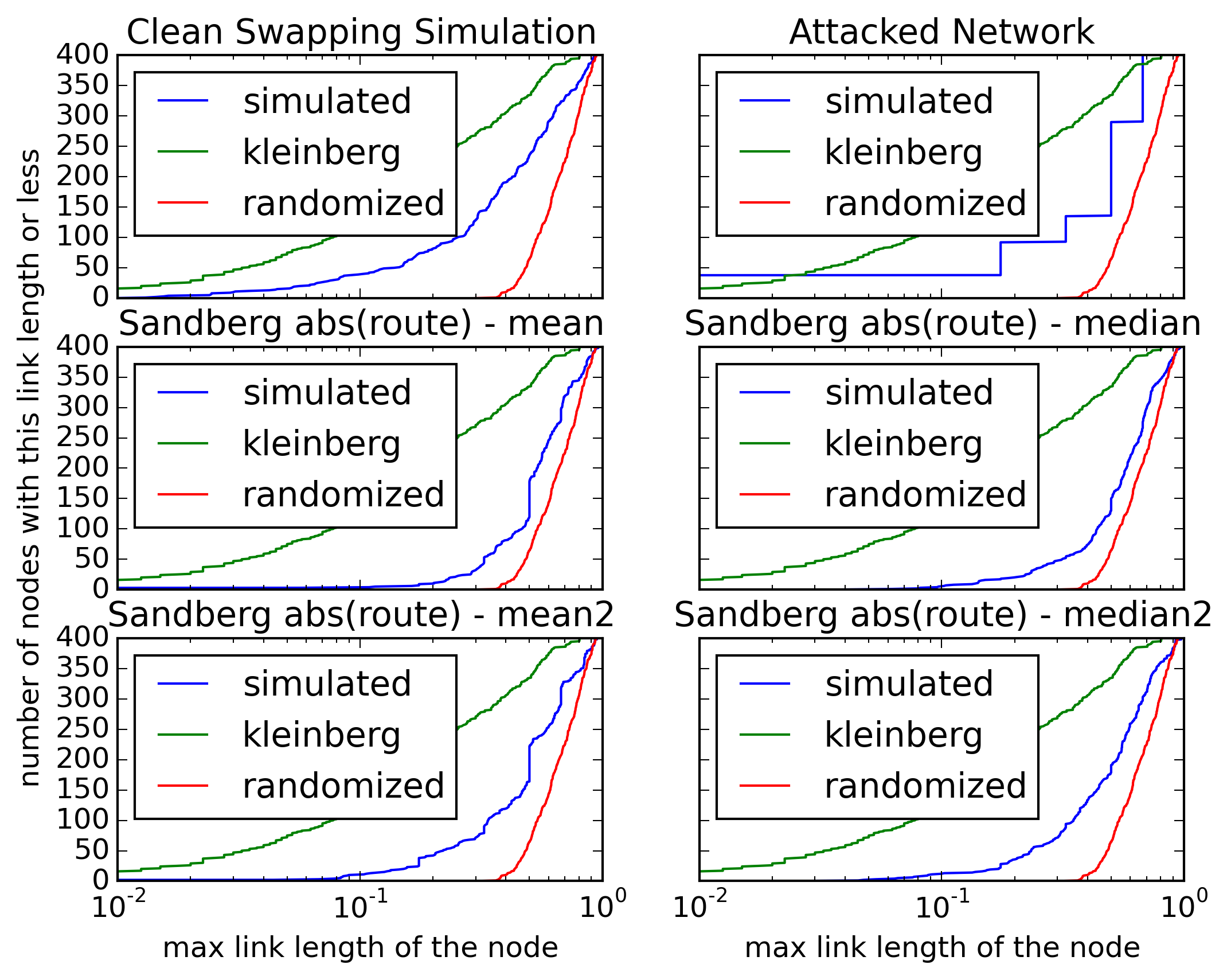
>> http://draketo.de/dateien/freenet/fix-pitch-black-400-mean-median-median2-peerdist.png
>> >>> -
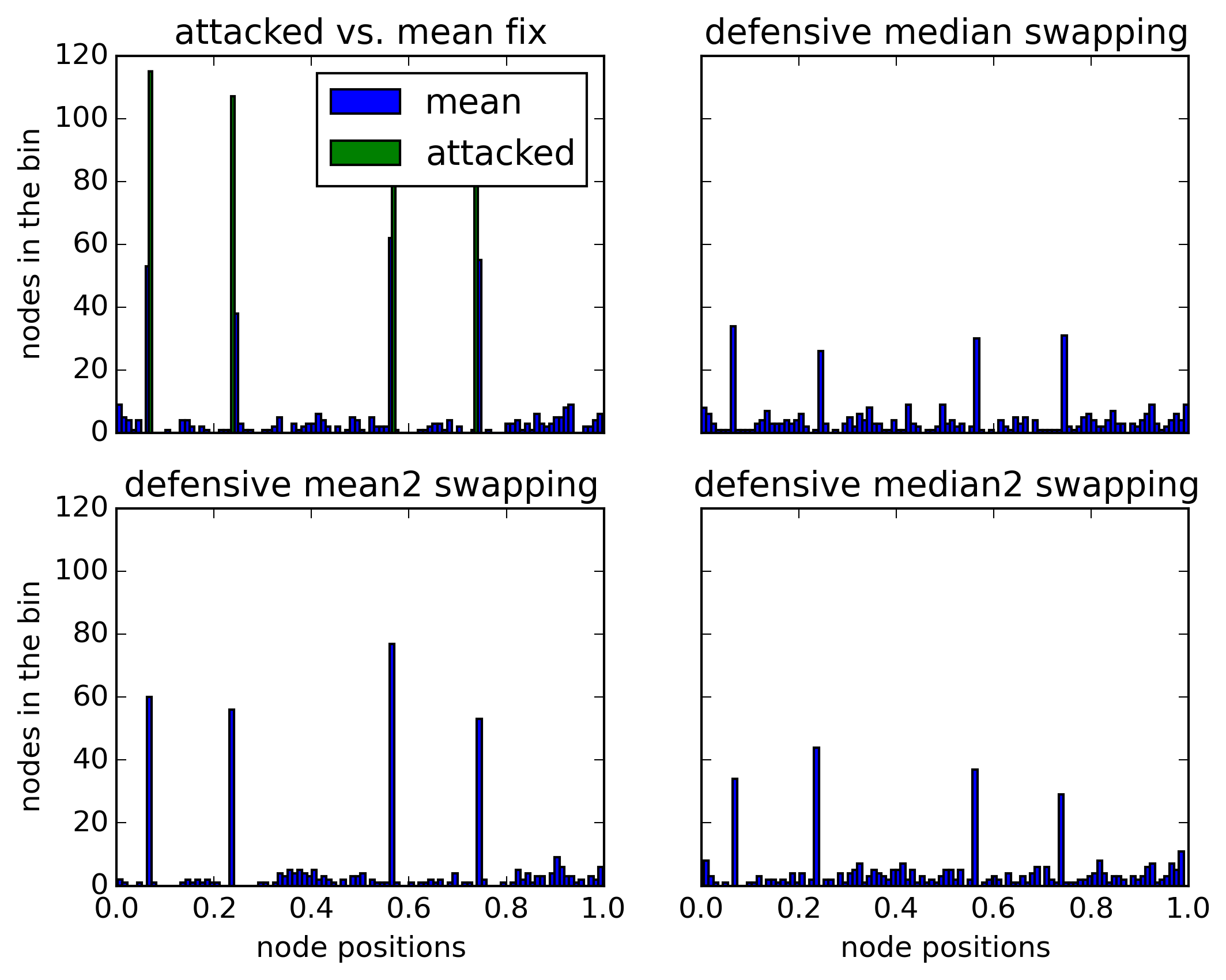
>> http://draketo.de/dateien/freenet/fix-pitch-black-400-mean-median-median2-lochist.png
>> >>>
>> >>> (because that’s what most people really want ☺)
>> >>>
>> >>> These show that the fix prevents complete fracturing of the keyspace:
>> It
>> >>> recreates the short connections.
>> >>>
>> >>>
>> >>> ## The simulator
>> >>>
>> >>> Most of the simulation is the work of Michael Grube. I just fixed a
>> >>> small bug.
>> >>>
>> >>> - Michaels Repo: http://github.com/mgrube/pbsim
>> >>> - My Repo: http://github.com/ArneBab/pbsim
>> >>>
>> >>> The network starts with a random network and then optimizes it —
>> either
>> >>> with clean swapping or under attack without and with different
>> >>> countermeasures.
>> >>>
>> >>> To run the simulation, run
>> >>>
>> >>>     ./testfixpitchblack.py
>> >>>
>> >>> You need pylab and networkx (links are in README.md).
>> >>>
>> >>>
>> >>> ## The Pitch Black Attack (the problem)
>> >>>
>> >>> Optimizing the network with swapping works pretty well without attacks
>> >>> (within the mathematical limits[1]) — as shown in the simulation
>> ("clean
>> >>> swapping network"). But this can currently be broken easily, even by a
>> >>> single attacker, using the Pitch Black Attack.[3]
>> >>>
>> >>> Swapping exchanges keys and implicitly trusts randomly selected
>> >>> nodes. Two nodes compare their peers, and if they determine that
>> >>> exchanging their locations improves the link length distribution to
>> >>> their respective group of peers, they swap the locations. Node A now
>> has
>> >>> the former location of node B and node B has the former location of
>> node A.
>> >>>
>> >>> Normally that’s no problem: The probability that this trust is
>> >>> violated is just the proportion of attackers in the network. So some
>> >>> swapping will wrong, but this will only happen rarely.
>> >>>
>> >>> There is one lasting effect however: If node B always hands out the
>> same
>> >>> location when swapping, this location will stay in the network
>> >>> indefinitely and former location of node A will be lost. This is slow,
>> >>> only one key can be killed per swapping, but highly effective.
>> >>>
>> >>> Using the Pitch Black Attack, attackers can remove selected locations
>> >>> From the network (which allows for censorship by making selected files
>> >>> with known keys inaccessible, because nodes with their content change
>> >>> to locations which won’t be searched for this content).
>> >>>
>> >>> The fix for this has been pending since 2008 because “We have
>> solutions
>> >>> for this but they are still being tested.”
>> >>> (https://freenetproject.org/about.html#papers). I consider this
>> testing
>> >>> to be done with this email. The fix works (described as follows).
>> >>>
>> >>>
>> >>> ## Approach
>> >>>
>> >>> To fix the Pitch Black Attack nodes route to a random location and
>> check
>> >>> the distance of the closest node they can reach. If this distance is
>> >>> much larger than expected, they consider the network to be under
>> attack
>> >>> and switch to this location to fill the gap they found.
>> >>>
>> >>> If detection and filling of gaps is faster than creation of gaps by
>> the
>> >>> Pitch Black Attack, this reduces the Pitch Black Attack from a death
>> >>> stroke to a nuisance.
>> >>>
>> >>>
>> >>> ## Requirements
>> >>>
>> >>> 1. The network must be stable for (a) a random network and (b) a
>> network
>> >>>    with a cluster of small-world structured nodes embedded in a random
>> >>>    network. The algorithm must not mistake (a) or (b) as attacked
>> >>>    networks, otherwise swapping will not be able to change a random
>> >>>    network to a small world network.
>> >>>
>> >>> 2. In case of an attack, nodes must switch do positions inside the
>> >>>    created gaps to fill them.
>> >>>
>> >>> 3. When switching locations, content must be preserved close to the
>> old
>> >>>    location.
>> >>>
>> >>>
>> >>> ## Information used
>> >>>
>> >>> The simulated algorithm only uses the estimated number of peers (also
>> >>> known as outdegree), the distance to direct peers and actual routing.
>> It
>> >>> does not need the size of the network.
>> >>>
>> >>> The number of peers is used to calculate the expected distance to a
>> >>> location in a randomly structured network. More exactly: The mean
>> >>> distance plus two standard deviations (97.5% of random routes will
>> find
>> >>> a shorter distance than this). Let’s call this expected random
>> distance range
>> >>> d_er. As far as I can reconstruct it, this distance was calculated by
>> >>> Oskar using statistics. I just use brute force, as shown in
>> >>> https://github.com/ArneBab/pbsim/blob/master/bruteforcemindist.py
>> >>>
>> >>> This is the magic number 0.037. If you choose a set of six random
>> >>> locations in the circular keyspace [0..1) repeatedly and stop the
>> >>> closest of these locations isn’t closer to a target than on the
>> previous
>> >>> try, and you re-run this experiment repeatedly, then 95% of the
>> results
>> >>> will be closer than 0.037. It’s the 95% limit of the distance to a
>> >>> target in a random network with outdegree 6.
>> >>>
>> >>>
>> >>> ## The basic algorithm
>> >>>
>> >>> Before starting to swap, a freenet node first selects a random
>> >>> location. Let’s call it l. Then it routes towards this location and
>> >>> notes the distance of the node closest to this location. Lets call it
>> >>> `d`.
>> >>>
>> >>> Now it calculates the mean distance to its direct peers. Let’s call
>> this d_mean
>> >>>
>> >>> If the distance d minus the mean distance to the peers d_mean is
>> larger
>> >>> than the expected random distance range d_er, the node assumes that
>> the
>> >>> random location l is within a gap. Instead of starting a swap request,
>> >>> it switches to this tested location l.
>> >>>
>> >>> if (d - d_mean) > d_er:
>> >>>    switch to l
>> >>> else:
>> >>>    initiate swap
>> >>>
>> >>> d - d_mean compares the routing result with the distribution of direct
>> >>> peers. If the gap is bigger than the mean distance to the peers, it
>> >>> might be a real gap, purely from local information.
>> >>>
>> >>> (d - d_mean) > d_er ensures that even if the peers have the same
>> >>> location (d_mean = 0), this is only treated as gap if d is larger than
>> >>> the distance which would be found on 95% of routing tries in a random
>> >>> network, d_er. This ensures that even when there is a small optimized
>> >>> group within a large randomized network (for example when the network
>> >>> grows quickly), the nodes in the optimized group will not mistake the
>> >>> routing quality outside the optimized group as attacked network.
>> >>>
>> >>>
>> >>> ## Adaptions
>> >>>
>> >>> ### Median distance
>> >>>
>> >>> During experimentation I found that using mean peer distance means
>> that
>> >>> nodes with more long-distance connections are less likely to detect a
>> >>> gap. An attacker might be able to segment the network so that every
>> node
>> >>> has a few long-distance connections to prevent detection of gaps. I
>> >>> tried to fix this using the median distance to peers instead of the
>> mean
>> >>> distance, since the median is less sensitive to outliers.
>> >>>
>> >>>    use d_median instead of d_mean
>> >>>
>> >>> This was the most effective adjustment, but I need help from someone
>> >>> with deeper knowledge about network statistics to test this.
>> >>>
>> >>> ### Route to two targets
>> >>>
>> >>> If the constant minimum distance for random networks (d_er) should
>> prove
>> >>> problematic, we can reduce the value of d_er by doing two routing
>> tries
>> >>> with different targets and check the shorter of the two distances but
>> >>> switch to the target with the larger distance. d_er would then for
>> >>> example be only around 0.02 instead of 0.037). But for this the
>> simulation results
>> >>> have been unclear.
>> >>>
>> >>>
>> >>> ## Avoid data loss
>> >>>
>> >>> If a node changes its location by a large distance, this means that
>> the
>> >>> content it holds cannot be found anymore. To fix this, it needs to
>> >>> re-insert all content in its store.
>> >>>
>> >>> This is no large problem with basic swapping, because there the
>> >>> locations should stabilize, changing only in small ways. In case of an
>> >>> attack, it becomes important, though.
>> >>>
>> >>> While it sounds expensive to re-insert all content in the store, it
>> >>> should not actually cost too much, since we can assume that most peers
>> >>> of the node will be close to its old location. So it could simply
>> insert
>> >>> the content in its store with a HTL around 2 and still be confident to
>> >>> reach the right nodes.
>> >>>
>> >>>
>> >>> ## Conclusion
>> >>>
>> >>> This solution mitigates the Pitch Black Attack with moderate cost.
>> Under
>> >>> attack the network no longer converges completely, but it still
>> reaches
>> >>> a more optimized state of which I would expect that it suffices for
>> >>> routing.
>> >>>
>> >>> It would be great to have more math on this, but I think it’s already
>> >>> ready for implementation.
>> >>>
>> >>> Please comment!
>> >>>
>> >>> Best wishes,
>> >>> Arne Babenhauserheide
>> >>>
>> >>> [1]: Stefanie Roos[2] showed that efficient convergence is not
>> possible
>> >>>      under churn, but this should not affect Freenet too badly,
>> because
>> >>>      in friend-to-friend mode many connections are extremely long
>> lived,
>> >>>      often on the order of years. Therefore real churn (as in
>> >>>      permanently lost connections) is extremely low compared to other
>> >>>      systems which often have lifetimes on the order of hours.
>> >>>
>> >>> [2]: Dipl. Math Stefanie Roos
>> >>>
>> https://tu-dresden.de/die_tu_dresden/fakultaeten/fakultaet_informatik/sysa/ps/beschaeftigte/mitarbeiter/sro_de
>> >>>
>> >>> [3]: This was shown by Christian Grothoff:
>> >>> http://grothoff.org/christian/pitchblack.pdf
>> >>> @conference{pitchblack,
>> >>>     title = {Routing in the Dark: Pitch Black},
>> >>>     booktitle = {23rd Annual Computer Security Applications
>> Conference (ACSAC 2007)},
>> >>>     year = {2007},
>> >>>     pages = {305{\textendash}314},
>> >>>     publisher = {IEEE Computer Society},
>> >>>     organization = {IEEE Computer Society},
>> >>>     abstract = {In many networks, such as mobile ad-hoc networks and
>> friend-to-friend overlay networks, direct communication between nodes is
>> limited to specific neighbors.  Often these networks have a small-world
>> topology; while short paths exist between any pair of nodes in small-world
>> networks, it is non-trivial to determine such paths with a distributed
>> algorithm.  Recently, Clarke and Sandberg
>> >>> proposed the first decentralized routing algorithm that achieves
>> efficient routing in such small-world networks.
>> >>>
>> >>> This paper is the first independent security analysis of Clarke and
>> Sandberg{\textquoteright}s routing algorithm. We show that a relatively
>> weak participating adversary can render the overlay ineffective without
>> being detected, resulting in significant data loss due to the resulting
>> load imbalance.  We have measured the impact of the attack
>> >>> in a testbed of 800 nodes using minor modifications to Clarke and
>> Sandberg{\textquoteright}s implementation of their routing algorithm in
>> Freenet. Our experiments show that the attack is highly effective, allowing
>> a small number of malicious nodes to cause rapid loss of data on the entire
>> network.
>> >>>
>> >>> We also discuss various proposed countermeasures designed to detect,
>> thwart or limit the attack. While we were unable to find effective
>> countermeasures, we hope that the presented analysis will be a first step
>> towards the design of secure distributed routing algorithms for
>> restricted-route topologies.},
>> >>>     keywords = {denial-of-service, Freenet, installation, routing},
>> >>>     url = {http://grothoff.org/christian/pitchblack.pdf},
>> >>>     author = {Nathan S Evans and Chis GauthierDickey and Christian
>> Grothoff}
>> >>> }
>> >>>
>> >>>
>> >
>>
>>
>>
>> _______________________________________________
>> Devl mailing list
>> [email protected]
>> https://emu.freenetproject.org/cgi-bin/mailman/listinfo/devl
>>
>
>
_______________________________________________
Devl mailing list
[email protected]
https://emu.freenetproject.org/cgi-bin/mailman/listinfo/devl