[EMAIL PROTECTED] <[EMAIL PROTECTED]> wrote in sci.stat.edu:
>Decision making is extremely important in the world today.  If there is work
>leading up to the decision that must be made and that work involves some
>error on the part of the decision maker the final answer may result in many
>things which are not reversable.  Examples:  Deciding to close a plant; not
>produce a product; send men into battle; select a dose of medicine; sell
>stock.  All involve a decision.  I don't see why we would give a student
>partical credit for doing a problem that results in a wrong decision.
Suppose the problem involves 10 data points and a t test is
appropriate. A hypothetical student does everything right except
looks up the t value for df=10 instead of df=9 in the table. Do you
really believe that student should get a zero for the problem
equally with the student who uses a z test instead of a t test,
equally with the student who uses a one-tailed instead of two-tailed
test (or vice versa), equally with the student who simply takes the
mean of the given data points and compares it to the hypothetical
mean without any sort of statistical test, equally with the student
who writes _nothing_?

It's true that all wrong answers are wrong, but they are not equally
wrong. (This is my problem with multiple choice exams. If the
problem is 1/2 + 1/3, the answers of 2/5 and 3/2 are both wrong, but
they are not wrong in the same way. [The latter one may be revealed
by a student's work to stem from a misreading of the "+" as a
division mark. The former reveals a fundamental failure to master
the addition of fractions.)

>  The
>most important thing is the answer, not not how it is approached.

On the other hand, I do not believe we should give credit for
correct answers that were not correctly arrived at. It's true that
19/95 = 1/5, but a student who gets it by "canceling the 9s" should
not get any credit at all, in my opinion.

>  The
>approach may be correct but the calculations may be faulty.  Fire 32 men and
>close the plant.  The decision is made.  You can't come back three-months
>later and say "Woops, I made an addition mistake.  Let's reopen the plant."
>It is WRONG to give partial credit when it leads to the wrong answer which
>results in a bad decision that may affect people's lives.

In theory I agree with you, but on the other hand these are
students. We need to balance between expecting high-quality work and
crushing their spirit. On your plan, a great many students would get
zeroes, and a great many of them would turn to more forgiving fields
of study even though in time they might have improved and become
fine statisticians.

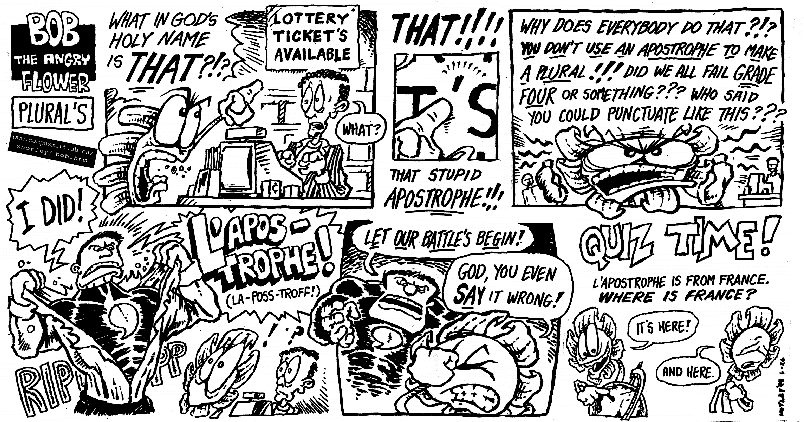
>Isn't the purpose of education to produce student's who make good decisions?

http://www.angryflower.com/plural.gif

--
Stan Brown, Oak Road Systems, Cortland County, New York, USA
                                  http://OakRoadSystems.com/
Support our troops: bring them home!
.
.
=================================================================
Instructions for joining and leaving this list, remarks about the
problem of INAPPROPRIATE MESSAGES, and archives are available at:
.                  http://jse.stat.ncsu.edu/                    .
=================================================================