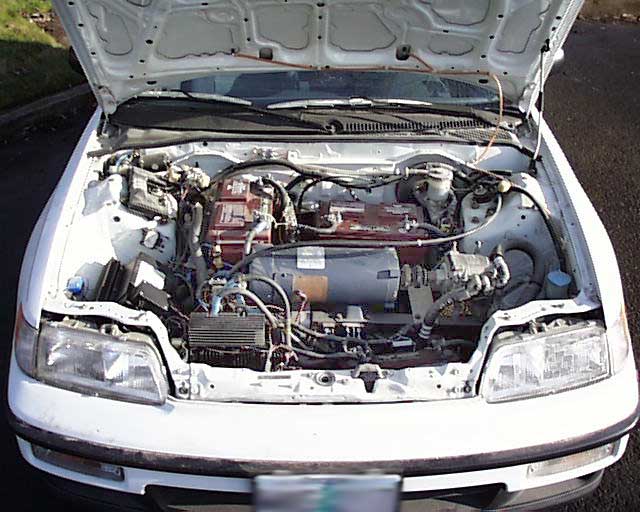
EV Digest 5699

Topics covered in this issue include:
  1) Re: Solectria A/C compressor anyone?
        by Victor Tikhonov <[EMAIL PROTECTED]>
  2) Re: Solectria A/C compressor anyone? A bit of background
        by Danny Miller <[EMAIL PROTECTED]>
  3) Wayland Invitational
        by "[EMAIL PROTECTED]" <[EMAIL PROTECTED]>
  4) solid state cooler in EV in place of air conditioning?
        by Tom Watson <[EMAIL PROTECTED]>
  5) Re: A123 Specs (was: Rich Rudman's PHEV project (?))
        by Steve Powers <[EMAIL PROTECTED]>
  6) Re: A123 Specs (was: Rich Rudman's PHEV project (?))
        by "Philippe Borges" <[EMAIL PROTECTED]>
  7) Surplus NiCD cells
        by Steve Powers <[EMAIL PROTECTED]>
  8) Re: Solectria A/C compressor anyone? A bit of background
        by Danny Miller <[EMAIL PROTECTED]>
  9) Re: Solectria A/C compressor anyone?
        by Victor Tikhonov <[EMAIL PROTECTED]>
 10) Re: Solectria A/C compressor anyone?
        by "Bob Rice" <[EMAIL PROTECTED]>
 11) Re: Want to build a sporty EV, AC is feasible too.
        by jeff <[EMAIL PROTECTED]>
 12) Re: Solectria A/C compressor anyone? A bit of background
        by Wayne <[EMAIL PROTECTED]>
 13) Re: Goldie Lives!
        by "Bob Rice" <[EMAIL PROTECTED]>
 14) Re: A123 Specs (was: Rich Rudman's PHEV project (?))
        by "Arthur W. Matteson" <[EMAIL PROTECTED]>
 15) Re: Solectria A/C compressor anyone? A bit of background
        by Lock Hughes <[EMAIL PROTECTED]>
 16) Re: Solectria A/C compressor anyone? A bit of background
        by "Richard Furniss" <[EMAIL PROTECTED]>
 17) Re: solid state cooler in EV in place of air conditioning?
        by "Mark Grasser" <[EMAIL PROTECTED]>
 18) RE: Want to build a sporty EV, AC is feasible too.
        by "Don Cameron" <[EMAIL PROTECTED]>
 19) Re: A123 Specs (was: Rich Rudman's PHEV project (?))
        by "Mike Phillips" <[EMAIL PROTECTED]>
 20) Burned Sparrow motor
        by "John G. Lussmyer" <[EMAIL PROTECTED]>
 21) Re: A123 Specs (was: Rich Rudman's PHEV project (?))
        by Steve Powers <[EMAIL PROTECTED]>
--- Begin Message ---
Jude Anthony wrote:
I've tried that using a 1120VDC 3600RPM 2.0HP motor from sciplus.com,
^^^^
rated at 14.2A. On the first test, it ran so fast the brushes glowed
orange; my wife panicked and made me turn it off.
I bet at 1120 volts DC anything will glow orange and run pretty fast...

Victor
--- End Message ---
--- Begin Message ---
One term I've heard mentioned to improve A/C performance is the
"Variable Orifice Valve". I am unsure if it is snake oil or not, the
standard critical question of "if it is so great, why didn't the mfg
include it?" applies. I have few factual details on them but they make
them for every A/C system. It's supposed to improve cooling performance
at low rpms, when coolant flow is below the ideal level.
This sounds very interesting. The auto A/C system I've looked at
control temp by using an air mixing door to reduce airflow across the
evaporator core. This is bad for efficiency to limit airflow across the
evaporator! It would be a GREAT idea to lower the compresser speed
instead (impossible in a belt-driven device where the A/C has no say in
the engine rpm) and always maximize evaporator airflow. Since we may be
looking to keep power consumption at a minimum, perhaps the occupant
would prefer cooling only to 85F if it gets more range. So we use
unlimited evaporator airflow and keep the compresser rpms low to
modulate the performance- if we do that, this is supposed to be the
region where the variable orifice valve provides substantial benefits.
If you don't have inverter current to run a 5000 BTU window unit, where
will you get the current to run a 288V Prius compresser? Does your pack
voltage run near enough to 288v to drive it directly?
I wonder about building an inverter to run a compresser off of >120v
pack voltages. It shouldn't be that hard actually. Now if you skip the
DC/DC converter stage and feed it a rough modified square wave of odd
voltages it might be pretty rough on the electronics in there, but the
electronics can be stripped and we drive the compresser directly. The
relatively crudely designed inverter might be rough on the compresser
too, but then again a 5000 BTU A/C may only be a $99 part so this isn't
a terrible loss to experiment with. While it would require a large
inductor, a DC/DC converter to run on lower or higher pack voltages
probably isn't an insurmountable problem either.
Danny

Michaela Merz wrote:
I thought about a bigger a/c in terms of a 5000 BTU window unit, but my
inverter is most likely unable to handle that and - I don't want to have a
huge chunk of a/c sitting in the bed of the truck.

Back to the drawing board. I think, the only way to go is to restore the
original S-10 a/c. The DENSO and other electric compressors either run
with a pretty complicated voltage and/or need some special ester in
addition to, or in combination with the refrigerant. I don't know if those
refrigerants would be usable with the rest of the S10's a/c system.
Solectria has (had) 144V compressors, actually normal units, belted to a
small motor. I don't have the mechanical knowledge to 'mate' a motor to an
compressor myself. The examples listed in reply to my original posting
were interesting, though I would have a hard time finding a spot in my
truck to put big motors like that.

Thanks for your insights.

Michaela
--- End Message ---
--- Begin Message ---
Hi,all,

I got home at 6:30 this morning from Portland, after 24 hours of EV insanity.
Everyone racing had some kind of a problem, although the TV producer from
Australia was still able to capture the White Zombie annihilating a Ford
Mustang.  My brain is in fog mode, so will send more later.

- F.T.


[EMAIL PROTECTED]
EarthLink Revolves Around You.
--- End Message ---
--- Begin Message ---
Hi

Is anyone using solid state coolers in their EV for cooling?

I was thinking(not a good sign)that because of the efficiency of
these and their small size(power transistor sized, except for the
heat sink) and the fact that you could put several inside your
heating system with controls to turn each on individually, they might
be a good choice?

any thoughts on this?

Tom

__________________________________________________
Do You Yahoo!?
Tired of spam?  Yahoo! Mail has the best spam protection around
http://mail.yahoo.com
--- End Message ---
--- Begin Message ---
As far as small NiCD, NiMH, and LiIon cells go and making them into battery
packs, welding is the industry standard for many reasons.  I spent many years
in the business, manufacturing and designing battery packs.  Trust me when I
tell you that welding is the way to go.  The issue is getting all that current
through those tabs that connect the cells.  To get a good weld, you are looking
at a 0.005" x 0.187" Ni or Ni plated steel strip.  Much thicker, and you won't
be able to weld it.  Welding wire on a cell is a major pain.  Again, trust me,
I have done it too many times.  Off hand, I don't know just how much current
you can push through one of those intercell tabe.  I am thinking, maybe 5 Amps
continuous.  Given that, why even bother with anything larger than a AA cell
(available in 2.1 AH capacity, that is a discharge rate of about 2.5 C), if you
can only get 5 Amps per string.  That's a lot of strings.  In my prototype
pack, still sitting in the garage, I couldn't pull
 more than about 5 Amps.  But I also had thermal fuses all over tha place.  For
NiMH, that is a good way to go (resettable thermal fuses).  For LiIon, you need
to monitor the voltage and percent of charge for each and every cell.  Today,
there are commercially available chips that can do that, but it is a lot of
money when you consider all those cells in all those strings.  My NiMH cellpack
would have had about 7000 AA cells in it.  At lets say $1 / cell, that's a
$7000 pack.  That is a lot of connections!  I don't know what the going rate is
now for these cells today.  They are out there in surplus, but you need to look
around.

  Steve

Mike Phillips <[EMAIL PROTECTED]> wrote:
  In the R/C community homebrewed is soldered, factory purchased is
welded.

Either works if you do it right. I've soldered hundreds. If I had to
make enough EV class modules I would work very hard on perfecting
welding. I've welded .002" wire to another part, so how hard could it
be to weld a flat tab to a flat surface?

The one advantage I've seen many times in the field is that when a
soldered pack gets shorted so it overheats, the solder joints melt and
open circuit the pack.

Mike


--- Philippe Borges
wrote:

> I play a little with multi cell lithium pack design and resistance
> connection quality is a major argument.
> Soldering or welding ? that is the question !
> Some say soldering is better (wider contact surface) others say
> welding is
> better (can't desolder from heating)
> i'm still searching ...but soldering is easier and explain RC
> community
> choice i suppose.
>
> cordialement,
> Philippe
>
> Et si le pot d'échappement sortait au centre du volant ?
> quel carburant choisiriez-vous ?
> http://vehiculeselectriques.free.fr
> Forum de discussion sur les véhicules électriques
> http://vehiculeselectriques.free.fr/Forum/index.php
>
>
> ----- Original Message -----
> From: "[EMAIL PROTECTED]"
> To:
> Sent: Sunday, July 30, 2006 1:18 AM
> Subject: A123 Specs (was: Rich Rudman's PHEV project (?))
>
>
> > I have tortured A123 cells on the bench and on the track. They meet
> > or exceed the spec sheet in every way I have tested.
> >
> > A lot depends on how you connect to them, by the way. You
> > must weld tabs to the ends with very pricey high-current equipment.
> > If you attempt to draw the max power from them with pressure
> contacts
> > or improperly welded tabs, (or other less-than-optimal connections)
> > you will not get what you were hoping for.
> >
> > The A123 folks know this and supply their evaluation cells
> > with double tabs on each end. These cells put out a lot of current,
> > and the tabs must be up to the task, or the tabs will be the
> weakest link.
> >
> > Bill Dube'
> >
> > At 03:45 PM 7/29/2006, you wrote:
> > >RC fellows disagree: A123 are not as good as claimed though still
> better
> for
> > >their usage than NIMH and 3/4 time than lipoly.
> > >
> > >cordialement,
> > >Philippe
> >
>
>


---------------------------------
See the all-new, redesigned Yahoo.com.  Check it out.
--- End Message ---
--- Begin Message ---
I read this point also:

-factory use welding because it's an automated process not because it's
better.

A lot of RC hobbyist are using sub-c NIMH near hell limit (200A) with
soldering tabs and say they don't want welding at all.

I have read lots of different points and still found no test publication...

A tab welder is very easy to do (i make one so everybody can make one :^)
Simpler homebrew one is capacitor discharge welder:
a power supply charging a capacitor banks
Note: the less the voltage the more the capacitence: 20V and 500 000 uf is
ok
Use a SCR as a switch commanded with a "foot pedal" it connect sudently the
capacitor voltage to the 2 coppers spot contact.

or use a microwave oven transformer rewired with 3 or 4 turns 2/0 cable at
secondary...this give an AC spot welder

In all case take care...

BUT this said good spot welding (read making +200 reliable welded spot ) is
incredibly hard so as actually i'm in a hurry, no time to tun an homebrew
welder....i'm still soldering my 18650.

cordialement,
Philippe

Et si le pot d'échappement sortait au centre du volant ?
quel carburant choisiriez-vous ?
 http://vehiculeselectriques.free.fr
Forum de discussion sur les véhicules électriques
http://vehiculeselectriques.free.fr/Forum/index.php


----- Original Message -----
From: "Mike Phillips" <[EMAIL PROTECTED]>
To: <[email protected]>
Sent: Sunday, July 30, 2006 6:35 PM
Subject: Re: A123 Specs (was: Rich Rudman's PHEV project (?))


> In the R/C community homebrewed is soldered, factory purchased is
> welded.
>
> Either works if you do it right. I've soldered hundreds. If I had to
> make enough EV class modules I would work very hard on perfecting
> welding. I've welded .002" wire to another part, so how hard could it
> be to weld a flat tab to a flat surface?
>
> The one advantage I've seen many times in the field is that when a
> soldered pack gets shorted so it overheats, the solder joints melt and
> open circuit the pack.
>
> Mike
>
>
>
> --- Philippe Borges <[EMAIL PROTECTED]> wrote:
>
> > I play a little with multi cell lithium pack design and resistance
> > connection quality is a major argument.
> > Soldering or welding ? that is the question !
> > Some say soldering is better (wider contact surface) others say
> > welding is
> > better (can't desolder from heating)
> > i'm still searching ...but soldering is easier and explain RC
> > community
> > choice i suppose.
> >
> > cordialement,
> > Philippe
> >
> > Et si le pot d'échappement sortait au centre du volant ?
> > quel carburant choisiriez-vous ?
> >  http://vehiculeselectriques.free.fr
> > Forum de discussion sur les véhicules électriques
> > http://vehiculeselectriques.free.fr/Forum/index.php
> >
> >
> > ----- Original Message -----
> > From: "[EMAIL PROTECTED]" <[EMAIL PROTECTED]>
> > To: <[email protected]>
> > Sent: Sunday, July 30, 2006 1:18 AM
> > Subject: A123 Specs (was: Rich Rudman's PHEV project (?))
> >
> >
> > > I have tortured A123 cells on the bench and on the track. They meet
> > > or exceed the spec sheet in every way I have tested.
> > >
> > >          A lot depends on how you connect to them, by the way. You
> > > must weld tabs to the ends with very pricey high-current equipment.
> > > If you attempt to draw the max power from them with pressure
> > contacts
> > > or improperly welded tabs, (or other less-than-optimal connections)
> > > you will not get what you were hoping for.
> > >
> > >          The A123 folks know this and supply their evaluation cells
> > > with double tabs on each end. These cells put out a lot of current,
> > > and the tabs must be up to the task, or the tabs will be the
> > weakest link.
> > >
> > >          Bill Dube'
> > >
> > > At 03:45 PM 7/29/2006, you wrote:
> > > >RC fellows disagree: A123 are not as good as claimed though still
> > better
> > for
> > > >their usage than NIMH and 3/4 time than lipoly.
> > > >
> > > >cordialement,
> > > >Philippe
> > >
> >
> >
>
--- End Message ---
--- Begin Message ---
You could build an array of 7000 cells for under $5000 if you want to do all
that welding.  Cells at $0.625 / ea.

  http://www.sciplus.com/category.cfm?subsection=13&category=134

  I have no idea if they have 7000 of them available.  That would be a 120 V
pack with 119 AH which you could pull as much as 500 Ah very short term.  That
is 4.2C  It would need to be cooled with fans and would need some kind of BMS.
At minimum, resettable thermal fuses on each string.  I sure am not going to
try it, but if someone was highly motivated, it could be done.

  Steve.

Steve Powers <[EMAIL PROTECTED]> wrote:
  As far as small NiCD, NiMH, and LiIon cells go and making them into battery
packs, welding is the industry standard for many reasons. I spent many years in
the business, manufacturing and designing battery packs. Trust me when I tell
you that welding is the way to go. The issue is getting all that current
through those tabs that connect the cells. To get a good weld, you are looking
at a 0.005" x 0.187" Ni or Ni plated steel strip. Much thicker, and you won't
be able to weld it. Welding wire on a cell is a major pain. Again, trust me, I
have done it too many times. Off hand, I don't know just how much current you
can push through one of those intercell tabe. I am thinking, maybe 5 Amps
continuous. Given that, why even bother with anything larger than a AA cell
(available in 2.1 AH capacity, that is a discharge rate of about 2.5 C), if you
can only get 5 Amps per string. That's a lot of strings. In my prototype pack,
still sitting in the garage, I couldn't pull
more than about 5 Amps. But I also had thermal fuses all over tha place. For
NiMH, that is a good way to go (resettable thermal fuses). For LiIon, you need
to monitor the voltage and percent of charge for each and every cell. Today,
there are commercially available chips that can do that, but it is a lot of
money when you consider all those cells in all those strings. My NiMH cellpack
would have had about 7000 AA cells in it. At lets say $1 / cell, that's a $7000
pack. That is a lot of connections! I don't know what the going rate is now for
these cells today. They are out there in surplus, but you need to look around.

Steve

Mike Phillips wrote:
In the R/C community homebrewed is soldered, factory purchased is
welded.

Either works if you do it right. I've soldered hundreds. If I had to
make enough EV class modules I would work very hard on perfecting
welding. I've welded .002" wire to another part, so how hard could it
be to weld a flat tab to a flat surface?

The one advantage I've seen many times in the field is that when a
soldered pack gets shorted so it overheats, the solder joints melt and
open circuit the pack.

Mike


--- Philippe Borges
wrote:

> I play a little with multi cell lithium pack design and resistance
> connection quality is a major argument.
> Soldering or welding ? that is the question !
> Some say soldering is better (wider contact surface) others say
> welding is
> better (can't desolder from heating)
> i'm still searching ...but soldering is easier and explain RC
> community
> choice i suppose.
>
> cordialement,
> Philippe
>
> Et si le pot d'échappement sortait au centre du volant ?
> quel carburant choisiriez-vous ?
> http://vehiculeselectriques.free.fr
> Forum de discussion sur les véhicules électriques
> http://vehiculeselectriques.free.fr/Forum/index.php
>
>
> ----- Original Message -----
> From: "[EMAIL PROTECTED]"
> To:
> Sent: Sunday, July 30, 2006 1:18 AM
> Subject: A123 Specs (was: Rich Rudman's PHEV project (?))
>
>
> > I have tortured A123 cells on the bench and on the track. They meet
> > or exceed the spec sheet in every way I have tested.
> >
> > A lot depends on how you connect to them, by the way. You
> > must weld tabs to the ends with very pricey high-current equipment.
> > If you attempt to draw the max power from them with pressure
> contacts
> > or improperly welded tabs, (or other less-than-optimal connections)
> > you will not get what you were hoping for.
> >
> > The A123 folks know this and supply their evaluation cells
> > with double tabs on each end. These cells put out a lot of current,
> > and the tabs must be up to the task, or the tabs will be the
> weakest link.
> >
> > Bill Dube'
> >
> > At 03:45 PM 7/29/2006, you wrote:
> > >RC fellows disagree: A123 are not as good as claimed though still
> better
> for
> > >their usage than NIMH and 3/4 time than lipoly.
> > >
> > >cordialement,
> > >Philippe
> >
>
>


---------------------------------
See the all-new, redesigned Yahoo.com. Check it out.


 __________________________________________________
Do You Yahoo!?
Tired of spam?  Yahoo! Mail has the best spam protection around
http://mail.yahoo.com
--- End Message ---
--- Begin Message ---
Keep in mind that the EER is I think about 9-15 in these units, usually
on the low side.
A device consuming 20A @ 12v- 240W- would produce like 2500 BTU. As
Michaela noted, the 2000BTU range is not even a "noticible" amount of
cooling in a road vehicle. It is impossible to get around the
substantial electrical requirements for cooling for the large volume of
A/C required in a road vehicle unless you bring the cold with you-
bottles of ice.
Danny

Roger Stockton wrote:
A quick Google turns these 13,500BTU self-contained roof mount units for
about $400-500.  The downside to using one of these is that they run on
115VAC, so you'd need to provide an inverter of about 2kW rating (the
air con is spec'd to consume just under 1500W).

However, if you browse Carrier's website and check out the "split
units", I notice these are available to run from either 12VDC or 24VDC,
and consume about 20A @ 12V:

<http://www.transportaircon.carrier.com/details/0,2806,CLI1_DIV8_ETI338,
00.html>
Cheers,

Roger.
--- End Message ---
--- Begin Message ---
Mike Chancey wrote:
...
Victor had a similar motor driven compressor back in the days when his
CRX was DC drive. He set his up direct drive, no belts at all. There
are pictures at:
http://www.metricmind.com/ac_honda/images/ac1.jpg

and

http://www.metricmind.com/ac_honda/images/ac2.jpg

I think he used the original Honda compressor.
Yes, it was original Honda compressor driven straight
off the 120V pack by Leeson 180VDC 7.6A 1.5hp 1750rpm
PM DC motor. The type is C4D17FK10C.

That motor was overkill for the job but I didn't know any better
back then - I saw this motor used for that exact purpose and
assumed that's the power needed. The compressor was consuming
5-6A at 120V and didn't even slowed down loaded. That is
well under 1hp, but with larger than CRX's compressor this
may not be the case.

Victor
--- End Message ---
--- Begin Message ---
----- Original Message -----
From: "Victor Tikhonov" <[EMAIL PROTECTED]>
To: <[email protected]>
Sent: Sunday, July 30, 2006 2:43 PM
Subject: Re: Solectria A/C compressor anyone?


> Jude Anthony wrote:
>
> > I've tried that using a 1120VDC 3600RPM 2.0HP motor from sciplus.com,
>                            ^^^^
> > rated at 14.2A.  On the first test, it ran so fast the brushes glowed
> > orange; my wife panicked and made me turn it off.
>
> I bet at 1120 volts DC anything will glow orange and run pretty fast...

>   Yeah, about 130MPH with an AEM-7 lokie and 8 cars, om Amtrak!More
downhill<g>!Headlite glows orange, too.

       Seeya

      Bob
> Victor
>
--- End Message ---
--- Begin Message ---
He was joking,This IS the one best list for both.

   The AC Induction motor and drives available are high voltage, high
effiency, low current machines with very broad torque curves. The are
less popular and so arguably more expensive for peak hp. (the whole
system is not so bad new by the time compare to DC  but no discount or
used parts and you have to sorta buy it all at once.)

Usually you don't bother with a transmission, reverse is in software and
the broad torqe curve does the job.

Series Wound DC motors have a really steep torqe curve starting at max
at stall and dropping off quickly. This happens to fit well with
accelerating a large mass. As the car gets rolling you need less.
Usually you keep the tranny cause it provides reverse and allows
different ratios for different speeds, An example : my 4050Lb 1987 300zx
with Zilla 1K and a warp 9 on 288Volts of orbitals. I put in in second
and take off from the light then shift to third. When I get to the stop
light I pull it into second again. The clutch is NOT used to launch,
just to shift gears. If I hit the highway and get into the 75-80 mph
range I use 4th. I could use 5th but It's a red sports car and I'll get
a ticket for sure.

I could and sometimes leave it in third around town, if I am
accelerating slow the amps don't get to high and it is convienent.


BLDC - BLAC - synchronous : the motors with permanent magnets, You have
a fixed field. Althought the effiency can be high, it is best at a
single point. the torque drops off linearly and there is notheing you
can do about it. These usually take six switching elements to
alternately connect the coils to positive and negative alternately,
Google "Six step" +  "trapazoidial drive".

Series : current in the field and in the rotor are equal, this is why
the torque curve has that current squared look to it. The +/-
commutating of the polarity of the coils is done with the (wait for it)
....the commutator.

The two different ways of reversing the polarity of a coil is to hold
one end at ground and make the voltage more positve and more negative
(AC motor) or swap polarity of both ends of the coil( series DC motor as
the coil connection slides under brush)


Induction : Torque is mostly limited by the max current you can induce
in the rotor before you melt it.  A computer keeps you from doing this.
And needs to know a lot about the motor(hince the matched motor and
controller combinations)  The rotor is designed for one or two rpm
ranges, everything else is a compromise. There is an exception, but It
is not available. This is the wound rotor induction motor. I personally
think we could make an EV drag race AC winner with one.


I think Using only positve pulses is a stepper motor or repulsion motor
and  isn't very appropriate for EV's
--- End Message ---
--- Begin Message ---
I pulled up a web site the other day that had an interesting electric
compressor for A/C use in hybriud vehicles, etc. Fisher Electric. Don't know
much more then that, but now I'm not able to pull the site up. The address
is below.

www.*fisher**electric*.com/f_*electric*_vehicle_tech.htm
--- End Message ---
--- Begin Message ---
----- Original Message -----
From: "John Westlund" <[EMAIL PROTECTED]>
To: <[email protected]>
Sent: Sunday, July 30, 2006 1:58 AM
Subject: Re: Goldie Lives!


> Rich Rudman wrote:
>
> >It would be nice if I had some nasty trick done to the
> >motor... but it's the same old 8 incher...sigh....
>
    ONLY an 8incher? Gees! It duz nice break stands, though!

> Forget the motor. You need some suspension tweaks. There's
> no reason your car shouldn't be running low 15s or quicker
> as it is other than the fact that it's FWD and can't get
> shit for traction.
>

     Maybe more agressive tires? Or full blown slicks?

 Hi John an' EVerybody;

   I tend to agree with you. FWD cars defy the laws of Physics, anyhow. But
there are guyz like Bob Salem, with a Wabbit Pickup that runs in the 90's.
And the rice burner FWD guyz that go faster than you would think, like 700
HP Civics, and other nonsense like that. I still think it is 'way cool that
drag cars, RWD rear up on their slicks, front wheels being rudders,awile and
GO like hell! And most Dragsters are RW drive, too. Those silly little
bicycle wheels in front wouldn't give them much traction, ether?

    My two wheelies worth.

     Bob
--- End Message ---
--- Begin Message ---
On Sun, 2006-07-30 at 12:01 -0700, Steve Powers wrote:
> As far as small NiCD, NiMH, and LiIon cells go and making them into battery
> packs, welding is the industry standard for many reasons.  I spent many years
> in the business, manufacturing and designing battery packs.  Trust me when I
> tell you that welding is the way to go.  The issue is getting all that
> current through those tabs that connect the cells.  To get a good weld, you
> are looking at a 0.005" x 0.187" Ni or Ni plated steel strip.  Much thicker,
> and you won't be able to weld it.  Welding wire on a cell is a major pain.
> Again, trust me, I have done it too many times.  Off hand, I don't know just
> how much current you can push through one of those intercell tabe.  I am
> thinking, maybe 5 Amps continuous.  Given that, why even bother with anything
> larger than a AA cell (available in 2.1 AH capacity, that is a discharge rate
> of about 2.5 C), if you can only get 5 Amps per string.  That's a lot of
> strings.  In my prototype pack, still sitting in the garage, I couldn't pull
>  more than about 5 Amps.  But I also had thermal fuses all over tha place.
> For NiMH, that is a good way to go (resettable thermal fuses).  For LiIon,
> you need to monitor the voltage and percent of charge for each and every
> cell.  Today, there are commercially available chips that can do that, but it
> is a lot of money when you consider all those cells in all those strings.  My
> NiMH cellpack would have had about 7000 AA cells in it.  At lets say $1 /
> cell, that's a $7000 pack.  That is a lot of connections!  I don't know what
> the going rate is now for these cells today.  They are out there in surplus,
> but you need to look around.

So *why* is welding superior?

The Dell battery pack I took apart had four weld spots on each battery
terminal.  I built a simple welder but couldn't seem to reproduce the
results.  I was at first under the impression that soldering would get
the batteries dangerously hot, and an explosion would be possible.  But
if not, I don't see why one wouldn't solder instead.  We don't weld
resistor leads together...what's different about batteries?

- Arthur
--- End Message ---
--- Begin Message ---
Sorry if this is OT but I ran around once with a gal that had a
"vintage" Toyota truck of some sort that had "flaps" at foot level
which opened and provided a huge airflow. Point only is that
conversions/whatever start with a vehicle that is designed around
aircon?  I have no experience w/Arizona whatever, but I'd be looking at
cutting holes in the vehicle first, B4 mucking w/my energy onboard...
Just 2 cents(Cdn), and running only on two wheels anyway...
Lock
Toronto

--- Danny Miller <[EMAIL PROTECTED]> wrote:

> Keep in mind that the EER is I think about 9-15 in these units,
> usually
> on the low side.
> A device consuming 20A @ 12v- 240W- would produce like 2500 BTU.  As
> Michaela noted, the 2000BTU range is not even a "noticible" amount of
> cooling in a road vehicle.  It is impossible to get around the
> substantial electrical requirements for cooling for the large volume
> of
> A/C required in a road vehicle unless you bring the cold with you-
> bottles of ice.
>
> Danny
>
> Roger Stockton wrote:
>
> >A quick Google turns these 13,500BTU self-contained roof mount units
> for
> >about $400-500.  The downside to using one of these is that they run
> on
> >115VAC, so you'd need to provide an inverter of about 2kW rating
> (the
> >air con is spec'd to consume just under 1500W).
> >
> >However, if you browse Carrier's website and check out the "split
> >units", I notice these are available to run from either 12VDC or
> 24VDC,
> >and consume about 20A @ 12V:
> >
>
><http://www.transportaircon.carrier.com/details/0,2806,CLI1_DIV8_ETI338,
> >00.html>
> >Cheers,
> >
> >Roger.
> >
> >
> >
> >
>
>


__________________________________________________
Do You Yahoo!?
Tired of spam?  Yahoo! Mail has the best spam protection around
http://mail.yahoo.com
--- End Message ---
--- Begin Message ---
Michaela Merz wrote:
Back to the drawing board. I think, the only way to go is to
restore the original S-10 a/c.
I'm with you Michaela, the auto makers sized the a/c units for that body
style and installed all the parts we need except for a 1HP motor to drive
the original compressor, take a small tool box to the bone yard and get
everything you need from a wrecked vehicle. The hard part is the compressor
drive motor (finding the right voltage and HP rating), when you find the
right motor you have built your own split a/c system.
The one thing that (I think) most of us need to get the a/c system up
running again is a DC/DC with a very wide input voltage and a pot on the
output to adjust the RPM of the drive motor, which opens the door for direct
drive compressor and easer motor selection.
Richard Furniss
is it suppose to smoke like that ?
--- End Message ---
--- Begin Message ---
Peltier device.


Mark Grasser
78 #358
BIG REDs
http://members.rennlist.com/mgrasser
----- Original Message -----
From: "Tom Watson" <[EMAIL PROTECTED]>
To: <[email protected]>
Sent: Sunday, July 30, 2006 3:01 PM
Subject: solid state cooler in EV in place of air conditioning?
Hi

Is anyone using solid state coolers in their EV for cooling?

I was thinking(not a good sign)that because of the efficiency of
these and their small size(power transistor sized, except for the
heat sink) and the fact that you could put several inside your
heating system with controls to turn each on individually, they might
be a good choice?

any thoughts on this?

Tom

__________________________________________________
Do You Yahoo!?
Tired of spam? Yahoo! Mail has the best spam protection around
http://mail.yahoo.com
--- End Message ---
--- Begin Message ---
Speak for yourself! This **is not** a DC list.  There are a lot of AC people
on this list too!

The reason why DC is better for performance boils down to availability.
There are more, cheaper high performance DC options available than AC
systems.

If the ACP AC motor/controller was in the $8,000 price range or if Siemens
or MES built an $8,000 400kW system, There would be a lot more AC systems
around.

Don


Don Cameron, Victoria, BC, Canada

see the New Beetle EV project   www.cameronsoftware.com/ev

-----Original Message-----
From: [EMAIL PROTECTED] [mailto:[EMAIL PROTECTED] On
Behalf Of Mike Phillips
Sent: July 30, 2006 9:30 AM
To: [email protected]
Subject: Re: Want to build a sporty EV, AC is feasible too.


>
> The consensus on this list seems to be that DC is better for
> performance.


That's because it's a DC list :)

Mike
--- End Message ---
--- Begin Message ---
Glad to talk to someone who has done cell tack welding Steve! How are
the tabs welded to the button? There is barely room for a return path
electrode and the tab. Or does the battery go in series with the welder?

Mike


--- In [EMAIL PROTECTED], Steve Powers <[EMAIL PROTECTED]> wrote:
>
> As far as small NiCD, NiMH, and LiIon cells go and making them into
battery packs, welding is the industry standard for many reasons.  I
spent many years in the business, manufacturing and designing battery
packs.  Trust me when I tell you that welding is the way to go.  The
issue is getting all that current through those tabs that connect the
cells.  To get a good weld, you are looking at a 0.005" x 0.187" Ni or
Ni plated steel strip.  Much thicker, and you won't be able to weld
it.  Welding wire on a cell is a major pain.  Again, trust me, I have
done it too many times.  Off hand, I don't know just how much current
you can push through one of those intercell tabe.  I am thinking,
maybe 5 Amps continuous.  Given that, why even bother with anything
larger than a AA cell (available in 2.1 AH capacity, that is a
discharge rate of about 2.5 C), if you can only get 5 Amps per string.
 That's a lot of strings.  In my prototype pack, still sitting in the
garage, I couldn't pull
>  more than about 5 Amps.  But I also had thermal fuses all over tha
place.  For NiMH, that is a good way to go (resettable thermal fuses).
 For LiIon, you need to monitor the voltage and percent of charge for
each and every cell.  Today, there are commercially available chips
that can do that, but it is a lot of money when you consider all those
cells in all those strings.  My NiMH cellpack would have had about
7000 AA cells in it.  At lets say $1 / cell, that's a $7000 pack.
That is a lot of connections!  I don't know what the going rate is now
for these cells today.  They are out there in surplus, but you need to
look around.
>
>   Steve
>
> Mike Phillips <[EMAIL PROTECTED]> wrote:
>   In the R/C community homebrewed is soldered, factory purchased is
> welded.
>
> Either works if you do it right. I've soldered hundreds. If I had to
> make enough EV class modules I would work very hard on perfecting
> welding. I've welded .002" wire to another part, so how hard could it
> be to weld a flat tab to a flat surface?
>
> The one advantage I've seen many times in the field is that when a
> soldered pack gets shorted so it overheats, the solder joints melt and
> open circuit the pack.
>
> Mike
>
>
>
> --- Philippe Borges
> wrote:
>
> > I play a little with multi cell lithium pack design and resistance
> > connection quality is a major argument.
> > Soldering or welding ? that is the question !
> > Some say soldering is better (wider contact surface) others say
> > welding is
> > better (can't desolder from heating)
> > i'm still searching ...but soldering is easier and explain RC
> > community
> > choice i suppose.
> >
> > cordialement,
> > Philippe
> >
> > Et si le pot d'échappement sortait au centre du volant ?
> > quel carburant choisiriez-vous ?
> > http://vehiculeselectriques.free.fr
> > Forum de discussion sur les véhicules électriques
> > http://vehiculeselectriques.free.fr/Forum/index.php
> >
> >
> > ----- Original Message -----
> > From: "[EMAIL PROTECTED]"
> > To:
> > Sent: Sunday, July 30, 2006 1:18 AM
> > Subject: A123 Specs (was: Rich Rudman's PHEV project (?))
> >
> >
> > > I have tortured A123 cells on the bench and on the track. They meet
> > > or exceed the spec sheet in every way I have tested.
> > >
> > > A lot depends on how you connect to them, by the way. You
> > > must weld tabs to the ends with very pricey high-current equipment.
> > > If you attempt to draw the max power from them with pressure
> > contacts
> > > or improperly welded tabs, (or other less-than-optimal connections)
> > > you will not get what you were hoping for.
> > >
> > > The A123 folks know this and supply their evaluation cells
> > > with double tabs on each end. These cells put out a lot of current,
> > > and the tabs must be up to the task, or the tabs will be the
> > weakest link.
> > >
> > > Bill Dube'
> > >
> > > At 03:45 PM 7/29/2006, you wrote:
> > > >RC fellows disagree: A123 are not as good as claimed though still
> > better
> > for
> > > >their usage than NIMH and 3/4 time than lipoly.
> > > >
> > > >cordialement,
> > > >Philippe
> > >
> >
> >
>
>
>
>
> ---------------------------------
> See the all-new, redesigned Yahoo.com.  Check it out.
>
--- End Message ---
--- Begin Message ---
Well, I dug out my completely burned Sparrow (it was Yellow!) out of
my shop today. I wanted to see if the at least the motor survived the heat.
Getting the motor out was kind of depressing, like doing an autopsy
on a friend. sigh.
Anyway, I don't think it is salvageable. All the brush rigging is
floating loose, and I think the solder in the stator started to melt.
Photos and a short video of the bird falling apart when being picked up is at:
http://www.casadelgato.com/ShopFire/Sparrow/Burned_Sparrow.html
Note that the full size pictures are BIG, generally over
1MB. (That's what you get when you use a 5M pixel camera!)
--
John G. Lussmyer      mailto:[EMAIL PROTECTED]
Dragons soar and Tigers prowl while I dream....
http://www.CasaDelGato.com
--- End Message ---
--- Begin Message ---
Use what is called a parallel welder - usually a DC welder.  Two electrodes on
the tab about .080" apart.

  This is what I used to use.
  http://www.unitekmiyachi.com/Products_Node_View.asp?Id=40096


Mike Phillips <[EMAIL PROTECTED]> wrote:
  Glad to talk to someone who has done cell tack welding Steve! How are
the tabs welded to the button? There is barely room for a return path
electrode and the tab. Or does the battery go in series with the welder?

Mike


--- In [EMAIL PROTECTED], Steve Powers wrote:
>
> As far as small NiCD, NiMH, and LiIon cells go and making them into
battery packs, welding is the industry standard for many reasons. I
spent many years in the business, manufacturing and designing battery
packs. Trust me when I tell you that welding is the way to go. The
issue is getting all that current through those tabs that connect the
cells. To get a good weld, you are looking at a 0.005" x 0.187" Ni or
Ni plated steel strip. Much thicker, and you won't be able to weld
it. Welding wire on a cell is a major pain. Again, trust me, I have
done it too many times. Off hand, I don't know just how much current
you can push through one of those intercell tabe. I am thinking,
maybe 5 Amps continuous. Given that, why even bother with anything
larger than a AA cell (available in 2.1 AH capacity, that is a
discharge rate of about 2.5 C), if you can only get 5 Amps per string.
That's a lot of strings. In my prototype pack, still sitting in the
garage, I couldn't pull
> more than about 5 Amps. But I also had thermal fuses all over tha
place. For NiMH, that is a good way to go (resettable thermal fuses).
For LiIon, you need to monitor the voltage and percent of charge for
each and every cell. Today, there are commercially available chips
that can do that, but it is a lot of money when you consider all those
cells in all those strings. My NiMH cellpack would have had about
7000 AA cells in it. At lets say $1 / cell, that's a $7000 pack.
That is a lot of connections! I don't know what the going rate is now
for these cells today. They are out there in surplus, but you need to
look around.
>
> Steve
>
> Mike Phillips wrote:
> In the R/C community homebrewed is soldered, factory purchased is
> welded.
>
> Either works if you do it right. I've soldered hundreds. If I had to
> make enough EV class modules I would work very hard on perfecting
> welding. I've welded .002" wire to another part, so how hard could it
> be to weld a flat tab to a flat surface?
>
> The one advantage I've seen many times in the field is that when a
> soldered pack gets shorted so it overheats, the solder joints melt and
> open circuit the pack.
>
> Mike
>
>
>
> --- Philippe Borges
> wrote:
>
> > I play a little with multi cell lithium pack design and resistance
> > connection quality is a major argument.
> > Soldering or welding ? that is the question !
> > Some say soldering is better (wider contact surface) others say
> > welding is
> > better (can't desolder from heating)
> > i'm still searching ...but soldering is easier and explain RC
> > community
> > choice i suppose.
> >
> > cordialement,
> > Philippe
> >
> > Et si le pot d'échappement sortait au centre du volant ?
> > quel carburant choisiriez-vous ?
> > http://vehiculeselectriques.free.fr
> > Forum de discussion sur les véhicules électriques
> > http://vehiculeselectriques.free.fr/Forum/index.php
> >
> >
> > ----- Original Message -----
> > From: "[EMAIL PROTECTED]"
> > To:
> > Sent: Sunday, July 30, 2006 1:18 AM
> > Subject: A123 Specs (was: Rich Rudman's PHEV project (?))
> >
> >
> > > I have tortured A123 cells on the bench and on the track. They meet
> > > or exceed the spec sheet in every way I have tested.
> > >
> > > A lot depends on how you connect to them, by the way. You
> > > must weld tabs to the ends with very pricey high-current equipment.
> > > If you attempt to draw the max power from them with pressure
> > contacts
> > > or improperly welded tabs, (or other less-than-optimal connections)
> > > you will not get what you were hoping for.
> > >
> > > The A123 folks know this and supply their evaluation cells
> > > with double tabs on each end. These cells put out a lot of current,
> > > and the tabs must be up to the task, or the tabs will be the
> > weakest link.
> > >
> > > Bill Dube'
> > >
> > > At 03:45 PM 7/29/2006, you wrote:
> > > >RC fellows disagree: A123 are not as good as claimed though still
> > better
> > for
> > > >their usage than NIMH and 3/4 time than lipoly.
> > > >
> > > >cordialement,
> > > >Philippe
> > >
> >
> >
>
>
>
>
> ---------------------------------
> See the all-new, redesigned Yahoo.com. Check it out.
>


---------------------------------
Do you Yahoo!?
 Get on board. You're invited to try the new Yahoo! Mail Beta.
--- End Message ---