The story of the Electric: Pacer, and Change of Pace
http://www.presspublications.com/from-the-press/12468-joe-badgers-rare-electric-pacer-the-last-of-its-kind
Joe Badger’s rare, electric Pacer the last of its kind
by J. Patrick Eaken   12 September 2013

Joe Badger likes AMC Pacers so much he collects them.

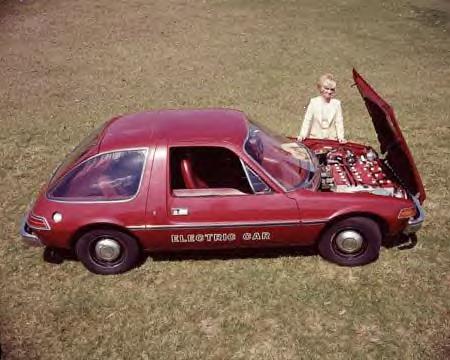
One of his Pacers, an electric car built by Electric Vehicles Associates
during the 1970s energy crisis, is believed to be the only one of its kind
remaining.

If you wonder down to Genoa’s Cruisin’ classic car show and street fair on
Sept. 21, you might catch Badger and his “Change of Pace.”

Badger, a Genoa resident, owns JBI Corp., an independent battery testing
laboratory not far from his home. So close, he can plug in his electric
Pacer overnight and drive it to work the next day without spending a cent
for gas.

EVA was started by high school vocational education teachers in Cleveland as
part of s student project. The aptly-named “Change of Pace” reached top
speeds of 55 miles per hour and went from zero to 30 in less than 12
seconds. The range was 30 to 50 miles.

According to Dennis Eichenberg, EVA made well over 100 Change of Pace
Pacers, and then turned to Ford Fairmonts and Ford Escorts.

Badger got his chance to meet Eichenberg, one of the original electrical
engineers to work on converting Pacers and other cars to electric power.

Badger bought his Pacer from a “car jockey,” who bought it from a New York
engineer, inventor, and art gallery owner. He believes he has the only one
remaining that is all-electric.

“There might be some with gas motors in them because they were experimental,
and most of them were sold to the government and electrical utilities and
all torn apart,” Badger said.

He saw it on e-Bay, and the temptation was too much.

“I test batteries for a living, I collect AMCs, and I thought, ‘Man, that’s
a rare car. I have to have it,’ so I bought it,” Badger said.

Badger’s Pacer only had 25 miles logged on it when he bought the car, but it
was rusted, and it took the Genoa businessman two years, five months, and
two weeks to finish restoration.

“I took it completely apart,” Badger said. “I mean, you could not
disassemble it any farther. I didn’t paint it or reassemble the body parts
first, but I can’t take all the credit. A lot of people helped me.

“I restored the original controls. I’ll say that they worked, but they
didn’t work very well and even the engineer who had worked on it originally
said they were dangerous, and that’s one of the reasons they were all
disassembled after testing. I have all those original controls, which is
very unusual. I don’t think you’ll find another set, and I put in a modern
controller.”

Badger also drives a 1973 German electric moped his father purchased to
work, but he doesn’t take either vehicle much farther. He could drive the
Pacer to Toledo or Sandusky, but would have to find somewhere to plug it in
and wait for a charge, which usually takes overnight.

“If you’re driving 35 to 40 miles per hour, I think you might get 50 to 60
miles. If you get up to 60 miles per hour, I’m not sure you’ll get 20 miles
out of it — you’ll probably get 10 to 15,” Badger said.

“It’s very complicated because it depends on how far you drove it — how many
amp-per-hours you took out. To fully charge a battery, you have to put in
more energy than you took out. So, if you took out 100 amp-per-hours, you’d
have to put back in 120 amp-per-hours to fully charge the battery,” Badger
continued.

“It has a little two-gallon gasoline tank because it has a gasoline fired
heater, like a Volkswagen, to keep the cockpit warm in the winter. I’ve
never used it, but other than you have to plug it into the wall to recharge
it. I have a charger built into the car, you open the gas cap. “

It has automatic transmission, and if you’re tired of changing oil, this
might be the car for you. Very little engine oil is necessary, if any, and
also not necessary are many engine parts needed to run a gasoline fueled
automobile.

“You have transmission fluid, but if you have no leaks you would use none or
a very minimal amount,” Badger said. “But, if you have flooded batteries you
have to keep distilled water in them. I don’t have any idea how much it
costs to charge it offhand — I haven’t figured that out. But it costs less
per mile to operate.

“It’s all manufactured very well with 120-volt golf cart batteries, and it
is actually programmable. I have a laptop that I carry in the front seat and
I can monitor its performance.”

The original owner invented a “hydraulically operated hybrid vehicle
recharging system,” which he patented and put on the car. Badger believes
the 1970s-era patent has expired, and he removed the system so that the
Pacer can be restored to its original condition. But, it did serve a
purpose.

“It has air cylinders next to all the shock absorbers, and if the car
bounced up and down over bumps, these air cylinders would compress air in a
tank, and that compressed air would run a generator which would help
recharge the battery,” Badger said.  “I’d compare it to regenerative braking
— when you put on the brakes, you use the energy developed to recharge the
battery. This car doesn’t have that, but it had this device on there, which
was patented, but it’s not very practicable. It gives you a hair more
range.”

And, if you’re driving and don’t want to hear engine noise, then this could
be the car for you, too.

“You can hear an electric motor hum, but actually when you are driving it 50
or 60 miles per hour all you’re hearing is road noise. There’s no engine
noise,” Badger said. “It’s built the way an electric car should be built —
with minimal devices that require electricity. You can get them as options,
but there is no radio. There is a fan, but there are no power windows. There
are no electric seats. You need to use the energy to drive the vehicle to
make it function.”

Badger says until the technology happens the auto industry is waiting for,
he would not encourage most car owners to buy an all-electric vehicle. He
also owns a Ford hybrid, which he says is a better bet, for now.

“There are a lot of new technologies, but it will take some breakthroughs,”
Badger said. “But you didn’t want to ever say never. It could happen now or
a long time from now.

“Lead-acid batteries, which my vehicles operates on, are probably the most
reliable and understood battery. Lithium batteries, they know how to make a
lithium battery and the chemistry of it is well-understood, but the problem
is manufacturing techniques have to be perfect. There can be no error, and I
know we’re great, but we’re not that good.

“I work for all these companies — Ford, Chevy, and a hybrid would be the way
to go because that’s the American lifestyle — you’d be able to fill it up
and go. If you want to get the mileage the government wants, you’ll have to
go with hybrids. I’d hate to give up the muscle cars and stuff and I
wouldn’t, but a pure electric car in the city, or if you are running back
and forth to Genoa a few times, for my transportation needs, which are very
minimal, which is just getting around town, a pure electric vehicle would be
OK. But they require some understanding.

“To drive from here to Rayz’ Café and back, it’s handy. To drive from here
to Cleveland and back, it’s not handy. For the average person, if you wanted
to participate in the green movement, I would tell you that a hybrid would
be a better choice.“
[© 2013 Press Publications]


http://www.amcpacer.com/stories/electric-pacer.asp
The Electric Pacer

Dennis Eichenberg had the privilege to work on converting Pacers and other
cars to electric power throughout his career as an electrical engineer.
Dennis shares the story of The Electric Pacer ...

[images
http://www.amcpacer.com/images/archives/electric-pacer-1.jpg
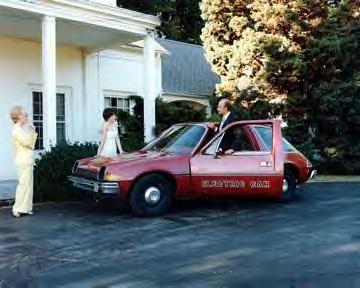
Change of Pace Electric Pacer

http://www.amcpacer.com/images/archives/electric-pacer-2.jpg

http://www.amcpacer.com/images/archives/electric-pacer-3.jpg


video
http://www.youtube.com/watch?v=JcdNX8_KjlI
A Change of Pace
Liquid Logic Films  Oct 7, 2007
Liquid Logic Films presents the story of the Electric Pacer
]

This is the story of the Electric Pacer! The energy crisis of the early
1970's generated great interest in electric vehicles, to reduce U.S.
dependency upon fossil fuels. The U.S. Department of Energy initiated
several electric vehicle programs to spur development. Fleet users were
encouraged to utilize electric vehicles as much as possible. Out of this
environment, Electric Vehicle Associates (EVA), Incorporated and the Change
of Pace Electric Pacer came to be!

High school vocational education teachers in Cleveland, Ohio as a student
project started EVA. EVA had converted various vehicles to electric power,
but when the Pacer hit the scene, it made the ideal electric vehicle. The
Pacer was strong, large on the inside, and small on the outside (for the
1970's). The large interior volume was ideal for carrying the lead acid
batteries, battery charger, and motor controller that was required for the
vehicle. The Change of Pace was a stellar performer. Top speed was in excess
of 55 mph, 0 to 30 mph was achieved in less than 12 seconds, and the range
was 30 to 50 miles, per SAE J227A schedules.

At first EVA purchased the Pacer as a complete vehicle. The engine, fuel
tank, and other components not required for the electric vehicle were
removed, and then the electric components were installed. As fleet orders
for the vehicle were received, EVA purchased the Pacer from AMC without the
gasoline components, and EVA installed the electric components.

The Pacer was not modified externally by EVA. The electric components added
weight to the Pacer, bringing the curb weight up to 4150 pounds.
Modification of the suspension was required to accommodate the additional
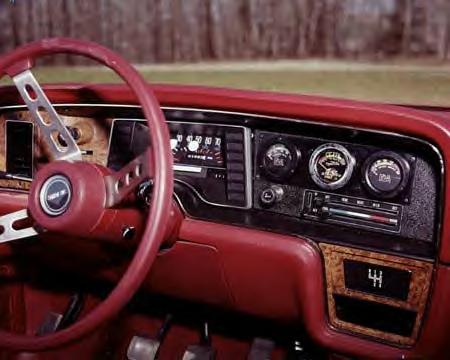
weight. The instrument panel was supplemented with a voltmeter and an
ammeter to assist the driver. The electric motor was a 15 KW unit with
forced air ventilation. The motor controller was an electronic SCR unit. The
energy came from twenty deep discharge lead acid 6-volt batteries connected
in series to provide a 120-volt traction system. The battery charger was
installed on board and could be powered from 110-volt or 220-volt ac power
systems. A transmission was used, and either a manual or automatic
ransmission was available. Front disc brakes were provided. DR78x14 steel
belted radial tires were installed to accommodate the additional weight of
the batteries. A 10,000 BTU gasoline heater was provided. Most Pacer
accessories were available, including air conditioning and stereo radios.

The various Pacer models were converted, but the station wagon was the most
popular conversion for fleet use. Many individuals purchased the Change of
Pace, and these could be very exciting automobiles, especially when cost was
not an issue. Some of these cars had every option available, and they were
really very nice automobiles.

The Change of Pace was driven the same as a gasoline powered Pacer, and the
operation was invisible to most drivers. The car was completely silent when
stopped, which is a very unusual experience. It seems that the car has
stalled, but it is ready to go whenever the accelerator is depressed.
Electric vehicles produce maximum torque at start, so they feel very
energetic. The additional weight and modified suspension produced a very
smooth ride.

The batteries required significant maintenance. The batteries had to be
fully recharged after every use, or would be damaged. Recharging required
several hours, depending upon how much the batteries were discharged. The
batteries had to have water added every few weeks, depending upon use. The
batteries posed the biggest problem for the Change of Pace. EVA stopped
production of the Change of Pace, when the Pacer was no longer available
from AMC, and EVA went out of business shortly thereafter.

EVA made well over 100 Change of Pace Pacers, and then turned to Ford
Fairmonts and Ford Escorts after the Pacer (they didn't have nearly the
character that the Pacer had). Long Island Light in New York was the largest
fleet purchaser of the Change of Pace Pacer.

Following are some photos of the Change of Pace. These were truly great
times! ...
[© 1995-2013 panhorst.net]
...
http://en.wikipedia.org/wiki/AMC_Pacer#Electric_Pacers
Electric Pacers
...
http://boingboing.net/2008/11/03/electric-pacer.html
Electric Pacer


http://www.theglobeandmail.com/globe-drive/car-life/classic-cars/amc-led-the-alternative-charge/article1811675/
AMC led the alternative charge
by BOB ENGLISH  Nov. 24 2010

The Chevy Volts and Nissan Leafs and the other plug-in electrics charging up
to make their debuts are the result of mega-million-dollar globally
leveraged corporate research and development efforts employing some of the
best computer-boosted brains and advanced technology on the planet.

But back in the oil-embargoed 1970s - the last time we were seriously jolted
into looking at electricity to maintain our mobility - a couple of Cleveland
high school shop teachers were among those who came to the rescue with their
golf-cart-battery powered Change of Pace Electric Pacer.

And the performance of this low-tech, juiced-up version of American Motors
Corp.'s novel small car - and of other similar industry and individual
efforts of the time - points out how discouragingly incremental the gains
made in the past three decades actually are. Or over the past century, for
that matter.

Inside the EVA Electric Pacer.

The Electric Pacer of the late 1970s delivered reasonable acceleration, had
a range of 80 km and its simple lead/acid battery pack could be plugged in
at home and recharged overnight. Chevy's Volt claims 65 km on battery power
alone (its gas engine extends that), the Leaf 160 km and Toyota's
due-in-2012 RAV4 EV the same - from ultra-high-tech and ultra-pricey
batteries and complex electronic systems.

The oil embargo of 1973 came as a double dose of reality with rapidly rising
fuel costs and actual shortages. At one point early in 1974, some 20 per
cent of U.S. gas stations' tanks were empty and those that did have gas to
sell had lines reaching around the block for their rationed supplies.

Back in 1976

Diminutive 14-year-old Romanian gymnast Nadia Comaneci becomes the first
athlete to receive a perfect score of 10 at the Montreal Olympic games.

The supersonic Concorde airliner, operated by British and French airlines,
makes its first commercial flights.

Apple Computer is created by computer geeks Steve Jobs and Steve Wozniak.

The 553.3-metre-high CN Tower in Toronto is completed, becoming the tallest
free-standing building in the world for the next 31 years.

One of the most influential and controversial world leaders of the past
century, People's Republic of China chairman Mao Zedong, dies.

Smaller, fuel-efficient cars were an obvious answer, but many believed it
might be time for electric cars - popular in the early 1900s - to stage a
comeback. Among these were U.S. government agencies, which backed
development programs and promoted electric vehicles, suddenly concerned
vehicle producers and those high school shop teachers in Cleveland.

The Electric Pacer had its genesis in a student project involving electric
shop instructor Warren Harhay and auto shop teacher Ed Sarian and the
conversion of a car to run on battery power. It performed well enough that
the pair created Electric Vehicle Associates (EVA) to commercially convert
cars to battery power and hired newly graduated electrical engineer Dennis
Eichenberg to help.

Eichenberg, who still works in the electric vehicle field, recalls an
exciting time with an atmosphere, similar to that we're experiencing today,
focused on concerns over fuel cost, availability and emissions with a great
deal of interest in electricity as the solution.

EVA's efforts soon attracted the attention of NASA and car maker AMC, which
had launched its new Pacer for 1975.

The compact Pacer, with futuristic aerodynamic styling penned by designer
Dick Teague, was billed as "the first wide small car." Ambitious original
plans had called for a Wankel rotary engine, but struggling AMC ended up
having to stick to its ancient six-cylinder driveline. The Pacer's cool look
(well some thought so, although it only lasted from 1975-1980) and its
wide-body ability to swallow a bunch of batteries made it an ideal vehicle
for EVA.

The conversion involved yanking out the drivetrain and installing 20
deep-discharge, six-volt, lead/acid batteries in the engine bay. They
delivered 120 volts to a 15 kilowatt (equivalent to 20 hp, but with plenty
of torque) air-cooled, electric motor that drove the rear wheels through a
manual or automatic transmission.

A separate battery ran wipers, lights and maybe an eight-track tape player.
Air conditioning was available, a gasoline fuelled heater kept the cabin
toasty in cold weather, and a voltmeter and ammeter were added to monitor
the system. Disc brakes up front, a stiffer suspension and beefier
steel-belted radial tires were fitted to cope with the increased weight of
4,150 lbs (1,880 kg). They also incorporated innovative regenerative braking
to recharge the batteries and an advanced electronic controller.

Batteries proved the Electric Pacer's Achilles heel, requiring a full charge
after every use, regular maintenance and replacement about once a year. And
after production of just more than 100 examples, it was all over by 1980
when AMC stopped building the Pacer. EVA produced a few converted Ford
Fairmonts and Escorts after that but soon had to pull the plug on the
company.

Eichenberg still feels positive that electric power will prove the answer in
the long run, however. "The driving characteristics of an electric motor
actually suit vehicles better than an internal combustion engine, but
batteries have always been the handicap and still are," he says.

The Electric Pacer didn't really outperform the electrics of early in the
century and today's efforts still don't provide a much more effective
solution than it did. But Eichenberg's convinced new technologies are out
there and will ultimately make the electric vehicle viable.

"It's just a matter of time. I believe in 20 years we'll all be driving
electric cars of some sort."
[© globeandmail.com]


For all EVLN posts use:
http://electric-vehicle-discussion-list.413529.n4.nabble.com/template/NamlServlet.jtp?macro=search_page&node=413529&query=evln&sort=date

EVLN: Hop on an ELF to Ditch the Keys for World Carfree Day 9/22
EVLN: Google joins solar plane team
+
EVLN: Become a film star with BMW i3 virtual test drive


{brucedp.150m.com}


--
View this message in context:
http://electric-vehicle-discussion-list.413529.n4.nabble.com/EVLN-Badger-s-Electric-Pacer-rare-last-of-its-kind-video-tp4665285.html
Sent from the Electric Vehicle Discussion List mailing list archive at
Nabble.com.
_______________________________________________
UNSUBSCRIBE: http://www.evdl.org/help/index.html#usub
http://lists.evdl.org/listinfo.cgi/ev-evdl.org
For EV drag racing discussion, please use NEDRA
(http://groups.yahoo.com/group/NEDRA)