On Wednesday, September 30, 2020 at 9:58:33 PM UTC+2, [email protected]
wrote:
>
> Yes, this is nice, since GWT home page is developed (in small part) with
> GWT... 😀
>
> To the Debugging with Chrome:
>
>    - Actually you still could read the variable name because it is
>    readable... and you can add your variable to the watcher and it's all
>    readable... Just try it.
>    - To run Jetty (included in GWT) just use Maven cmd "mvn
>    gwt:generate-module gwt:devmode". You can do this *inside* NetBeans or
>    *outside* from NetBeans, makes no difference.
>    - After you change your code NetBeans will compile the Java code, you
>    don't need to stop the Jetty. Just reload your webapp in Chrome browser
> and
>    GWT transpiler will transpile your changed Java code (incremental), very
>    fast. So, do not restart your Jetty. Chrome will show the changed code
>    after the reload.
>
> To be able to do this you need to separate the projects:
>
>    - client
>    - shared
>    - server
>
> So you are able to just use the integrated Jetty from GWT and you don't
> need the "server" part. You'll find lot of advantages to separate those
> modules. It is later easier to upgrade to the newer version of GWT and you
> don't have  "classpath hell".
>
> The easiest thing to test the complete cycle of your webapp is to run two
> web containers:
>
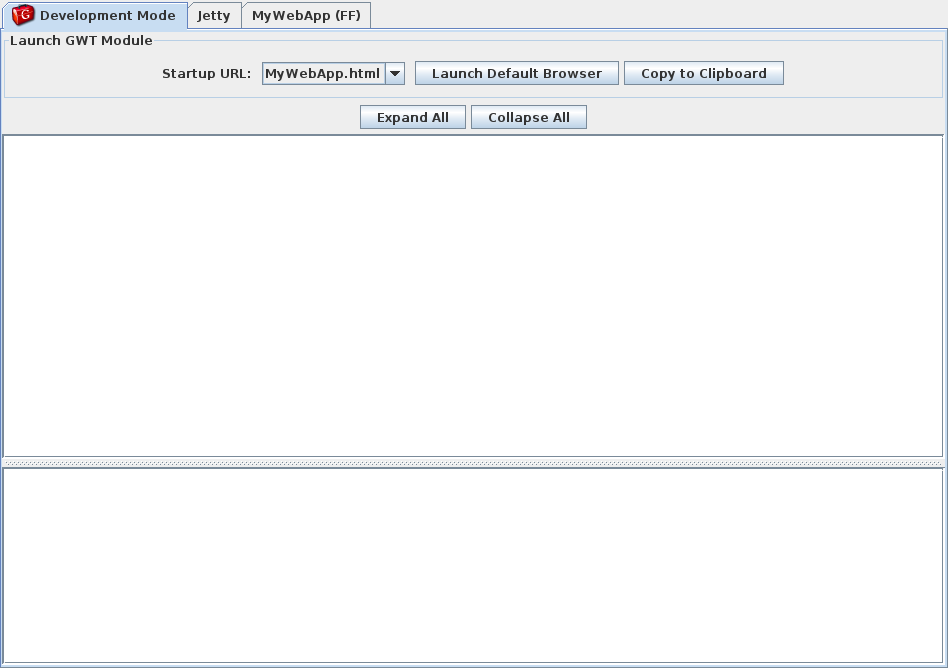
>    1. Jetty web container for the *client* part. This is integrated in
>    GWT, see this screenshot:
>    http://www.gwtproject.org/images/myapplication-devmode.png
>    2. On the *server* you just use the web container which you need:
>       - If you are using Spring Boot, just use it.
>       - If you are using JBoss / WildFly just use it.
>
> The *client* (web browser with HTML, JS and CSS) accesses the *server*
> (Servlet, ...) with *remote* procedure anyway (GWT RPC, REST, ...). So
> it's ok to run 2 processes in the *development time*. In the *deployment
> time* later, you could "copy" the result of the client (HTML, CSS, JS) to
> the root directory of your web container, so that you could just run one
> process.
>
IMO it's much better to run DevMode in -noserver mode (or run CodeServer
directly), that outputs a *.nocache.js stub into the webapp served by
whatever server you're using (or configure that server to go read resources
in an additional folder; that's my preferred approach). That way, it works
(almost) just like in production; your host page can be dynamically
generated by your server, intercepted for authentication, etc. Nothing but
the *.cache.* files are served by the DevMode/CodeServer.

--
You received this message because you are subscribed to the Google Groups "GWT
Users" group.
To unsubscribe from this group and stop receiving emails from it, send an email
to [email protected].
To view this discussion on the web visit
https://groups.google.com/d/msgid/google-web-toolkit/593d6db5-3226-4cf0-b445-aeb87f89486fo%40googlegroups.com.