Thanks for the tip, and sorry for the obvious mistake.

I got repreport to work now after adding the <ivy pattern> to my configuration.
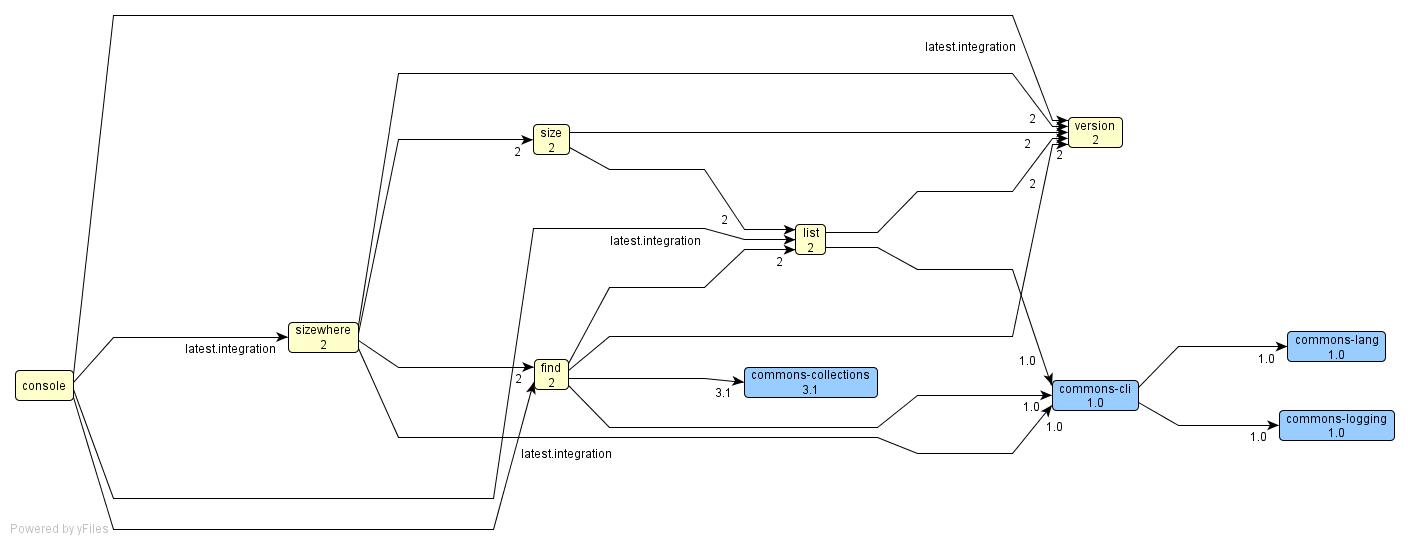
Unfortunately it doesn't include any information on the versions and
configurations, just the node names and the dependency arcs. I was hoping I
would see a graph similar to the one generated by the report task, like this
one:
http://www.jaya.free.fr/misc/ivy/samples/projects-dependencies-graph.jpg
It would really be useful once you have multiple versions installed to have a
report that shows how they depend on each other (A v1.0 depends on B v4.0, A
v1.1 depends on B v4.6, etc).

Two follow-up comments:
1) In the process of tinkering with multi-project example, I believe I found a
small problem.
In the top build.xml file, it defines "clean" as:

  <target name="clean" depends="clean-all" description="clean tutorial: delete
repository, ivy cache, and all projects">
    <delete dir="repository"/>
    <delete dir="ivy-cache"/>
  </target>

Shouldn't it be:
  <target name="clean" depends="clean-all" description="clean tutorial: delete
repository, ivy cache, and all projects">
    <delete dir="repository"/>
    <delete dir="${user.home}/.ivy/cache"/>
  </target>

I searched for an Ant property that points to the ivy cache location but I
couldn't find one. I know it can be set in ivyconf, it could be useful to have
it also available in a property to allow  for example for the cleaning of the
cache.

2) The HTML reports, although quite nice, do not scale. It is quite easy to
generate a report.html so large that your browser will refuse to load it (or
die trying)... a suggestion would be to take a page from JavaDoc and generate
multiple html files with a unifying html that uses frames to present the whole
thing.

Regards,
  Nascif

-----Original Message-----
From: Xavier Hanin [mailto:[EMAIL PROTECTED]
Sent: Wednesday, June 27, 2007 3:31 AM
To: [email protected]
Subject: Re: repreport output - no edges?

On 6/26/07, Nascif Abousalh-Neto <[EMAIL PROTECTED]> wrote:
>
> I was able to make the necessary changes to the multi-project tutorial
> project (1.4.1 version) to get it to work using only local
> repositories (including one that holds the apache common libraries). I
> struggled a bit with the configurations, which I believe were
> broken/missing in some of the files, but in the end I got a top-to-bottom
> succesful compilation.
>
> Then I proceeded to run the repreport task, and to my disappointment
> it produces a graph with all the nodes - but no edges or version information!
> This is the .dot file:
>
>
> /* * directed graph dot input file. * * generated by ivy report */
>             digraph G
> {"commons-lang""commons-logging""commons-collections""commons-cli""ver
> sion""find""size""sizewhere""console""list"}
>
> The .graphml is just like that.
> Any ideas? This is how it looks like in my Ant file:
>
>   <target name="configure">
>     <!-- setup ivy default configuration with some custom info -->
>     <property name="ivy.local.default.root" value="${repository.dir
> }/sas/"/>
>     <property name="ivy.shared.default.root" value="${repository.dir
> }/tpj/"/>
>
>     <!-- here is how we would have configured ivy if we had our own
> ivyconf file -->
>     <ivy:configure file="${common.dir}/ivyconf.xml" />
>   </target>
>
>   <target name="repreport" depends="configure">
>     <ivy:repreport graph="true" dot="true"/>
>   </target>
>
> And ivyconf.xml is:
> <ivyconf>
>   <conf defaultResolver="chain"/>
>   <resolvers>
>     <chain name="chain">
>       <filesystem name="local">
>         <artifact
> pattern="${repository.dir}/local/[organisation]/[module]/[revision]/[artifact]-[revision].[ext]"
> />
>       </filesystem>
>       <filesystem name="shared">
>         <artifact
> pattern="${repository.dir}/shared/[organisation]/[module]/[revision]/[artifact]-[revision].[ext]"
> />
>       </filesystem>
>       <filesystem name="tpj">
>         <artifact
> pattern="${repository.dir}/tpj/[organisation]/[module]/[revision]/[artifact]-[revision].[ext]"
> />
>       </filesystem>
>     </chain>
>   </resolvers>
> </ivyconf>


Your ivyconf doesn't contain pattern for ivy files, so Ivy can't find any
metadata about the modules it finds (and thus no dependencies). You should add
<ivy pattern=""/> to your filesystem resolvers, pointing to your ivy files, and
it should work better.

Please keep us informed of the result.

Xavier

Thanks,
>   Nascif
>


--
Xavier Hanin - Independent Java Consultant Manage your dependencies with Ivy!
http://incubator.apache.org/ivy/