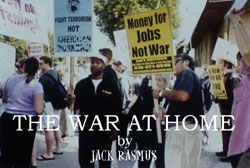
Books by Jack Rasmus: The Corporate Offensive Against American Workers and
Unions from Ronald Reagan to George W. Bush


What Reviewers Say About THE WAR AT HOME
<http://www.kyklosproductions.com/posts/index.php?p=37>


Reviewers Comments

"Did you like Howard Zinns, A People's History of the United States? If so,
you are going to love the new book by Jack Rasmus, THE WAR AT HOME: The
Corporate Offensive From Ronald Reagan to George W. Bush. Rasmus effectively
picks up the story where Zinn leaves off..His book is an excellent
complement and companion to Zinn's popular work..Give THE WAR AT HOME a
look. It is a sobering and path-breaking effort to 'put it all in one
place'."

Harvey Schwartz,
Curator, ILWU Oral History Collection
Labor Archives and Research Center
San Francisco State University

"A hard-hitting, full-scale account of the corporate assault on American
working people. No one seeing all the strands of that attack brought
together in one place can feel anything but outrage. Rasmus's stirring book
is for labor activists, but its effect will be to create a lot more labor
activists than there already are. A great job!"

David Brody,
Professor Emeritus of History
University of California, Davis

"THE WAR AT HOME is a path-breaking work which will stand as a milestone on
the road to a fight back by and for working people..Jack Rasmus has
performed a major service to the movement by starting what needs to be a
great debate about our collective future..we all should read it and spread
the word about THE WAR AT HOME."

Laurence H. Shoup, Ph.D. History
Author, Imperial Brain Trust: The Council On Foreign Relations and U.S.
Foreign Policy


'The War at Home' <http://www.kyklosproductions.com/posts/index.php?p=14>


 <http://www.kyklosproductions.com/images/war/homewar.jpg> THE WAR AT HOME
is a nonfiction book about the current Bush-Corporate offensive against
American workers and their unions. Its ten chapters cover the current Jobs
Crisis, offshoring, Free Trade and the collapse of manufacturing, declining
Wages and workers' incomes, the great American Tax Shift, attacks on
Pensions and Social Security, the pending privatization of Medicare, the
health care costs crisis, the transformations of the Republican and
Democratic parties, the decline of union membership and bargaining power,
the pending split in the AFL-CIO, and the origin and evolution of the
corporate offensive from Reagan through George W. Bush.

On this page you can read the PREFACE and the TABLE OF CONTENTS and advance
order <http://www.kyklosproductions.com/posts/#order>  the book.


Preface to the War at Home
<http://www.kyklosproductions.com/posts/index.php?p=8>


Copyright 2004 Jack Rasmus

Corporate America and its numerous pundits and talk-show mouthpieces are
quick to point fingers and charge 'class war, you're advocating class war',
whenever anyone writes or speaks up about the Corporate Offensive against
workers and their unions today. Accusations of class warfare are levied at
the slightest criticism of the radical restructuring of jobs, wages, the
retirement system, taxes, healthcare, and civil liberties currently underway
today-restructuring begun by Reagan two decades ago and now accelerating
even more rapidly under George W. Bush.

'Class war' has become the economic 'N-word' for Corporate America and Bush
apologists. But like a discrete racist who acts but dares not say it, Bush
and his corporate contributors have been engaging increasingly in the very
thing, economic Class War, they so readily decry.

That practice of Class War has become so blatant of late that even notable
figures within Corporate America itself have raised a note of concern.
Someone no less than Warren Buffet, the multi-billionaire and richest man in
America, in his most recent annual letter to the stockholders of his
investment company, Berkshire Hathaway, was compelled to point out "if class
war is being waged in America, my class is clearly winning".

In the pages that follow, THE WAR AT HOME unapologetically attempts to
describe and analyze the major elements of that class war being waged today
in the U.S. against American workers and their unions.

The offensive comes from many directions and takes many forms. A particular
worker may be impacted in one way more than another and not aware of the
full scope of the coordinated assault. For one, it may be the loss of his or
her job to rampant outsourcing. For another, it may take the form of a
tripling of the cost of health insurance or a loss of medical benefits
coverage for themselves or dependents. For many it has meant wage cuts or
the foregoing of any wage increase whatsoever for several years. For those
in middle age, the growing anxiety of how to pay for the spiraling cost of a
college education for their children without losing their home or abandoning
forever any prospect of retirement. For those approaching retirement, the
increasing fear whether their pension will still be there or will be wiped
out by a corporate bankruptcy court. For those in retirement, the fear of
cuts in pensions or social security payments, costs of drugs and Medicare
premiums, or companies simply discontinuing retirees health coverage. And
for virtually all, the extraction of taxes in larger amounts from their
paychecks, while watching the wealthy and corporations granted an incessant
series of tax breaks with no apparent end.

THE WAR AT HOME attempts to bring together in one source, address in one
place, the various major elements of this new Corporate Offensive that has
been building in scope and intensity since the early 1980s. While others
have been describing different aspects of it-jobs, taxes, benefits,
retirement, etc.- none to our knowledge have addressed the broader
development in general or in one place. Nor has anyone placed the event in a
longer term historical perspective and policy context.

Not until recently has the offensive been able to reach a threshold point
that has enabled its true scope and meaning to become increasingly clear. In
quantitative terms, the magnitude of the negative impact on American workers
and their unions perhaps had to reach a certain level before the qualitative
aspects revealed the bigger picture-much as the mosaic pieces of a puzzle
eventually reveal the outline of the broader vision.

Until the advent of Ronald Reagan, Class War in America remained publicly
muted. It has always been there, though somewhat subdued during the long
period of the great social compact between Labor, Capital and Government
that spanned the period from the late 1940s through the worst of the Cold
War. But just as that war began to wind down during the 1980s, the new war,
the 'War At Home', began to gain momentum.

Like the Cold War abroad, the costs of the 'Class War' at home to tens of
millions of American workers and their unions, have been immense over the
past quarter century. That magnitude of costs is measured, moreover, not
only in terms of economic hardship but in terms of the immense psychological
misery of tens of millions of U.S. citizens. The WAR AT HOME attempts to
trace the growing momentum of the new Class War in America, the new
Offensive, being waged by corporations and their political friends from
Reagan through Bush.

THE WAR AT HOME is different in yet another important way. It is written for
those actively engaged at the grass roots level in opposing the new
Corporate Offensive. It is written for the worker and the community activist
desperately trying to survive and deal with the devastation of the American
health care system; for progressive intellectuals concerned with the
accelerating destruction of civil liberties and civil rights; for students
with a social conscience aware of the constant rising cost of education
amidst ever declining job opportunities; for local union stewards and
officers frustrated at every turn when they try to defend the wages,
benefits or the job security of their members; for the American working
class family struggling to make up for stagnating wages by working second
and third jobs and assuming an ever growing burden of debt just to maintain
living standards; for professionals and workers who spent years and tens of
thousands of dollars to educate themselves only to find their jobs and
future outsourced or offshored to Asia or Latin America; for all those
actively supporting candidates for elections who may be opposing one or more
elements of the Corporate Offensive; and for everyone increasingly concerned
that something fundamental has changed in America, that the 'rules of the
game' are being turned against them, and who are determined to defend their
own rights and interests.

THE WAR AT HOME does not refuse to assume a perspective or to take sides.
Its intent is to arm the reader with essential data, statistics, facts and
arguments that reveal the character of the new Corporate Offensive. It
raises suggested policies and solutions for consideration at the close of
each chapter.. And it is hoped the facts, analyses, and proposals presented
in the book will prove useful to the reader, who may then be able to argue
and advocate more effectively in defense of the more than 100 million
working and middle class families in America today whose basic economic
rights and interests are increasingly being ignored by politicians across
the political spectrum.

This book isn't about how the Business Roundtable met at some Virginia
mountain retreat and decided how to finance and lobby the defeat of the
Labor Law Reform bill in 1978. It's not about which corporate CEOs met with
George W. Bush staffers to plan the details of the 2001 and 2003 tax
legislation benefiting the wealthiest top 10% Americans by more than $2
trillion. It's not about how heads of major American manufacturing companies
plotted strategies to force re-opening of union collective bargaining
agreements in 1980 in the steel, auto and teamsters union, setting in motion
the concessions bargaining of that decade. Nor is it about how CEOs of most
major multinational corporations today co-operate ever more closely to
export more and more jobs to China, Central and South America, and beyond..

Direct evidence of this kind of deep organization politics is often limited,
circumstantial and, at best, inferred. The key business and government
participants in such events seldom give interviews or respond to pollsters
or journalists, or accommodate inquiries of academics writing books. That
reticence, however, does not make such events any less real. The best
evidence of such events are the results and outcomes that follow them-in the
form of programs and policies that get passed by Congress and state
legislatures, get implemented by Executive branches of government, become
legitimized in turn by the courts, and are implemented by leading
corporations and business groups at the point of production. The
identifiable results and consequences, the outcomes, are far more important
than any opaque process. Follow the money, identify who benefits, and more
often than not there will lie the originating forces behind the policies.

This book in its core chapters is concerned with describing, chronicling,
and analyzing those results and consequences. While corporate lobbyinig
groups are identified, the details of which corporaate personalities were
directly involved, as well as when, where and how they decided on the
resturcturing, are left for another work and time. Our attention here is on
the outcomes of policies and programs that constitute the core of the
Corporate Offensive that has been growing in scope and magnitued from Reagan
through George W. Bush-as measured in terms of wages, incomes, taxes, jobs,
retirement rights and security, health care and general social legislation
with direct benefits to working class Americans.

The lengthy Introductory Chapter of the book is designed to place the
current Corporate Offensive in broad historical perspective, as well as
within the context of the deepening economic, cultural, and political crisis
in American today-the only decade comparable to which was perhaps the decade
of the 1850s. The Introduction further argues the current Corporate
Offensive is not a new phenomenon, but is only the latest of several such
offensives that have occurred in America over the past century during which
a restructuring of the economy and social relations, or what are here called
the 'rules of the game', have taken place. The more immediate roots of the
current Corporate Offensive are traceable, furthermore, to the preceding
transition decade of the 1970s. An overview of the connections between that
transition decade, the early emergence of the current phase of the Corporate
Offensive under Reagan in the 1980s, and the Offensive in its current form
under George W. Bush concludes the Introductory Chapter.

The remaining chapters of the book turn to focus on the various dimensions
of the current Offensive. Thus Chapter One addresses the huge transfer of
incomes that has occurred over the past three decades from the roughly 105
million plus core working class Americans to the wealthiest 10% and 1%.
Chapter Two describes the parallel and related shift in the relative tax
burden, from the wealthy and corporations to middle and working class
Americans, and its overall contribution to the general transfer of incomes.
Special emphasis is given to the current acceleration of this income
transfer via tax shifting under George W. Bush.

Subsequent chapters address how income has been transfered before taxes are
paid. Chapter Three looks deeper into what has happened to the 'core' real
hourly wages and earnings of the 105 million plus American workers since
1980, revealing details often overlooked by a consideration of more general
categories of incomes and wealth. Chapter Four supplements Three by
examining emerging Corporate wage strategies at 'the periphery', as opposed
to the 'core' basic hourly wage. Thus in Chapter Four corporate strategies
are examined aimed at containing and reducing overtime pay, holding down the
minimum wage, checking movements for a living wage, and shifting health
insurance costs and contributions from employers to workers.

The subsequent Chapters Five through Seven address the subject of jobs.
Chapter Five examines the role of Free Trade policies from Reagan through
George W. Bush, and shows how Free Trade has been at the core of the general
Corporate Offensive since 1980. The chapter addresses the role of trade
policy in the destruction of ten million jobs, and how trade-related jobs
destruction is accelerating under George W. Bush. Chapter Six considers in
some detail the changing structure and composition of jobs and jobs markets
in the U.S. since 1980, and the emergence of what is called the 'New World
Job Order'. Examined and estimated in some detail are the growing pools of
tens of millions contingent jobs and workers, low paid services jobs, and
the new millions of 'hidden' unemployed. The implications of the radical,
restructuring of jobs in the U.S. for workers and the economy in general are
explored. Chapter Seven then addresses in detail George W. Bush's record on
jobs during his first term, the phenomenon of extended jobless recoveries
from Reagan to Bush, and the relationship of those jobless recoveries to the
structural changes in jobs markets sin the U.S. The chapter closes by
dissecting Bush's deceitful claim that tax cuts for the rich produce jobs
for the rest, and considers the possibility of yet another aborted jobs
recovery and recession in a Bush second term.

Chapters Eight through Ten look at the condition of 'deferred wages', the
residual 'wage surplus' in the form of employer health insurance
contributions, private pension plans, and Social Security retirement
benefits. Each chapter considers how these social benefits so critical to
workers' standards of living have been reduced, rolled back, or
progressively privatized since the Corporate Offensive was launched,
resulting in fewer benefits and coverage for workers simultaneous with a
shifting of the costs for the same from employers to their workforce.

Jack Rasmus <http://www.kyklosproductions.com/images/posts/rasmus_01.jpg>
The Conclusion Chapter, entitled "The Corporate Offensive, Democrats, and
the AFL-CIO", recaps the general themes raised in the Introductory Chapter,
summarizes the key defining characteristics of the current Corporate
Offensive, and places that offensive within the context of the general
organizational and political crisis confronting American workers, the
AFL-CIO unions, and their historic post world war II ally, the Democratic
Party. The final chapter concludes with initial suggestions for structural
and odther reforms of the AFL-CIO, as a contribution to the debates
currently underway on that subject in union circles today.

Jack Rasmus,
National Executive Board
National Writers Union, UAW, AFL-CIO
http://www.kyklosproductions.com
[EMAIL PROTECTED]


CONTENTS of the War at Home
<http://www.kyklosproductions.com/posts/index.php?p=10>


Copyright 2004 Jack Rasmus

PREFACE

INTRODUCTION: Convergence, Crisis & Corporate Restructuring

CHAPTER 1: The Road Back to 1929

CHAPTER 2: The Great American Tax Shift

CHAPTER 3: Corporate Wage Strategies I: The Thirty Year Pay Freeze

CHAPTER 4: Corporate Wage Strategies II: Attacking the Periphery

CHAPTER 5: Free Trade and the Collapse of Manufacturing in America

CHAPTER 6: Welcome to the New World Job Order

CHAPTER 7: Jobless Recoveries and the Bush Recession

CHAPTER 8: Medical Mount St. Helens: The Health Care Crisis in America

CHAPTER 9: Pensions in the Corporate Cross-Hairs

CHAPTER 10: Stealing the Social Security Surplus

CONCLUSION: The Corporate Offensive, Democrats, and the AFL-CIO


_______________________________________________
Marxism-Thaxis mailing list
[email protected]
To change your options or unsubscribe go to:
http://lists.econ.utah.edu/mailman/listinfo/marxism-thaxis