*The Strategic Implications of Iran's STD Epidemic*
*by David P. GoldmanAsia Times Online
<http://www.atimes.com/atimes/Middle_East/MID-02-300115.html>January 30,
2015*

*http://www.meforum.org/5000/strategic-implications-iran-std
<http://www.meforum.org/5000/strategic-implications-iran-std>*

[image: http://www.meforum.org/pics/large/925.jpg]

In the 5th Century BC, the "Persian disease" noted by Hippocrates probably
was bubonic plague; in 8th-century Japan, it meant the measles. Today it
well might mean chlamydia. Standout levels of infertility among Iranian
couples, a major cause of the country's falling birth rate, coincide with
epidemic levels of sexually transmitted disease. Both reflect deep-seated
social pathologies. Iran has become a country radically different from the
vision of its theocratic rulers, with prevailing social pathologies quite
at odds with the self-image of radical Islam.

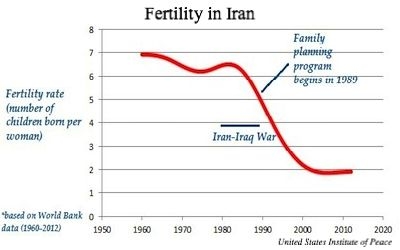
Iran's fertility decline from about seven children per female in 1979 to
just 1.6 in 2012
<http://iranprimer.usip.org/blog/2013/apr/01/un-stats-irans-slow-population-growth>
remains a conundrum to demographers. Never before in recorded history has
the birth rate of a big country fallen so fast and so far. Iran's
population is aging faster than that of any other country in the world. In
2050, 30% of its people will be over 60, the same ratio as in the United
States but with a tenth of America's per capita GDP. I see no way to avoid
a social catastrophe unique in human experience. Since I first drew
attention to Iran's demographic implosion a decade ago
<http://www.atimes.com/atimes/Front_Page/GH23Aa01.html>, I have heard not
one suggestion as to how Iran might avert this disaster, despite some
belated efforts to raise the birth rate.

*Iran's fertility decline remains a conundrum to demographers. Never before
has the birth rate of a big country fallen so fast and so far.*

Iran was the first Muslim country to achieve mass literacy, thanks in large
part to the Shah's Literacy Corps of the 1970s. Muslim total fertility
rates correlate closely with female literacy rates: As soon as Muslim women
have the means to make their own decisions, they reject traditional society
and the fertility behavior associated with it.

But another factor is at work. Iran has the highest incidence of lifetime
infertility of any country in the world, estimated at between 22% and 25%
in separate Iranian government surveys
<http://www.ncbi.nlm.nih.gov/pmc/articles/PMC3719328/>. Roughly a quarter
of Iranian couples, that is, are unable to bear children.

By comparison, lifetime infertility ranges from 11% in Europe and 15% in
India. The Iranian data are more extensive than in most other countries
because Iran's government has devoted enormous resources to finding
explanations and remedies for its uniquely high infertility rate.

The lifetime infertility in selected countries: Iran (year of survey
2004-2005) 24.9%; Australia(1991-1993) 18.4%; Denmark (1995) 15.7%; Indian
Kashmir (1997) 15.1%; UK (1988) 14.1%; France (1988) 12.2%; Europe
(1991-1993) 11.3%; Norway (1985-1995) 6.6%.

One explanation for Iran's strikingly infertility rate is the high level of
consanguineous (cousin) marriages, that is, inbreeding. Azadeh Noaveni
<http://foreignpolicy.com/2014/01/17/the-islamic-republic-of-baby-making/>
writes:

Iran, like other Middle Eastern countries, has an extremely high
infertility rate. More than 20 percent of Iranian couples cannot conceive,
according to a study conducted by one of the country's leading fertility
clinics, compared with the global rate of between 8 and 12 percent. Experts
believe this is due to the prevalence of consanguineous marriages, or those
between cousins. Male infertility is "the hidden story of the Middle East,"
says Marcia Inhorn, a Yale University medical anthropologist and a
specialist on assisted reproduction in the region.

This surmise probably is wrong. Iran's rate of cousin marriage is about
25%, lower than most of the Middle East. We do not have permanent
infertility data for most Middle Eastern countries, but the fertility rate
in neighboring Iraq (at four children per female) is more than double that
of Iran. In fact, the proportion of cousin marriages is inversely
correlated with fertility, because women in the sort of traditional society
that fosters cousin marriage tend to bear more children.

A more probable cause of Iran's extremely high rate of infertility is
sexually transmitted disease, particularly chlamydia, the most common
bacterial STD and one likely to go undetected in countries with poor public
health systems. This may seem incongruous, for the Islamic Republic of Iran
represents itself as the guardian of social standards against Western
decadence. Nonetheless, the government's own data strongly support this
inference.

A 2013 paper <http://www.ncbi.nlm.nih.gov/pmc/articles/PMC3719322/> by a
team of Iranian researchers, "Effects of Chlamydia trachomatis Infection on
Fertility: A Case Control Study," observes:

The molecular prevalence of C. trachomatis was 12.6% in woman in Tehran,
the capital of Iran, and in another study it was 21.25% in women attending
Shahid Beheshti Hospital in Isfahan, Iran. Considering the different
prevalence rates of C. trachomatis infection in Iran, it is vitally
essential to assess the impact of C. trachomatis on the reproductive health
of women.

*Iran appears to have the world's highest rate of lifetime infertility
because it also has the world's highest rate of STD infections.*

By contrast, the US Center for Disease Control
<http://www.cdc.gov/std/stats12/chlamydia.htm> reports a rate of 643 cases
per 100,000 American women, or an infection rate of only 0.6%. Among
sexually active females aged 14-19 years, the American population segment
most at risk, the infection rate was 6.8%. Globally, the chlamydia
infection rate was 4.3% in 2008, according to the World Health Organization.

Iran appears to have the world's highest rate of lifetime infertility
because it also has the world's highest rate of STD infections. This is a
tentative conclusion, to be sure, because Iran's fairly primitive public
health system has produced only fragmentary evidence about STD infection
rates. It is nonetheless convincing.

Iranian authorities have made dire warnings about epidemic rates of STD
infection. As Muftah.org
<http://muftah.org/irans-battle-with-stds-and-cultural-taboos/> reported in
late 2013:

On World AIDS Day (December 1st), Iran's Health Minister Hassan Hashemi,
announced that Iran is facing a dramatic increase in HIV diagnoses.
Speaking at an AIDS-awareness conference at the Ministry of Health, Hashemi
noted that over the past eleven years, AIDS cases have increased nine-fold.
He further warned that the lack of sexual education and persistent social
taboos surrounding sexually transmitted diseases (STDs) in Iranian society
were factors in this alarming trend.

Just weeks later on December 18th, news about increases in Iran's STD
infection rates again made national headlines. Mostafa Aqlyma, the
President of the Association of Social Workers told the Iranian Labor News
Agency (ILNA) that the country was experiencing an outbreak of genital
warts and that "nearly one million people have been affected" by the virus.
Aqlyma described the epidemic as "more dangerous than HIV," and noted that
he had treated almost ten times the number of male patients this year as
compared to last.

That is at odds with the Islamic Republic's image in the West, but it is
quite consistent with the complaints of Iranian officials about the
widespread increase in casual sexual relationships. Premarital sex is
illegal in Iran, but the peculiar Shi'ite institution of Sigha, or
temporary marriage, allows Iranians to engage casual sex with official as
well as clerical sanction. Iran's Sharzad news service
<http://archive-org.com/org/s/shahrzadnews.org/2014-02-09_3679003_20/Shahrzad_News_To_prevent_isolation_Rowhani_should_respond_people_s_demands/>
reported in 2014:

Figures released by the Iranian National Statistics Office indicate that
*Sigha* - temporary partnership - is on the rise, while fewer and fewer
people are marrying in the conventional way. According to the deputy
justice minister, Sigha rose by 28% in 2012 and by a further 10% in the
first half of this year. Sociologist Mustafa Aghlima told the ISNA news
agency: "The increase in Sigha at the cost of fewer proper marriages means
the collapse of family life and its cultural values."

I have been unable to find statistics on the total number of Sigha liaisons
in Iran, but anecdotal evidence suggests that they are very common. The
Azerbaijani website Trend <http://en.trend.az/iran/2182691.html> reports:

Some 84.5 percent of Iranians aged 18 to 29 years are in favor of temporary
marriage, Iranian *Shargh* newspaper reported citing Iran's Youth Affairs
and Sports Ministry's study. According to the study which has conducted
tests among 3,000 young people of Iran's 14 cities, about 62.9 percent of
Iranian youth avoid temporary marriage due to fear of bad reputation.
During the last several years, number of websites which offer temporary
marriage services to Iranians has increased.

[image: http://www.meforum.org/pics/large/926.jpg]

*Former President Mahmoud Ahmadinejad once said that Iranian women who
decline to bear children are guilty of "genocide" against their nation.*

The survey seems to conclude that the vast majority of young Iranians the
support the idea of temporary marriage and can arrange one online, while
63% decline to do so - which suggests that 37% do.

Prostitution also is quite common in Iran, although I have been unable to
find an official estimate later than a 1994 International Labor
Organization estimate of 300,000 working prostitutes. Estimates vary
widely, but the Iranian authorities acknowledge that it is a serious social
problem.

Iran's leaders are well aware of the consequences of the sudden aging of
its population; former President Mahmoud Ahmadinejad said that Iranian
women who decline to bear children were guilty of "genocide" against their
country:

'Two children' is a formula for the extinction of a nation, not the
survival of a nation … The most recent data showing that there are only 18
children for every 10 Iranian couples should raise an alarm among the
present generation … This is what is wrong with the West. Negative
population growth will cause the extinction of our identity and culture.
The fact that we have accepted this places us on the wrong path. To want to
consume more rather than having children is an act of genocide.

Iran promotes In Vitrio Fertilization (IVF) as a solution to infertility,
as Ms Moaveni reported at Foreign Policy:

Women chat openly about IVF on state television, couples recommend
specialists and trade stories on Internet message boards, and practitioners
have begun pushing insurance companies to cover treatment. And the state
runs subsidized clinics, so the cost for treatment is lower than almost
anywhere else in the world: A full course of IVF, including drugs, runs the
equivalent of just $1,500.

IVF is a godsend for couples who wish to have children but cannot conceive
otherwise, but it is unlikely to have much of an impact on Iran's overall
numbers.

*Iran's economy will be crushed under an avalanche of elderly dependents a
generation from now.*

Directly or indirectly, Iran's childlessness stems from a deep and
intractable national anomie, a loss of personal sense of purpose in a
country whose theocratic elite has no more support at the grass roots than
did the Communist Party of the Soviet Union in the 1980s.

We know how this will end: Iran's economy will be crushed under an
avalanche of elderly dependents a generation from now. What we do not know
is what will happen en route to the end. The sad task of Iran's neighbors
is to manage its inevitable decline and prevent its own sense of national
tragedy from turning into tragedies for other peoples as well. Iran's
position is without precedent among the nations of the world. It knows as a
matter of arithmetic that it has no future. Its leadership feels that it
has nothing to lose in strategic adventures, which means that the rest of
the world should take no chances with Iran.

*David P Goldman is a Senior Fellow at the London Center for Policy
Research and the Wax Family Fellow at the Middle East Forum. His book* How
Civilizations Die (and why Islam is Dying, Too)
<http://www.amazon.com/How-Civilizations-Die-Islam-Dying/dp/159698273X> *was
published by Regnery Press in September 2011. A volume of his essays on
culture, religion and economics,* It's Not the End of the World - It's Just
the End of You <http://www.amazon.com/Its-Not-End-World-Just/dp/1614122024>*,
also appeared that fall, from Van Praag Press.*


__._,_.___
 ------------------------------
Posted by: "beowulf" <[email protected]>
------------------------------


 Visit Your Group
<https://groups.yahoo.com/neo/groups/grendelreport/info;_ylc=X3oDMTJmMmJtY2QzBF9TAzk3MzU5NzE0BGdycElkAzIwMTk0ODA2BGdycHNwSWQDMTcwNTMyMzY2NwRzZWMDdnRsBHNsawN2Z2hwBHN0aW1lAzE0MjI3NDcwNzM->

   - New Members

<https://groups.yahoo.com/neo/groups/grendelreport/members/all;_ylc=X3oDMTJndmhsbnJ1BF9TAzk3MzU5NzE0BGdycElkAzIwMTk0ODA2BGdycHNwSWQDMTcwNTMyMzY2NwRzZWMDdnRsBHNsawN2bWJycwRzdGltZQMxNDIyNzQ3MDcz>
   1

 [image: Yahoo! Groups]
<https://groups.yahoo.com/neo;_ylc=X3oDMTJlZ3VydWVpBF9TAzk3NDc2NTkwBGdycElkAzIwMTk0ODA2BGdycHNwSWQDMTcwNTMyMzY2NwRzZWMDZnRyBHNsawNnZnAEc3RpbWUDMTQyMjc0NzA3Mw-->
• Privacy <https://info.yahoo.com/privacy/us/yahoo/groups/details.html> •
Unsubscribe <[email protected]?subject=Unsubscribe>
• Terms of Use <https://info.yahoo.com/legal/us/yahoo/utos/terms/>

__,_._,___

--
--
Thanks for being part of "PoliticalForum" at Google Groups.
For options & help see http://groups.google.com/group/PoliticalForum

* Visit our other community at http://www.PoliticalForum.com/
* It's active and moderated. Register and vote in our polls.
* Read the latest breaking news, and more.

---
You received this message because you are subscribed to the Google Groups
"PoliticalForum" group.
To unsubscribe from this group and stop receiving emails from it, send an email
to [email protected].
For more options, visit https://groups.google.com/d/optout.