Gah! I should not be replying... I should have left already.
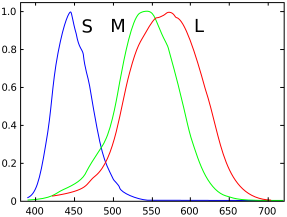
Just quickly -- the overlap means we can simulate any color in many ways
and it is hard for the eye to tell how it is being tricked because of
the overlap (there are often many ways to "mix" colors to get the same
response from the 3 receptors) the eye finds it difficult to distinguish.
Think of it this way. Any color from nature is going to have the same
problem of cross-talk in our receptors. Birds have a better system
because they, as well as having a 4th primary color, also have little
color filters in front of their cone cells to sharpen their color
response so it is harder to trick their receptors.
Cheers,

        - Miriam

Christopher Night wrote:
On Mon, Mar 19, 2012 at 5:05 PM, Miriam English <[email protected]
<mailto:[email protected]>> wrote:

    Because we only have 3 color detector cells in our eyes we can
    imitate any color with various combinations of red, green, and blue
    lights mixed together in varying amounts.


Unfortunately it's not that simple. The idea is that if we could
independently stimulate each of the three colors receptors (cones) in
our eyes, then we could reproduce any visual sensation and thereby any
color. The problem is that this is impossible. There's no such thing as
a wavelength of light that stimulates the middle (green) cones without
also stimulating either of the outer two. There's significant overlap in
their spectral response.

http://upload.wikimedia.org/wikipedia/commons/1/1e/Cones_SMJ2_E.svg

-Christopher
--
If you don't have any failures then you're not trying hard enough.
 - Dr. Charles Elachi, director of NASA's Jet Propulsion Laboratory
-----
Website: http://miriam-english.org
Blogs:   http://miriam-e.dreamwidth.org
         http://miriam-e.livejournal.com