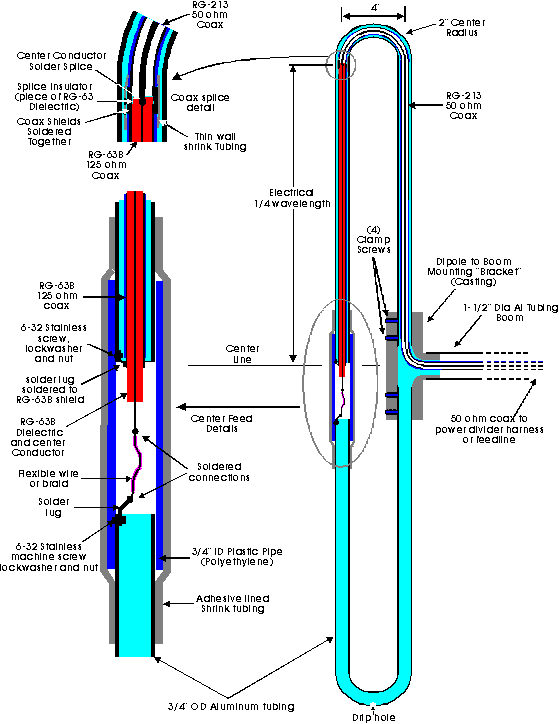
The matching section inside the loop is a 1/4 wavelength of RG-63B 125
ohm coax.  The overall outside diameter is the same as RG-214 but the
dielectric is semi-air (like a large version of RG-62 93 ohm coax) and
the center conductor is quite small, like RG-59.  I have a few hundred
feet of RG-63B if you want to experiment.
The actual length of the matching section in the commercial loop is not
however a 1/4 wavelength at the center freq of the dipole but rather on
the high side.  A Sinclair loop I dismantled had a matching section that
was 1/4 wave at 182 MHz.  I believe that this is the secret to the extra
wide bandwidth of the dipole.  Using a matching section that is 1/4 wave
at the center freq of the dipole (156 MHz) gives a much better return
loss at 156 MHz but is at least 20% narrower bandwidth.

I have made a number of clones with both the dipole and the matching
section tuned to 146MHz.  The return loss was very good at 2m (SWR very
close to 1:1 vs the commercial antenna that was 1.2:1 at its lowest
point over the 138-174 MHz bandwidth.)  I also used the same design in
several 4 bay 220MHz versions that have been in service for up to 15 years.

Check the following URL for a diagram of my clone design:

http://www.gorum.ca/fdipolev.gif

One point of warning:  It is very hard to insert the coax into the loop.
  You have to make as short a splice as possible since it must slide
past the 180 deg bend in the loop.  Avoid messing with this coax unless
absolutely necessary.

As for the harness, the key point is that the electrical length of the
RG-213 from each dipole must be identical.  The actual electrical length
is unimportant, it just has to be the same for all dipoles.  The actual
configuration of the harness depends on the number of dipoles.  One and
4 dipoles can be made entirely with RG-213 whereas 2 and 8 dipoles
require a 1/4 wave section of RG-83 35 ohm coax. The one mystery I have
is how Sinclair inserts the harness into the mast for the fully enclosed
model.  The matching section parts of the harness are completely inside
the mast and is beyond the means of us amateurs.  However an external
harness is very practical.

Burt Lang  VE2BMQ

Paul Kelley N1BUG wrote:
> That's what I thought Chuck. Thanks! I haven't yet decided whether I
> want to rip the heat shrink tubing off an element and disassemble it
> to see what coax is inside, which is why I asked.
>
> I was sort of contemplating whether it might be possible to replace
> all that coax with RG-214 in an attempt to build a noise free
> harness. But if there's a matching section, I'm sure the return loss
> without it would be really ugly.
>
> Paul N1BUG
>
>
> Chuck Kelsey wrote:
>> There is a 1/4 wave impedance matching section of coax (125?) inside the
>> element. The matching section is stagger tuned from the element itself.
>> That's why it is more boadbanded and why you see two return loss dips.
>>
>> Chuck
>> WB2EDV
>>
>>
>> ----- Original Message ----- >
>>
>>> I wonder if anyone knows what (if any) gimmick Sinclair used to get
>>> such broad SWR bandwidth on these dipoles? The exposed portion of
>>> the coax on each dipole is RG-213, 50 ohms... but I'm wondering if
>>> they may use some quarter wavelength (or ???) of some other
>>> impedance on the part hidden inside the dipole, especially since
>>> these things exhibit a clear double dip SWR curve (one dip near the
>>> low end of the design range, 138 MHz, and another dip near the upper
>>> end, 174 MHz, with a somewhat reactive bump in between).
>>>
>>> 73,
>>> Paul N1BUG
>
>
> ------------------------------------
>
>
>
> Yahoo! Groups Links
>
>
>
>