Thanks Burt!

Great info there.
If all the dipoles seem to be OK (not noisy) I am thinking of making
my own harness to use 4 of them. I've constructed several
multiple-antenna EME arrays so I understand the concepts and the
importance of equal lengths, etc.

My only concern with making my own harness is that the length of
coax attached to each dipole is not long enough to reach a tee
connector on the mast and allow sufficient vertical spacing between
dipoles. (The original configuration had four bays of two side by
side dipoles, so the shorter length was appropriate there.) It will
be easy enough to add on some coax but since the impedance at my 147
MHz frequency is not exactly 50 ohms and somewhat reactive it will
vary somewhat with the coax length. I don't think it will be enough
to cause major issues.

I see that I will need to use some odd multiple of a quarter
wavelength for the 50 ohm coax sections from the array center tee to
each of the outer tees feeding pairs of dipoles.

I need to see if I can figure out what failed and why in the
original configuration before I go investing time and money into a
rebuild though. Its useful service life before becoming too noisy
was less than a year!

Paul N1BUG


Burt Lang wrote:
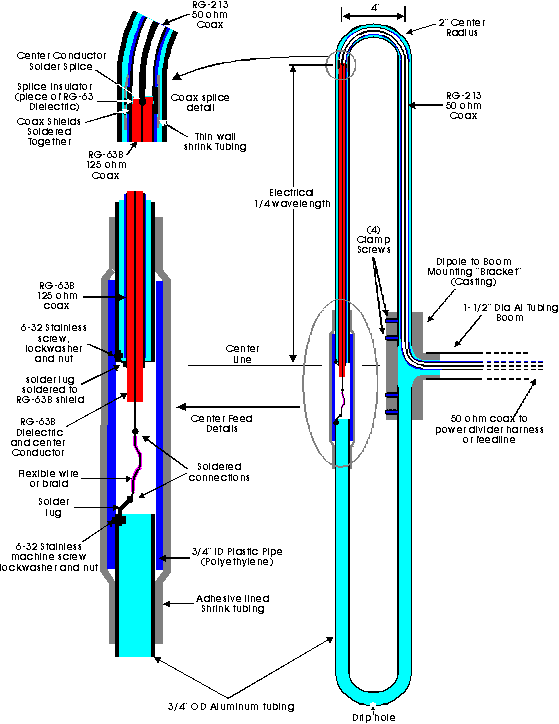
> The matching section inside the loop is a 1/4 wavelength of RG-63B 125
> ohm coax.  The overall outside diameter is the same as RG-214 but the
> dielectric is semi-air (like a large version of RG-62 93 ohm coax) and
> the center conductor is quite small, like RG-59.  I have a few hundred
> feet of RG-63B if you want to experiment.
>
> The actual length of the matching section in the commercial loop is not
> however a 1/4 wavelength at the center freq of the dipole but rather on
> the high side.  A Sinclair loop I dismantled had a matching section that
> was 1/4 wave at 182 MHz.  I believe that this is the secret to the extra
> wide bandwidth of the dipole.  Using a matching section that is 1/4 wave
> at the center freq of the dipole (156 MHz) gives a much better return
> loss at 156 MHz but is at least 20% narrower bandwidth.
>
> I have made a number of clones with both the dipole and the matching
> section tuned to 146MHz.  The return loss was very good at 2m (SWR very
> close to 1:1 vs the commercial antenna that was 1.2:1 at its lowest
> point over the 138-174 MHz bandwidth.)  I also used the same design in
> several 4 bay 220MHz versions that have been in service for up to 15 years.
>
> Check the following URL for a diagram of my clone design:
>
> http://www.gorum.ca/fdipolev.gif
>
> One point of warning:  It is very hard to insert the coax into the loop.
>   You have to make as short a splice as possible since it must slide
> past the 180 deg bend in the loop.  Avoid messing with this coax unless
> absolutely necessary.
>
> As for the harness, the key point is that the electrical length of the
> RG-213 from each dipole must be identical.  The actual electrical length
> is unimportant, it just has to be the same for all dipoles.  The actual
> configuration of the harness depends on the number of dipoles.  One and
> 4 dipoles can be made entirely with RG-213 whereas 2 and 8 dipoles
> require a 1/4 wave section of RG-83 35 ohm coax. The one mystery I have
> is how Sinclair inserts the harness into the mast for the fully enclosed
> model.  The matching section parts of the harness are completely inside
> the mast and is beyond the means of us amateurs.  However an external
> harness is very practical.
>
> Burt Lang  VE2BMQ