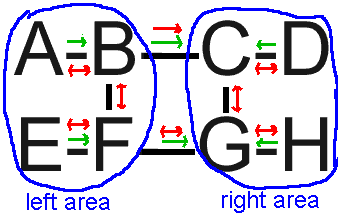
In einer eMail vom 12.07.2008 02:57:44 Westeuropäische Normalzeit schreibt
[EMAIL PROTECTED]:
On Fri,  Jul 11, 2008 at 7:05 PM,  <[EMAIL PROTECTED]> wrote:
> My  understanding of what you want is this: forwarding from C to B is not
>  allowed. Hence the packet from D to E must go like
> this:  D--->C-->G-->F-->E    and NOT  D-->C-->B-->F-->E.
> My saying is: That can be respected.  But this is almost normal
Dijkstra.Only
> the following enhancements are  required: Build a graph, which consists of
> these nodes A,..H and of  directed arrows. Between any two nodes according
to
> the black lines  there are two  inversely directed arrows.Except  between B
>  and C. Here there is only one arrow which is from B to C, but not from C
to
> B.
> Node C runs Dijkstra with itself being the root, however  modified such that
> selecting a predecessor node for any node presumes  that  there is an arrow
> from that predecessor node to that  "any"-node. So , while running Dijkstra,
> C won't even see that B is a  neighbor/candidate.Hence the resulting
shortest
> path tree will not  include "from C to B" but only "from C to G".

Okay. I added what I  think you just described in red  at
http://bill.herrin.us/network/geoag-h1.gif. Is that  correct?

Yes.


This  means that the forwarding information base at node G looks  like:

destination {left area}: send to F
destination C: send to  C
destination H: send to H
destination D: send to C

And the FIB  at node C looks like:

destination {left area}: send to G
destination  G: send to G
destination D: send to D
destination H: send to G

Is  that correct?

Yes.


So,  D--->C-->G-->F-->E happens for packets from D to E because  when
the packet is at C, C understands that all of {left area} is  available
via G and when the packet is at G, G understands that all of  {left
area} is available via F.
Still correct.


Thus  geographic aggregation cut the FIB
almost in half since C and G only have  to keep track of {left area}
instead of keeping track of A, B. F and  E.

Still correct?
Yes, if you want, but I prefer to say No: I do not pursue to have a FIB of
the current classic design. My goal is to fill a table from which by means  of
a single indexed/offset element lookup the next hop can be retrieved.

Heiner