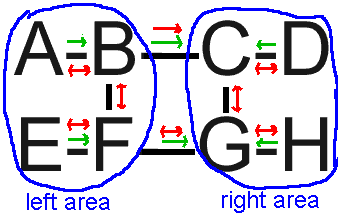
In einer eMail vom 12.07.2008 18:16:25 Westeuropäische Normalzeit schreibt
[EMAIL PROTECTED]:
On Sat,  Jul 12, 2008 at 3:13 AM,  <[EMAIL PROTECTED]> wrote:
> In  einer eMail vom 12.07.2008 02:57:44 Westeuropäische Normalzeit  schreibt
> [EMAIL PROTECTED]:
>> Okay. I added what I think you  just described in red at
>>  http://bill.herrin.us/network/geoag-h1.gif. Is that correct?
>
>  Yes.
>
>> This means that the forwarding information base at  node G looks like:
>>
>> destination {left area}: send to  F
>> destination C: send to C
>> destination H: send to  H
>> destination D: send to C
>>
>> And the FIB at  node C looks like:
>>
>> destination {left area}: send to  G
>> destination G: send to G
>> destination D: send to  D
>> destination H: send to G
>>
>> Is that  correct?
>
> Yes.

Okay, good. Now, based on the graph you  just agreed to and the two FIB
tables you just agreed to, route a packet  from node H to node A. The
path I compute is H->G->F->B->A. Do  you get that path as well?


Sure. Each router computes a Dijkstra shortest path tree to all the others.
Hereby, whenever a predecessor is determined (which either is the computing
router or which at least is closer to the computing router) for some node, the
condition must be met, that there is an arrow from that predecessor  to  that
"some node".
So no matter who originates the packet or who receives the packet, it will
forward it in compliance with such policy restrictions.

Heiner