Hello again Hatuey,

Yes, the k-band utility from Bilbao will give you the band paths for the
bulk. For a surface, it is indeed a little different but not really any
more difficult. The question you asked is not especially relevant to
SIESTA, but I will answer it anyway because it's a good pedagogical example.
I am using this paper as a sample reference for your case:
http://www.cmdmc.com.br/redecmdmc/lab/arquivos_publicacoes/2781_Density%20Functional%20Theory%20Study%20on%20the%20Structural%20and%20Electronic%20Properties%20of%20Low%20Index.pdf
-- they are dealing with composite TiO2//SnO2 rutile surfaces but in the
same Miller index planes that you are interested in, and also TiO2 and SnO2
individually so it makes for a good example. Usually it is a good idea to
adopt the conventions of previously published research, especially if you
are making direct comparisons to them.

Draw your attention to pages 8948 and 8949 where they depict the calculated
band structure. They also show the Brillouin zone of the surface. The
surface Brillouin zone ought to be a rectangle for this material because we
are dealing with a cubic crystal cut along a face diagonal, so one
dimension of the surface Brillouin zone will be longer than the other. The
labels M and X, now, are NOT the same as the bulk M and X high-symmetry
points.

Consider the (110) plane case: If you make a cut to the bulk crystal along
(110) and then orient your viewpoint so that [110] is normal to your line
of sight (the z-direction, like in your simulation), one choice of lattice
vectors that yield a rectangular surface unit cell is: {1 -1 0} and {0 0
1}. You are probably already using this in your surface unit cell. The
paper, and its predecessor on which the label conventions are based (
http://prb.aps.org/pdf/PRB/v64/i7/e075407) use X for the reciprocal "short"
direction, X' for the reciprocal "long" direction, and M as the vector
composition of both X and X'. The reciprocal "short" direction is parallel
to the surface unit cell "long" direction, correct? So now, for the SnO2
rutile (110) case, we arrive at the conclusion that X is along [0 0 1] and
X' is along [1 -1 0], and M is along [1 -1 1]. Pretty simple, right? But
we're not done because we need to tell SIESTA what to do with this
information and it doesn't care about the bulk crystal, just the surface
unit cell for the purposes of finding reciprocal lattice vectors and so on.
In this unit cell, the x direction is along [0 0 1], and the y-direction is
along [1 -1 0] in the bulk crystal.

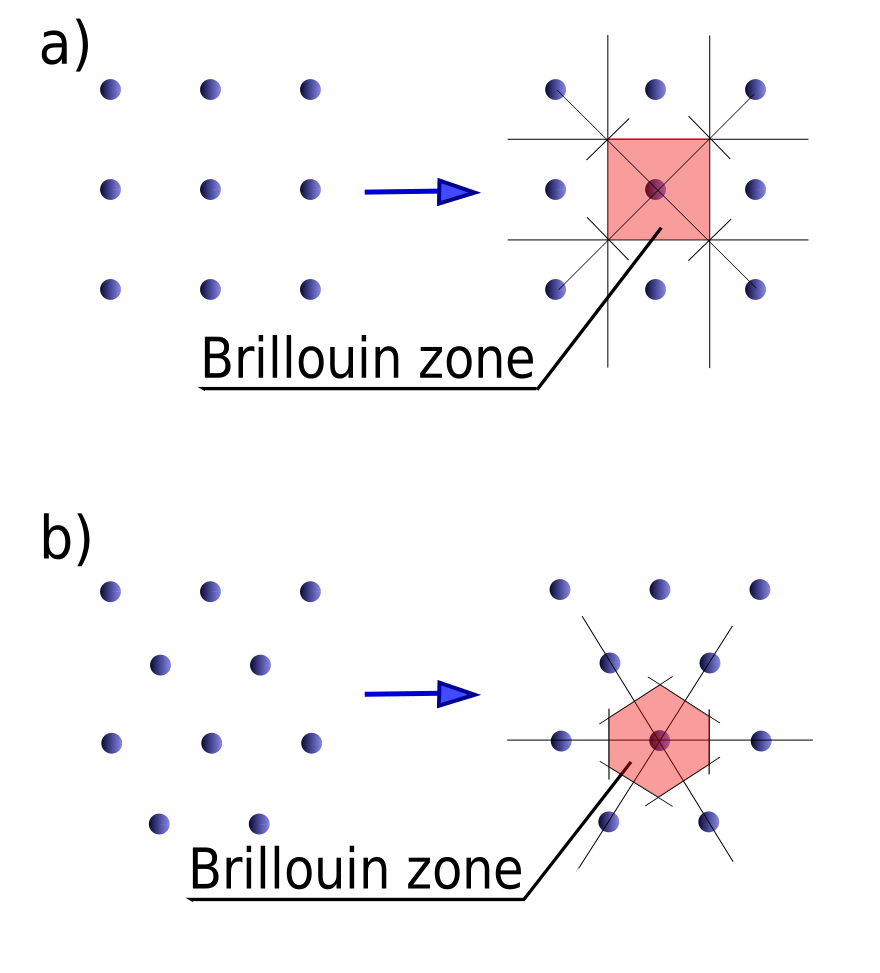
We need to remember that the 1st Brillouin zone's boundary is half the
length of the reciprocal cell vectors (see
http://upload.wikimedia.org/wikipedia/commons/2/22/Brillouin_zone.svg for a
graphical example), so, for the surface unit cell of (110) Rutile SnO2:
The Gamma point is at [0 0 0] (that's easy)
The X' point is at [0 0.5 0] (because it's parallel to the y-direction, the
reciprocal short direction)
The M point is at [0.5 0.5 0] (because it's the sum of vectors X' and X,
therefore x+y unit vectors)
The X point is at [0.5 0 0] (again, the x-direction in the surface unit
cell, the reciprocal long direction)

And then, creating this path in reciprocal space in a way SIESTA can
understand (and I'm estimating the number of points in each line):

WriteBands         .true.
BandLinesScale    ReciprocalLatticeVectors

%block BandLines
1    0 0 0 \Gamma
20   0.5 0 0 Xprime
50   0.5 0.5 0 M
20   0 0.5 0 X
50   0 0 0 \Gamma
%endblock BandLines

Then, run: (assuming your systemlabel is "SnO2_110")
bash>> gnubands < SnO2_110.bands > SnO2_110_bands.dat

When plotted with software like matplotlib or gnuplot, this should create a
plot that is similar to figure 2b in the 1st reference I gave you once you
choose the correct viewing window. Keep in mind that your energies will be
with respect to the program's energy zero and not the VBM, Fermi energy, or
vacuum level unless you write a script to subtract that energy from the
second column of SnO2_110_bands.dat.

If you calculate the lengths of each reciprocal lattice vector in 1/bohr or
Angstrom you can probably make a more consistent band lines scale than the
one I used above for the number of points along each line, but I'll leave
that as an exercise for you. Also another exercise for you: do you have to
change anything in the SIESTA .fdf that I've shown you above if you want to
print the bandlines for SnO2 (101) instead of (110)? Why or why not?

I hope this helped! Also, I believe I'm fully correct, but if you perform
the calculation and find any errors, let me know and we can continue the
conversation.

Best of luck,


On Thu, Jun 6, 2013 at 7:52 AM, Hatuey Hack <[email protected]>wrote:

> Dear **Abraham,
>
> Thank you very much for the very useful information!
>
> In the link from the Bilbao Crystallographic Server, I got the k-vectors
> for the bulk Brillouin zone, right? I am not seen (understand) how, from
> them, I can determine the k-points (and then the path) in a given plane,
> for example, for the (110) plane.
>
> I think (but I may be wrong) that if I put a path from the bulk when
> calculating the surface, I will waste computing resource, and some bands in
> the direction perpendicular to the plane will be null or flat.
>
> Regards,
>
> Hatuey
>
>   ------------------------------
>
> *On Wed, Jun 5, 2013 at 10:19 PM, Abraham Hmiel <[email protected]>wrote:
> Hi Hatuey,*
>
> What you're looking for is here: http://www.cryst.ehu.es/**
> cryst/get_kvec.html <http://www.cryst.ehu.es/cryst/get_kvec.html> - find
> the space group for SnO2 and enter it in the box. The k-vector coordinates
> that SIESTA uses in a band structure calculation are in the first set of
> columns, "CDML." If you input coordinates this way, it is important to use
> "BandlinesScale   ReciprocalLatticeVectors" in your .fdf file.
>
> Then, the manual page http://www.icmab.es/leem/**
> siesta/Documentation/Manuals/**siesta-3.1-manual/node55.html<http://www.icmab.es/leem/siesta/Documentation/Manuals/siesta-3.1-manual/node55.html>
>  **for information on how to define the path in k-space which will of
> course be implemented in your .fdf file.
>
> Defining the path in k-space has no implications for the density of states
> calculation. I always use the projected density of states output options,
> as I have a lot more control over what orbitals I'm looking at for my own
> analysis. That particular page is here: http://www.icmab.es/**
> leem/siesta/Documentation/**Manuals/siesta-3.1-manual/**node60.html<http://www.icmab.es/leem/siesta/Documentation/Manuals/siesta-3.1-manual/node60.html>
>
> With PDOS, it is usually a good idea to have a finer k-grid than your SCF
> calculation. For example, if you are simulating a surface with a converged
> k-grid of:
>
> %block kgrid_Monkhorst_pack
> 6 0 0 0.0
> 0 6 0 0.0
> 0 0 1 0.0
> %block kgrid_Monkhorst_pack
>
> The following k-grid may be suitable for a PDOS calculation:
>
> %block PDOS.kgrid_Monkhorst_pack
> 16 0 0 0.0
> 0 16 0 0.0
> 0 0 1 0.0
> %block PDOS.kgrid_Monkhorst_pack
> *
> De:* Hatuey Hack <[email protected]>
> *Para:* "[email protected]" <[email protected]>
> *Enviadas:* Quarta-feira, 5 de Junho de 2013 11:17
> *Assunto:* defining k path for surfaces
>
> Dear all,
>
> I am trying to calculate the band structure for different 2D systems. My
> systems consist in nanosheets of SnO2 obtained in the 101 and 110 direction
> from a tetragonal structure "grown" in the xy plane with the vacum in the z
> direction.
>
> I would like to know how to define the k path in the Brillouin zone for
> electronic band and DOS calculation.
>
> Best regards,
>
> Hatuey
>
>
>


--
*Abraham Hmiel*
Katherine Belz Groves Fellow in Nanoscience
Xue Group, College of Nanoscale Science and Engineering at SUNY Albany
http://abehmiel.net/about