Sorry, I  already realize I've made a proofreading mistake:

'use X for the reciprocal "short" direction, X' for the reciprocal "long"
direction, and M as the vector composition of both X and X'. The reciprocal
"short" direction is parallel to the surface unit cell "long" direction,
correct?'
should instead read:

'use X for the reciprocal "long" direction, X' for the reciprocal "short"
direction, and M as the vector composition of both X and X'. The reciprocal
"short" direction is parallel to the surface unit cell "long" direction,
correct?'

apologies.


On Thu, Jun 6, 2013 at 10:08 AM, Abraham Hmiel <[email protected]> wrote:

> Hello again Hatuey,
>
> Yes, the k-band utility from Bilbao will give you the band paths for the
> bulk. For a surface, it is indeed a little different but not really any
> more difficult. The question you asked is not especially relevant to
> SIESTA, but I will answer it anyway because it's a good pedagogical example.
>
> I am using this paper as a sample reference for your case:
> http://www.cmdmc.com.br/redecmdmc/lab/arquivos_publicacoes/2781_Density%20Functional%20Theory%20Study%20on%20the%20Structural%20and%20Electronic%20Properties%20of%20Low%20Index.pdf
> -- they are dealing with composite TiO2//SnO2 rutile surfaces but in the
> same Miller index planes that you are interested in, and also TiO2 and SnO2
> individually so it makes for a good example. Usually it is a good idea to
> adopt the conventions of previously published research, especially if you
> are making direct comparisons to them.
>
> Draw your attention to pages 8948 and 8949 where they depict the
> calculated band structure. They also show the Brillouin zone of the
> surface. The surface Brillouin zone ought to be a rectangle for this
> material because we are dealing with a cubic crystal cut along a face
> diagonal, so one dimension of the surface Brillouin zone will be longer
> than the other. The labels M and X, now, are NOT the same as the bulk M and
> X high-symmetry points.
>
> Consider the (110) plane case: If you make a cut to the bulk crystal along
> (110) and then orient your viewpoint so that [110] is normal to your line
> of sight (the z-direction, like in your simulation), one choice of lattice
> vectors that yield a rectangular surface unit cell is: {1 -1 0} and {0 0
> 1}. You are probably already using this in your surface unit cell. The
> paper, and its predecessor on which the label conventions are based (
> http://prb.aps.org/pdf/PRB/v64/i7/e075407) use X for the reciprocal
> "short" direction, X' for the reciprocal "long" direction, and M as the
> vector composition of both X and X'. The reciprocal "short" direction is
> parallel to the surface unit cell "long" direction, correct? So now, for
> the SnO2 rutile (110) case, we arrive at the conclusion that X is along [0
> 0 1] and X' is along [1 -1 0], and M is along [1 -1 1]. Pretty simple,
> right? But we're not done because we need to tell SIESTA what to do with
> this information and it doesn't care about the bulk crystal, just the
> surface unit cell for the purposes of finding reciprocal lattice vectors
> and so on. In this unit cell, the x direction is along [0 0 1], and the
> y-direction is along [1 -1 0] in the bulk crystal.
>
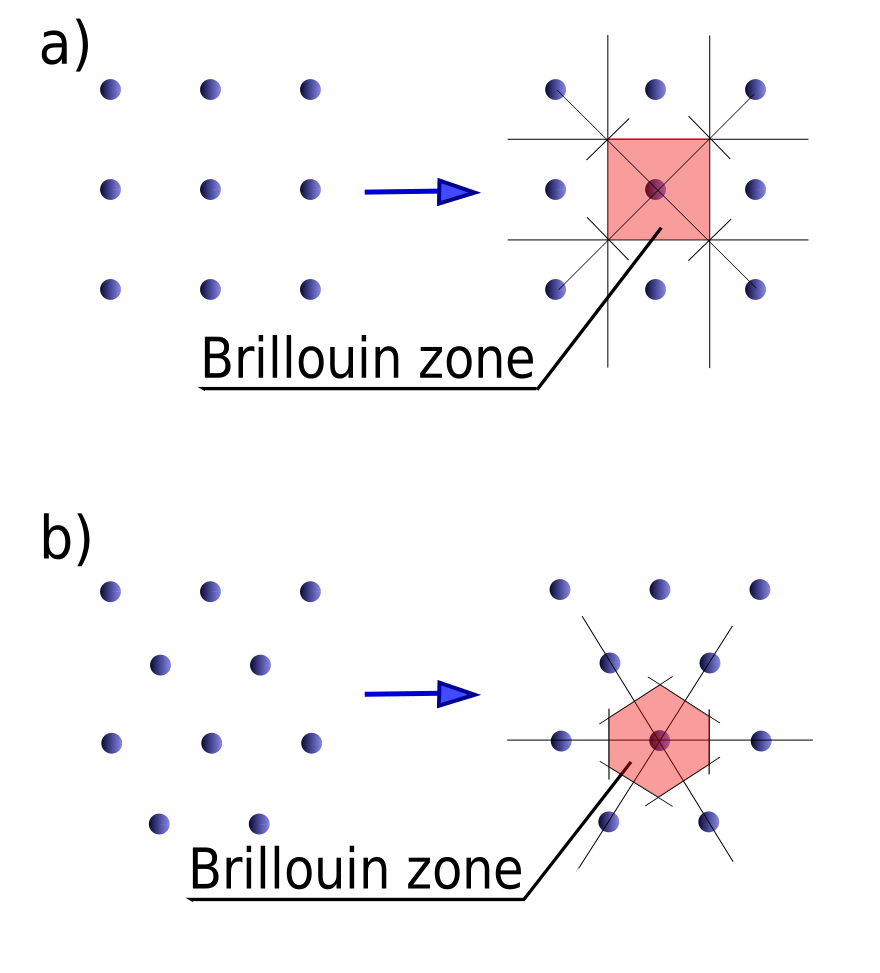
> We need to remember that the 1st Brillouin zone's boundary is half the
> length of the reciprocal cell vectors (see
> http://upload.wikimedia.org/wikipedia/commons/2/22/Brillouin_zone.svg for
> a graphical example), so, for the surface unit cell of (110) Rutile SnO2:
> The Gamma point is at [0 0 0] (that's easy)
> The X' point is at [0 0.5 0] (because it's parallel to the y-direction,
> the reciprocal short direction)
> The M point is at [0.5 0.5 0] (because it's the sum of vectors X' and X,
> therefore x+y unit vectors)
> The X point is at [0.5 0 0] (again, the x-direction in the surface unit
> cell, the reciprocal long direction)
>
> And then, creating this path in reciprocal space in a way SIESTA can
> understand (and I'm estimating the number of points in each line):
>
> WriteBands         .true.
> BandLinesScale    ReciprocalLatticeVectors
>
> %block BandLines
> 1    0 0 0 \Gamma
> 20   0.5 0 0 Xprime
> 50   0.5 0.5 0 M
> 20   0 0.5 0 X
> 50   0 0 0 \Gamma
> %endblock BandLines
>
> Then, run: (assuming your systemlabel is "SnO2_110")
> bash>> gnubands < SnO2_110.bands > SnO2_110_bands.dat
>
> When plotted with software like matplotlib or gnuplot, this should create
> a plot that is similar to figure 2b in the 1st reference I gave you once
> you choose the correct viewing window. Keep in mind that your energies will
> be with respect to the program's energy zero and not the VBM, Fermi energy,
> or vacuum level unless you write a script to subtract that energy from the
> second column of SnO2_110_bands.dat.
>
> If you calculate the lengths of each reciprocal lattice vector in 1/bohr
> or Angstrom you can probably make a more consistent band lines scale than
> the one I used above for the number of points along each line, but I'll
> leave that as an exercise for you. Also another exercise for you: do you
> have to change anything in the SIESTA .fdf that I've shown you above if you
> want to print the bandlines for SnO2 (101) instead of (110)? Why or why
> not?
>
> I hope this helped! Also, I believe I'm fully correct, but if you perform
> the calculation and find any errors, let me know and we can continue the
> conversation.
>
> Best of luck,
>
>
>
> On Thu, Jun 6, 2013 at 7:52 AM, Hatuey Hack <[email protected]>wrote:
>
>> Dear **Abraham,
>>
>> Thank you very much for the very useful information!
>>
>> In the link from the Bilbao Crystallographic Server, I got the k-vectors
>> for the bulk Brillouin zone, right? I am not seen (understand) how, from
>> them, I can determine the k-points (and then the path) in a given plane,
>> for example, for the (110) plane.
>>
>> I think (but I may be wrong) that if I put a path from the bulk when
>> calculating the surface, I will waste computing resource, and some bands in
>> the direction perpendicular to the plane will be null or flat.
>>
>> Regards,
>>
>> Hatuey
>>
>>   ------------------------------
>>
>> *On Wed, Jun 5, 2013 at 10:19 PM, Abraham Hmiel <[email protected]>wrote:
>> Hi Hatuey,*
>>
>> What you're looking for is here: http://www.cryst.ehu.es/**
>> cryst/get_kvec.html <http://www.cryst.ehu.es/cryst/get_kvec.html> - find
>> the space group for SnO2 and enter it in the box. The k-vector coordinates
>> that SIESTA uses in a band structure calculation are in the first set of
>> columns, "CDML." If you input coordinates this way, it is important to use
>> "BandlinesScale   ReciprocalLatticeVectors" in your .fdf file.
>>
>> Then, the manual page http://www.icmab.es/leem/**
>> siesta/Documentation/Manuals/**siesta-3.1-manual/node55.html<http://www.icmab.es/leem/siesta/Documentation/Manuals/siesta-3.1-manual/node55.html>
>>  **for information on how to define the path in k-space which will of
>> course be implemented in your .fdf file.
>>
>> Defining the path in k-space has no implications for the density of
>> states calculation. I always use the projected density of states output
>> options, as I have a lot more control over what orbitals I'm looking at for
>> my own analysis. That particular page is here: http://www.icmab.es/**
>> leem/siesta/Documentation/**Manuals/siesta-3.1-manual/**node60.html<http://www.icmab.es/leem/siesta/Documentation/Manuals/siesta-3.1-manual/node60.html>
>>
>> With PDOS, it is usually a good idea to have a finer k-grid than your SCF
>> calculation. For example, if you are simulating a surface with a converged
>> k-grid of:
>>
>> %block kgrid_Monkhorst_pack
>> 6 0 0 0.0
>> 0 6 0 0.0
>> 0 0 1 0.0
>> %block kgrid_Monkhorst_pack
>>
>> The following k-grid may be suitable for a PDOS calculation:
>>
>> %block PDOS.kgrid_Monkhorst_pack
>> 16 0 0 0.0
>> 0 16 0 0.0
>> 0 0 1 0.0
>> %block PDOS.kgrid_Monkhorst_pack
>> *
>> De:* Hatuey Hack <[email protected]>
>> *Para:* "[email protected]" <[email protected]>
>> *Enviadas:* Quarta-feira, 5 de Junho de 2013 11:17
>> *Assunto:* defining k path for surfaces
>>
>> Dear all,
>>
>> I am trying to calculate the band structure for different 2D systems. My
>> systems consist in nanosheets of SnO2 obtained in the 101 and 110 direction
>> from a tetragonal structure "grown" in the xy plane with the vacum in the z
>> direction.
>>
>> I would like to know how to define the k path in the Brillouin zone for
>> electronic band and DOS calculation.
>>
>> Best regards,
>>
>> Hatuey
>>
>>
>>
>
>
> --
> *Abraham Hmiel*
> Katherine Belz Groves Fellow in Nanoscience
> Xue Group, College of Nanoscale Science and Engineering at SUNY Albany
> http://abehmiel.net/about
>
>


--
*Abraham Hmiel*
Katherine Belz Groves Fellow in Nanoscience
Xue Group, College of Nanoscale Science and Engineering at SUNY Albany
http://abehmiel.net/about