A common complaint in America today is that politics and even society as a
whole are broken
<https://www.theatlantic.com/ideas/archive/2020/11/american-system-broken/616991/>.
Critics point out endless lists of what should be fixed: the complexity of the
tax code
<https://www.pbs.org/newshour/economy/column-need-rewrite-tax-code-scratch>,
or immigration reform
<https://www.uschamber.com/immigration/calling-on-congress-fix-americas-broken-immigration-system>,
or the inefficiency of government.
But each dilemma usually comes down to polarized deadlock between two
competing visions and everyone’s conviction that theirs is the right one.
Perhaps this white-knuckled insistence on being right is the root cause of
the societal fissure – why everything seems so irreparably wrong.

As religion <https://liberalarts.utexas.edu/rs/faculty/jt27> and philosophy
<https://www.uml.edu/fahss/philosophy/faculty/kaag-john.aspx> scholars, we
would argue that our apparent national impasse points to a lack of
“epistemic humility,” or intellectual humility – that is, an inability to
acknowledge, empathize with and ultimately compromise with opinions and
perspectives different from one’s own. In other words, Americans have
stopped listening.

So why is intellectual humility in such scarce supply? Of course, the
quickest answer might be the right one: that humility runs against most
people’s fear of being mistaken
<https://podcasts.apple.com/us/podcast/how-to-be-wrong/id1603230204>, and
the zero-sum view that being right means someone else has to be totally
wrong.
Read news coverage based on evidence, not tweetsGet newsletter

But we think that the problem is more complex and perhaps more interesting.
We believe epistemic humility
<https://plato.stanford.edu/entries/wisdom/> presents
something of a twofold danger that makes being humble frightening – and
has, ever since Socrates first put it at the heart of Western philosophy.
Knowing you don’t know

If your best friend told you that you were the wisest of all human beings,
perhaps you would be inclined to smile in agreement and take the dear
friend for a beer. But when the ancient Athenian Socrates was delivered
this news, he responded with sincere and utter disbelief – even though his
friend had confirmed it with the Delphic oracle
<https://historycooperative.org/the-oracle-of-delphi/>, the fortune-telling
authority of the ancient world.

This nascent humility – “No, get out of here, I’m definitely not the
wisest” – helped spark what became arguably the greatest philosophical life
of all time <https://plato.stanford.edu/entries/socrates/>. Despite
relative old age, Socrates immediately embarked on a journey to find
someone wiser than himself and spent many days seeking out the sages of the
ancient world, a quest Plato recounts in his “Apology of Socrates
<https://chs.harvard.edu/primary-source/plato-the-apology-of-socrates-sb/>.”

The problem? He discovered that the sages thought they knew more than they
actually did. Eventually, Socrates concluded that he himself was, in fact,
the wisest of all men, because at least he “knew that he didn’t know.”

This is not to say that Socrates knew nothing: He demonstrates time and
again that he knows a lot and routinely demonstrated good judgment. Rather,
he acknowledged there were definite limitations to the knowledge he could
claim.

This is the birth of “epistemic humility” in Western philosophy: the
acknowledgment that one’s blind spots and shortcomings are an invitation
for ongoing intellectual investigation and growth.
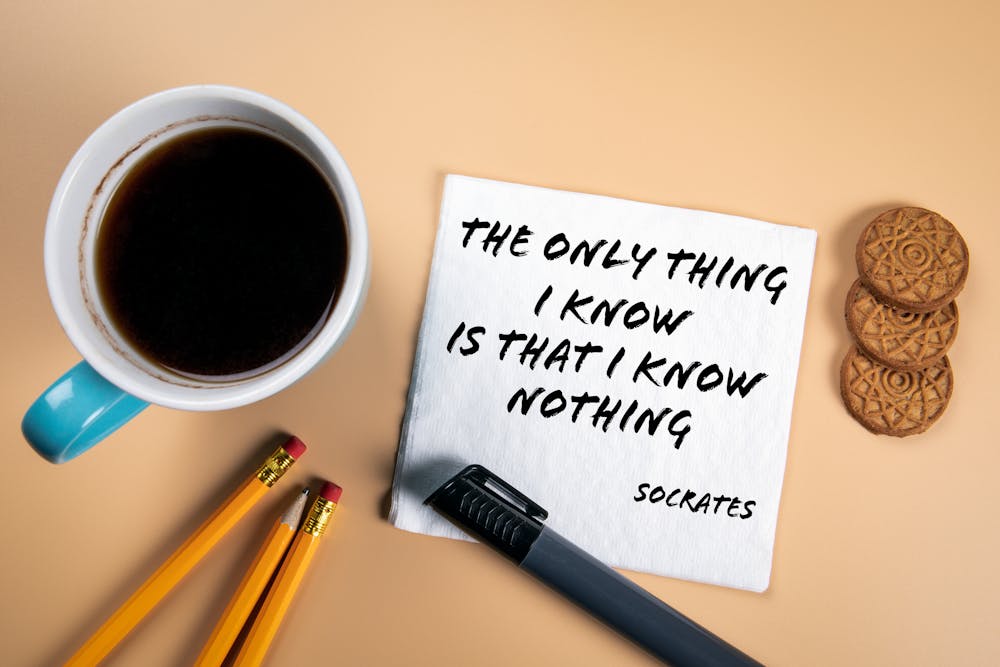
[image: A coffee mug, pencils, pen and cookies next to a note reading 'The
only thing I know is that I know nothing – Socrates.']
<https://images.theconversation.com/files/521090/original/file-20230414-16-lfypqt.jpg?ixlib=rb-1.1.0&q=45&auto=format&w=1000&fit=clip>Reminder
to self: Keep it humble. tumsasedgars/iStock via Getty Images Plus
<https://www.gettyimages.com/detail/photo/the-only-thing-i-know-is-that-i-know-nothing-quote-royalty-free-image/1289867552?phrase=socrates&adppopup=true>Provoking
the powerful

But this mindset can feel dangerous to other people – especially if they
feel absolutely certain in their convictions.

In ancient Athens, as much as in the U.S. today, being perceived as right
translated into money and power. The city-state’s culture was dominated by
the Sophists, who taught rhetoric to nobles and politicians, and the Poets,
ancient playwrights. Greek theater and epic poetry were closely related to
religion
<https://www.historymuseum.ca/cmc/exhibitions/civil/greece/gr1180e.html>,
and their creators were treated as mouthpieces for aesthetic and moral
<https://www.vast-project.eu/theatre/> truth.

What’s more, theater and poetry were also major moneymakers, which
motivated artists to adopt a mentality of “fail fast, fail better,” with an
eye to eventually proving correct and getting paid.

By critically interrogating the idols and polarized views of his culture,
Socrates threatened the power holders of his city. A constantly questioning
figure is a direct threat to individuals who spend their lives defending
unquestioned belief – whether it’s belief in themselves, their superiors or
their gods.

Take Euthyphro, for example, one of Socrates’ principal interlocutors
<https://www.gutenberg.org/files/1642/1642-h/1642-h.htm>. Euthyphro is so
sure that he knows the difference between right and wrong that he is
bringing his own father to trial. Socrates quickly disabuses him of his
certainty, famously debating him about the true meaning of piety.

Or take Meletus, the man who eventually brought Socrates to trial
<http://www.historyshistories.com/the-trial-of-socrates.html> on
accusations of corrupting youth. In Plato’s account of the trial, it takes
Socrates no time to show this “good patriot,” as Meletus calls himself,
that he does not understand what patriotism truly means. Without any
pretensions to knowing the absolute truth, Socrates is able to shed light
on the underlying assumptions around him.

It’s frustrating to read the Platonic dialogues
<https://www.sacred-texts.com/cla/plato/index.htm>, the works of philosophy
that recount Socrates’ life and teaching, in part because Socrates rarely
claims the final word on any subject. In short, he gives more questions
than answers. But what remains constant is his openness to uncertainty that
keeps his inquiry on the move, pushing his inquiries further and deeper.
Paying the price

The second danger of epistemic humility is now probably in view. It’s the
danger that Socrates faced when he was brought to trial for corrupting
Athens’ youth – the danger to the humble skeptics themselves.

He is brought up on two very serious charges
<http://www.historyshistories.com/the-trial-of-socrates.html>. The first
was an accusation that he taught students to make the weaker argument
appear to be the stronger – which is actually what the Sophists did, not
Socrates. The second was that he had invented new gods – again, he didn’t
do that; poets and playwrights did.

What was he really guilty of? Perhaps only this: Socrates criticized the
arrogant self-assertion of his culture’s influencers, and they brought him
to trial, which concluded in his death sentence.
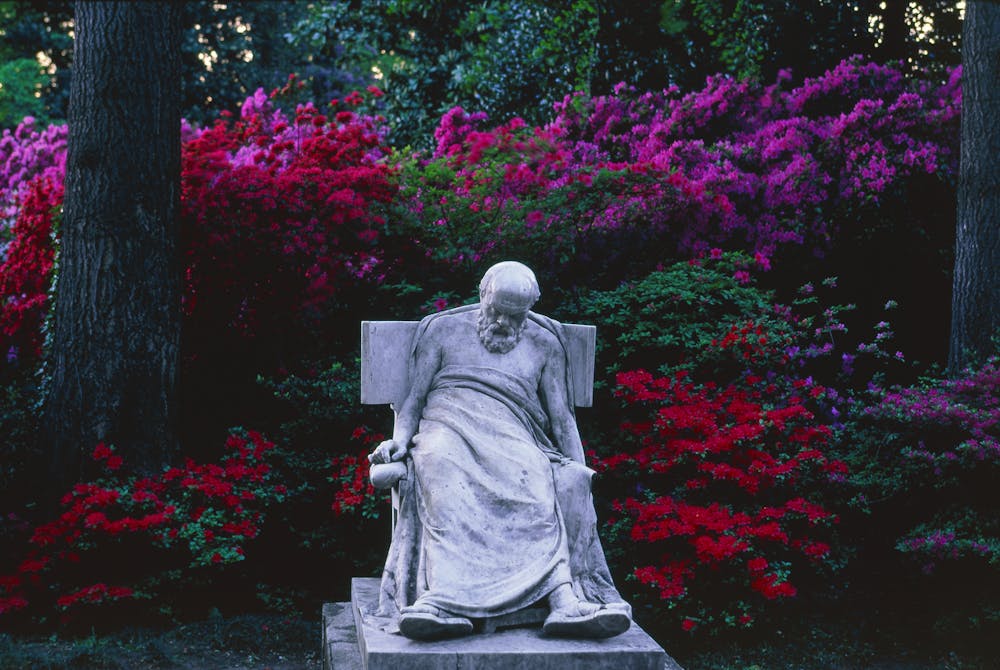
[image: Vibrant red and purple flowers behind a statue of a slumped-over
man.]
<https://images.theconversation.com/files/521091/original/file-20230414-24-tna6by.jpg?ixlib=rb-1.1.0&q=45&auto=format&w=1000&fit=clip>He
asked the big questions, and he paid a price. Roland Gerth/The Image Bank
via Getty Images
<https://www.gettyimages.com/detail/photo/sokrates-statue-in-the-parco-civico-of-lugano-royalty-free-image/519981918?phrase=socrates%20dying&adppopup=true>

Socrates taught that being humble about one’s own views
<https://philosophynow.org/issues/53/Socratic_Humility> was a necessary
step in searching for truth – perhaps the most essential one. That was and
perhaps still is a revolutionary view, because it forces us to challenge
preconceived ideas about what we believe, what we worship and where we tap
meaning. He placed himself in the middle of Athenians’ sharply polarized
debates about what truth and goodness were, and he was the one who got hit.

“Humility like darkness,” wrote American philosopher Henry David
Thoreau, “reveals
the heavenly lights
<https://www.google.com/books/edition/Walden/49qWhJ0gjZQC?hl=en&gbpv=1&dq=Humility+like+darkness+Thoreau&pg=PA346&printsec=frontcover>.”
Put another way, humility about the verity, accuracy and wisdom of one’s
ideas can reveal the fact that others have understandable reasons for
thinking as they do — as long as you try to see the world as they are
seeing it. In contrast, arrogance tends to extinguish the “heavenly light”
about what we still don’t fully understand.

Being humble about one’s position in the world is not an invitation for a
post-truth, anything-goes opinion free-for-all. Truth – the idea of truth –
matters. And we can pursue it together, if we are always open to being
wrong.

Article in Media today  KR IRS 25423  Pardon me if coincidental

--
You received this message because you are subscribed to the Google Groups
"Thatha_Patty" group.
To unsubscribe from this group and stop receiving emails from it, send an email
to [email protected].
To view this discussion on the web visit
https://groups.google.com/d/msgid/thatha_patty/CAL5XZoo%2BVRe7umUWkOJMh6m1AuQbUsLZ5qUor2qFiRGBheJpzA%40mail.gmail.com.