PITU GOTRA Part4 K RAJARAM IRS 4524//5524
*KR    This is not repeated one but conspicuously given as another
perspective, written by another Vedic scholar. *

*Gotras and Pravaras*

The Gotra indicates the chief clan to which an individual belongs. Further
within a Gotra, there exists many ‘Pravaras’ or ‘sub-lineages’. Both the
Gotra and Pravara are identified with Rishis who were part of the lineage.

Our ancient land of Bharata is the cradle of Sanatana Dharma. This is the
land where humans are born in order to undergo the churning due to karma –
to simultaneously enjoy the blessings of punya and exhaust paapa through
suffering. This is the holy land where Sriman Narayana undertook numerous
avataras to sustain dharma. This is the land where Rama established his
ideal kingdom – Rama Rajya – and also the land where Krishna taught us how
to fight adharma.

In this very land were born numerous great souls – realized souls – who had
direct perception of the Supreme Being – the *parabrahman*. These souls had
complete knowledge of the truth of the world and were detached from the
material bindings of samsara – the cycle of birth and death. These souls
are what we collectively refer to as ‘Rishis’. Although the root of the
word Rishi indicates ‘gati’ or movement, its primary meaning is knowledge.
It indicates knowledge of the *shastras*, *satya* or truth and *tapas* or
austerity. Therefore, those souls who had great knowledge, were wedded to
truth and always engaged themselves in austerities came to be known as
*Rishis*.

The Vishnu Purana declares the greatness of Rishis thus

यो वेदनिहितं गुहायां परमे व्योमन् सोश्नुते सर्वान् कामान् ब्रह्मणा विपश्चिता
…..

The Rishis had, in their hearts, that parabrahman who has been described by
the Vedas!

Classification of Rishis

The shastras declare parabrahman as the one who is infinite in an infinite
number of ways. He is ananta in every *guNa* – auspicious attribute – that
we can think of. Naturally, it is impossible for anyone to realize – or
have full knowledge of – any entity that is infinite. Still, different
souls have varying knowledge of this parabrahman, subject to the extent of
their intrinsic ability – swaroopa. This ability to know brahman is highest
amongst the Rishis.

Within the category of Rishis also, there is a gradation based on their
level of realization. Thus we have Rishis, Rajarshis, Devarshis, Maharshis
and Brahmarshi. In the Bala Kanda of the Valimiki Ramayana, there is a
description of how Sage Vishwamitra performs repeated cycles of tapas to
progressively attain each of these positions and finally ends up becoming a
Brahmarshi.

Based on the area of their excellence or fame, there are again a few
categories into which Rishis are classified. When Chaturmukha Brahma (the
four headed devata – different from parabrahma the Supreme Being) started
his process of creation, ten Rishis emerged from his mind – the manas – and
these ten were naturally endowed with the divine knowledge of parabrahman.
These ten Rishis – Bhrigu, Marichi, Atri, Angirasa, Pulaha, Kratu, Manu,
Daksha, Vasishta and Pulastya – came to be known as manasa-putras.

As briefly mentioned earlier, those who attain the highest level of
knowledge of parabrahman – amongst the Rishis – are known as Brahmarshis.
Seven of them are very well known – Bhrigu, Angirasa, Atri, Vishwamitra,
Kashyapa, Vasishta and Shandilya.

At the next level, the Rishis are known as Maharshis. Some of the
well-known Maharshis are Shukra, Brihaspati, Upanasha, Utathya, Vamadeva,
Apojya, Ishija, Kardama, Vishravassu, Shakti, Valikhilya and Dhara. These
became Maharshis due to their *jnana* or knowledge.

There is another category of Rishis who attained their exalted position due
to their relentless pursuit, and practice, of truth. They are known as
Satyarshis. Some of the well-known Satyarshis are Vatsara, Nagrahu,
Bharadhwaja, Bruhadutta, Sharadvanta, Vajashravasa, Dadichi and Vaishravana.

Yet another classification of Rishis is based on their ‘drashtatva’ or
‘realization’ of the mantras of the Vedas. These Rishis are known as ‘
*mantra-drashtaara-rishi*’. Some of the well-known Rishis under this
category are Bhrigu, Kavya, Prachetasa, Grutsamada, Nabha, Angirasa,
Bharadhwaja, Gargya, Kanva, Vamadeva, Kakshivanta, Kashyapa, Vatsara,
Raibhya-Asita, Atri, Valgutaka, Vasishta and Kundina.

Thus we find a variety of parameters based on which the ancient Rishis were
identified and classified.

(*Note: The above list of Rishis, under each category, is obviously not
exhaustive*)

Origins of the Gotra-pravartaka Rishis

The Rishis are also the *pravarkatas* – the propagators – of various
vamshas, the lineages. It is believed that all lineages in the Bharata
Bhumi have originally their roots in one of the Rishi paramparas. The
lineages are identified by two main attributes – the *Gotra* and the
*Pravara*. The Gotra indicates the chief clan to which an individual
belongs. Further within a Gotra, there exists many ‘Pravaras’ or
‘sub-lineages’. Both the Gotra and Pravara are identified with Rishis who
were part of the lineage.

The Gotra is always identified by the name of a single Rishi (mostly) while
the Pravara can have a number of Rishis associated with it – up to even
seven. Just to illustrate, the author of this post belongs to the
‘Kashyapa’ Gotra – the clan of the Sage Kashyapa – and further belongs to a
‘Tryarsheya’ Pravara – or a Pravara containing the names of three Rishis –
the same being Kashyapa-Avatsara-Naidhruvi.

Even today, in many traditional families, the custom of offering
salutations to an elder by distinctly stating ones Gotra and Pravara is
prevalent. This is termed as ‘Gotrabhivandana’.

There are a number of Rishis who are propagators of Gotra –
Gotra-pravartakas. We shall get to the details of these Rishis a little
later. However, there are primarily seven chief Rishis – Saptarshis – who
are considered as the root for even the Gotra-pravartaka Rishis. In other
words, even the Gotra-pravartaka Rishis came from the lineages of these
seven Rishis. The names of these seven – Bhrigu, Angirasa, Kashyapa, Atri,
Vasishta, Agastya and Vishwamitra – are slightly different from the
Saptarshis quoted earlier in the post.

The Matsya Purana provides an interesting insight into the origins of these
seven Rishis and how they became the Gotra-pravartaka Rishis.

The longevity of an individual Brahma is 100 years, after which he attains
Moksha. Each of the 100 years consists of 360 days and nights. Every single
day (and similary every night) in the life of the Chaturmukha Brahma
consists of 14 *manvantaras*. Each manvantara, as measured by our time
standards, is equal to 306,720,000 human years. Presently, in the life of
the current Chaturmukha Brahma, 6 manvantaras have already passed, and the
seventh manvantara is underway. The name of the present manvantara is
‘Vaivaswata’ – so named after the ‘Manu’ or the leader of the current time
period. The first of the manvantaras was similarly named after the then
Manu – Swayambhu.

Chaturmukha Brahma had created the various life forms during the Swayambhuva
manvantara. This included the various Rishis – the Saptarshis being the
chief among them. However, it so happened that Lord Shiva once cursed the
Rishis to lose their tapasya. The Rishis were greatly depressed by this and
they sacrificed their lives, choosing to not live a life without knowledge
of the parabrahman.

महादेवस्य शापेन त्व्यक्त्वा देहं स्वयं तथा |

ऋषयश्च समुद्भूताच्युते शुक्रे महात्मनः || M.P – 195 – 6 ||

In the Vaivasvata manvantara, Chaturmukha Brahma decided that it was time
to bring back the various Rishis to ensure the propagation of jnana and
dharma happened without any hindrance. To facilitate this, he underwent a
‘retas-skhalana’. The veerya thus produced by Brahma was offered, by
himself, into a great sacrifice! From the sacrifice, numerous Rishis took
birth one after the other.

>From the base of the sacrifice, Rishi Bhrigu made his appearance. From the
heated coals, Rishi Angirasa was born. Rishi Atri was born from the flames
of the fire. From the rays of the fire emerged the resplendent Rishi
Marichi. From the hair of Brahma, Rishi Kapisha and Pulastya were born.
>From his long locks, Rishi Pulaha was born. Right from the middle of the
sacrificial fire, Rishi Vasishta appeared. Rishi Kashyapa and Agastya also
came out of the sacrificial fire like the others. Numerous other Rishis
were also given birth by Brahma in this fashion.

These Rishis got married and subsequently gave rise to numerous other
Maharshis. Thus the various lineages started to grow at the onset of
Vaivasvata manvantara.

The seven primary Gotra-pravartakas

All the Gotra-pravartaka Rishis are categorized under seven primary Rishis.
These seven – Bhrigu, Angirasa, Atri, Kashyapa, Vasishta, Agastya and
Vishwamitra – were all Brahmarshis occupying the highest echelons amongst
the hierarchy of the Rishis.

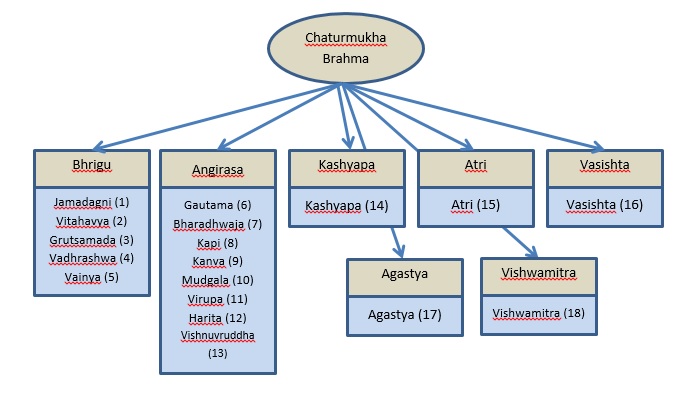
>From these seven Rishis, there arose 18 chief groups – gaNas – to which all
the Gotra causing Rishis belonged. In other words, every Rishi who has
propagated a Gotra belongs to one of these 18 gaNas.

The classification of the 7 Brahmarshi families into 18 gaNas is as follows.

   - Rishi Bhrigu heads five gaNas.


   - The Rishis who are the head of these five gaNas are Jamadagni,
   Vitahavya, Grutsamada, Vadhrashwa and Vainya


   - Rishi Angirasa accounts for eight gaNas.


   - The Rishis who are the head of these eight gaNas are Gautama,
   Bharadhwaja, Kapi, Kanva, Mudgala, Virupa, Harita, Vishnuvruddha


   - The other 5 Brahmarshis – Kashyapa, Atri, Vasishta, Agastya and
   Vishwamitra – head one gaNa each.

Thus the 18 Rishi gaNas are *Jamadagni, Vitahavya, Grutsamada, Vadhrashwa,
Vainya, Gautama, Bharadhwaja, Kapi, Kanva, Mudgala, Virupa, Harita,
Vishnuvruddha, Kashyapa, Atri, Vasishta, Agastya and Vishwamitra*.

*Brahmarshis and the Gotra Ganas*

[image: Gotra Pravara]
<https://indiafacts.org/wp-content/uploads/2018/07/Gotra-Pravara.jpg>

Ganas and Gotra Rishis

Each of the 18 gaNas listed above have under them a number of ‘Gotra
Rishis’. Thus, from 18, we get many tens of Gotras, the descendants of whom
are amongst us even today. Further under each Gotra, numerous Rishis and
Rishi-kumaras were born. Based on the tradition in the particular Gotra, a
number of ‘Pravaras’ or sub-lineages became prevalent.

Thus, each gaNa has several Gotras, each of which further has one or more
Pravaras. The Pravaras are classified based on the number of Rishis who are
remembered in the lineage.

   - Ekarsheya – Pravara has the name of only one Rishi


   - Dvarsheya – names of two Rishis used


   - Tryarsheya – three Rishi names are used


   - Pancharsheya – five Rishis are remembered as part of the Pravara


   - Saptarsheya – seven Rishis comprise the Pravara

The documentation of all the Gotra names under each gaNa and the list of
all Pravaras under each of those Gotras will be a very exhaustive work,
beyond the scope of this post. However, in order to illustrate the richness
of the classification, the names of few Gotras under each gaNa and a few
Pravaras will be given below.

1.   *Bhrigu – Jamadagni Gana*

Some of the well-known Gotras under this gaNa are Jamadagni, Vatsa,
Chyavana, Mandavya, Mandukeya, Manduka, Vitashayana, Vairohitya, Valmiki,
Markandeya, Panini, Rishtishena, Arshtishena, Anupavi, Druda, Vata,
Prachinayogya and Baida.

Some of the Pravaras under this gaNa are

   - Bhargava (bhrigu) – Chyavana – Apnuvana – Ourva – Jamadagni.
   (pancha-rishi-Pravara)


   - Bhargava – Chyavana – Apnuvana – Arshtishena – Anupa.
   (pancha-rishi-Pravara)


   - Bhargava – Chyavana – Apnuvana – Ourva. (chatur-rishi-Pravara)


   - Bhargava – Chyavana – Apnuvana. (tri-rishi-Pravara)

2.           *Bhrigu – Vitahavya Gana*

The well-known Gotras under this gaNa are Vitahavya, Yaska, Vadhula, Mauna,
Maukasa, Sharkarakshi, Sharshti, Shalankayana, Daivantyayana, Jabala and
Savarni.

Some of the Pravaras under this gaNa are

   - Bhargava – Vaitahavya – Savetasa. (tri-rishi-Pravara)

* Bhrigu – Grutsamada Gana*

Grutsamada and Shaunaka are the well-known Gotras under this gaNa.

The Pravara common under this gaNa is

   - Bhargava – Grutsamada – Shaunaka (tri-rishi-Pravara)

4.           *Bhrigu – Vadhrashwa Gana*

Vadhrashwa and Mitrayu are the famous Gotras under this gaNa

The common Pravara belonging to this gaNa is

   - Bhargava – Daivodasa – Vadhrashwa (tri-rishi-Pravara)

5.           *Bhrigu – Vainya Gana*

Vainya and Partha are the most famous Gotra Rishis under this Gana.

The Pravara most often found under this gaNa is

   - Bhargava – Vainya – Partha

*The above are the gaNas coming under Brahmarshi Bhrigu.*

6.           *Angirasa – Gautama Gana*

The well-known Gotras under this gaNa are seven in number – Gautama,
Ayasya, Ouchathya, Kakshivanta, Oushija, Bruhaduktha and Vamadeva.

Some of the Pravaras under this gaNa are

   - Angirasa – Ayathya – Gautama (tri-rishi-Pravara)


   - Angirasa – Vamadevaya – Barhaduktha (tri-rishi-Pravara)


   - Angirasa – Outhathya – Kakshivanta – Gautama – Dairghatamasa
   (pancha-rishi-Pravara)

7.           *Angirasa – Bharadhwaja Gana*

The well-known Gotras under this Gana are Bharadhwaja, Kusha, Agniveshya,
Urja, Yama, Kata, Shaishira, Ksheerashrunga, Vandana, Bruhaspati,
Sarvastamba, Kapi, Matavachasa, Gargya and Shainaka.

The commonly occurring Pravaras under this gaNa are

   - Angirasa – Barhaspatya – Bharadhwaja (tri-rishi-Pravara)


   - Angirasa – Barhaspatya – Bharadhwaja – Katya – Aksheela
   (pancha-rishi-Pravara)


   - Angirasa – Barhaspatya – Bharadhwaja – Shainya – Gargya
   (pancha-rishi-Pravara)

8.           *Angirasa – Kapi Gana*

Tarasvanta, Shalaka, Bindu, Shalka, Patanjali, Bhuyasi, Danuki and
Jalandhara are the eight chief Gotras under this gaNa.

The main Pravara under this gaNa is

   - Angirasa – Mahiyuva – Rikshayyavasa (tri-rishi-Pravara)

9.           *Angirasa – Kanva Gana*

Ajamidha, Ghora and Kanva are the main Gotras under this gaNa.

In this gaNa, the main Pravaras are all consisting of a single rishi –
ekarsheya Pravaras. Angirasa, Ajamidha, Ghora and Kanva are thus the four
main ekarsheya Pravaras.

10.        *Angirasa – Mudgala Gana*

The five main Gotras under this gaNa are Mudgala, Trivedi, Takshya,
Bharmashyva and Moudgalya.

Each of the five Gotras have ekarsheya Pravaras. Hence the Pravaras are
also as the Gotra names above.

11.        *Angirasa – Virupa Gana*

The Rishis under this Gana are Virupa, Prushadashva, Paarshadashvi,
Rathithara, Aangushta and Ashtadamshtra.

The main Pravara under this gaNa is

   - Angirasa – Paarshadashva – Vairupa (tri-rishi-Pravara)

12.        *Angirasa – Harita Gana*

The ten main Gotras under this gaNa are Harita, Ambarisha, Mandhata,
Yuvanashva, Kautsa, Painga, Shankha, Dabhra, Hemagava and Kaumara.

The two main Pravaras under this gaNa are

   - Angirasa – Ambarisha – Harita (tri-rishi-Pravara)


   - Angirasa – Ambarisha – Yauvanashva (tri-rishi-Pravara)

13.        *Angirasa – Vishnuvruddha Gana*

Fourteen Rishis are well known as Gotra-pravartakas under this gaNa. They
are Vishnuvruddha, Shata, Mata, Mapana, Dabhrana, Jaalpa, Oupagavi,
Vidabhrana, Badarayana, Nitundi, Kratu, Satyaki and Taluki.

The main Pravaras under this gaNa are

   - Angirasa – Vishnuvruddha – Badarayana (tri-rishi-Pravara)


   - Angirasa – Paurukutsa – Trasadasya (tri-rishi-Pravara)

*Thus the above are the details corresponding to the gaNas coming under
Brahmarshi Angirasa*

14.        *Kashyapa Gana*

Brahmarshi Kashyapa has one gaNa under him. There are ten famous Rishis
under this gaNa. They are Kashyapa, Vatsara, Naidhruva, Sankruti,
Putimasha, Raibhya, Shandilya, Shandila, Devala and Asita.

The main Pravaras under this gaNa are

   - Kashyapa – Vatsara – Naidhruvi (tri-rishi-Pravara)


   - Kashyapa – Vatsara – Raibhya (tri-rishi-Pravara)


   - Kashyapa – Shandila – Devala (tri-rishi-Pravara)

15.        *Atri Gana*

The following are the Rishis belonging to the gaNa coming under Brahmarshi
Atri.

Atri, Prathama, Svasti, Krishna, Chandra, Pada, Aadima, Atreya, Vamarathya,
Gavishtira, Rasa, Paurvatithya, Tithi, Bahutaka, Dhananjaya, Sumangala,
Bijavapi and Saumangalya.

The well-known Pravaras under this gaNa are

   - Atreya – Archananasa – Shyavashva (tri-rishi-Pravara)


   - Atreya – Sumangala – Shyavashva (tri-rishi-Pravara)

16.        *Vasishta Gana*

Under Brahmarshi Vasistha, the Gotras are Vasishta, Vaasishta, Upamanyu,
Gauravita, Putimasha, Dvitiya Upamanyu, Aabharadvasu, Indrapramada,
Parashara, Paarasharya, Vyasa, Shakti, Kundina, Tandi, Sankruti,
Sankhyayana, Jatukarnya, Dvitiya Kaundinya and Maitravaruni.

Some of the Pravaras under this gaNa are

   - Vasishta (eka-rishi-Pravara)


   - Vaashishta – Shakti – Paarasharya (tri-rishi-Pravara)


   - Vaahishta – Maitravaruni – Kaundinya (tri-rishi-Pravara)

17.        *Agastya Gana*

The Gotras under Brahmarshi Agastya are Agastya, Aagastya, Daardyachyuta,
Idhmavaha, Somavaha, Saravaha, Yajnavaha, Himodaka and Panika.

The main Pravaras are

   - Aagastya – Daardachyuta – Idhmavaha (tri-rishi-Pravara)


   - Aagastya – Daardachyuta – Somavaha (tri-rishi-Pravara)


   - Aagastya – Painayaka – Panika (tri-rishi-Pravara)

18.        *Vishwamitra Gana*

Vishwamitra Gana has thirty nine main Rishis. They are Vishwamitra,
Devarata, Manu, Shraumata, Jaulaki, Valuki, Chakita, Ulooka, Yajnavalkya,
Narada, Bruhadagni, Kala, Babha, Shabali, Bahu, Rohina, Shalankayana,
Savarni, Kamakayana, Purana, Shalavata, Agnideva, Damana, Shaunaka,
Ashtaka, Aja, Madhucchandasa, Devashrava, Dhananjaya, Shunga, Kata,
Shaishira, Varidhapa, Aghamarshana, Sunu, Pana, Dhoomra, Jatara and
Ekahavyaka.

Some of the main Pravaras under this gaNa are

   - Vishwamitra – Devarata – Oudala (tri-rishi-Pravara)


   - Vishwamitra – Devarata – Daivashravasa (tri-rishi-Pravara)


   - Vishwamitra – Madhucchandasa – Dhananjaya (tri-rishi-Pravara)


   - Vishwamitra – Shalankayana – Kaushika (tri-rishi-Pravara)


   - Vishwamitra – Gathina – Vaishvamitra – Raukshaka – Raivana
   (pancha-rishi-Pravara)

*Thus are the details of all the 18 gaNas of Rishis who are the ancestors
of all our lineages.*

Gotras and Marriages

Even today, in Sanatana Dharma, the Gotras and Pravaras are an important
factor in deciding whether two families will proceed with a marriage
proposal. Sa-gotra (within the same Gotra) and especially sa-Pravara (same
gotra and also same Pravara) marriages are strictly avoided by traditional
families.

Another measure typically used in determining suitability, or otherwise, of
marriages is the concept of Sapinda relationship. If in the paternal side
of the bride and the paternal side of the groom, there exists any person
who performs “pinda daan” to a common ancestor within 7 generations, then
that relationship becomes a sapinda relationship, and is avoided for
marriage.

Markandeya Purana defines this sapinda relationship very succinctly.

पिता पितामहश्चैव तथैव प्रपितामहः |

पिण्डसंबन्धिनो ह्येते विज्ञेयाः पुरुषास्त्रयः ||

लेपसंबन्धिनश्चान्ये पितामहपितामहात् |

प्रभृत्युक्तास्त्रयस्तेषां यजमानस्तु सप्तमः ||

इत्येषः मुनिभिः प्रोक्तः संबन्धस्साप्तपूरुषः ||

“*Father, grandfather and great-grandfather are the three purushas known as
“pinda sambandhi”. The great-great-grandfather, his father and his
grandfather – these three are known as “pinda-lepa sambandhi”. Including
the person who has the right to give pinda, 7 generations thus get
accounted for. So have the great munis decided*”

Thus amongst the 7 generations thus described, if there is any common
pinda-pradaatru (pinda-giver) on either side, then the relationship will
end up becoming a sapinda relation.

Gotras for the unknown

Apart from the above detailed Rishis and Gotras thereof there are many
Gotras which have originated from many Kshatriyas. These are not covered in
this post. One may get to know the same from family sources.

For those who do not know their Gotras, either because the family lost
knowledge of the same, or if a person became an orphan in childhood – the
Gotra and Pravara of the family purohita becomes their Gotra.

आचार्यगोत्रप्रवरानभिज्ञस्तु द्विजः स्वयम् |

दत्त्वात्मानं तु कस्मैचित्तद्गोत्रप्रवरो भवेत् ||

Another solution given in the shastras is to accept the Kashyapa Gotra
since the Shrutis declare Kashyapa as the forefather of all humanity.

गोत्रस्यत्वपरिज्ञाने काश्यपं गोत्रमुच्यते |

यस्मादाह श्रुतिः सर्वाः प्रजाः कश्यपसंभवाः ||

References

   - Smruti muktavali – Shodasha Karma Prakarana – By Sri Krishnacharya,
   Shishya of Sri Raghavendra Swamiji


   - Matsya Purana.


   - Markandeya Purana.


   - Valmiki Ramayana.


   - “Rishigalu” – A book in Kannada by Sri Be. Na. Vijayeendracharya,
   published by Sri Harivayu Prakashana, First edition, 2014
   -
   ------------------------------------------------------------------------
   - https://youtu.be/uvk0EBlrfbw    Gotra 20 minutes k Suresh
   - https://youtu.be/ZUVB7Ipl92Q  hindi
   - ---------------------------------------------------------------------

K RAJARAM IRS PART 4  4524//5524

--
You received this message because you are subscribed to the Google Groups
"Thatha_Patty" group.
To unsubscribe from this group and stop receiving emails from it, send an email
to [email protected].
To view this discussion on the web visit
https://groups.google.com/d/msgid/thatha_patty/CAL5XZorMdBF3s3ECZ8g-YAZKBDnpGcuaaVqreCufLphMJ6QDAA%40mail.gmail.com.