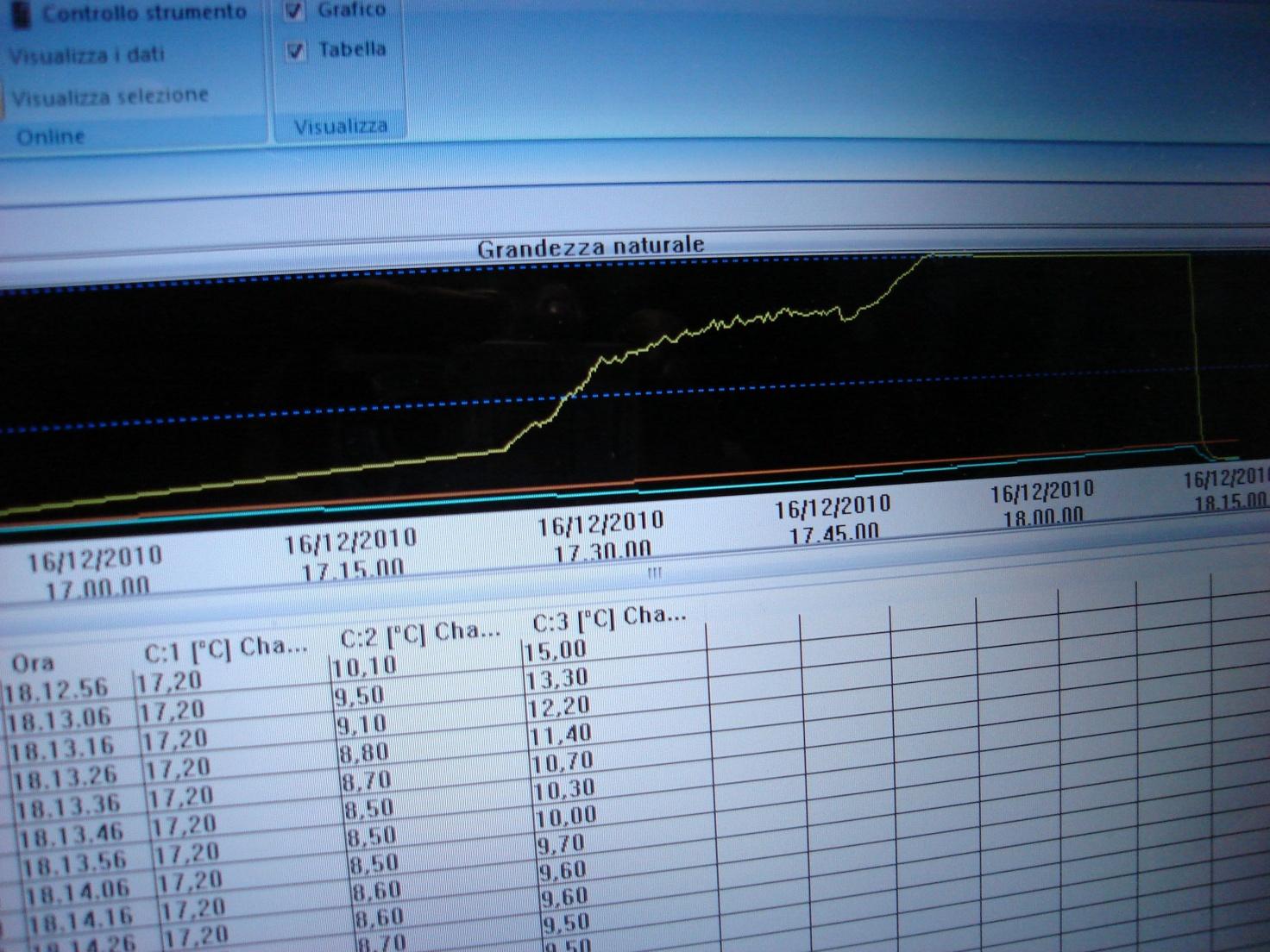
Actually I took still another look for the graph:

http://2.bp.blogspot.com/_852Sj2_TNC4/TTwDi8cYrtI/AAAAAAAAE1E/TT603dSfpzs/s1600/report3.jpg
It is really difficult to try to estimate temperatures from this graph.

However it looks that my estimations were somewhat inaccurate. But it
looks that ΔT was 1.5 times higher during the last 6 minutes before
boiling than the first 30 minutes, when only 1.2 kW heating element
was active. Therefore likely output power was 9kW.

Therefore I estimate with 90% confidence that the heating power of
December E-Cat was between 6kW and 9 kW. And heat after death was
2-8kW, but this is really difficult to estimate, but it was rather
constant. My hunch is that power drop was only 1.2 kW, when E-Cat was
disconnected from external power source.

–Jouni

2011/8/31 Jouni Valkonen <[email protected]>:
> Small addition, this 6kW figure is minimum possible heating power. We
> have also empirical way for calculating total enthalphy, that gives
> higher value than 6 kW. If it is assumed that E-Cat was full of water
> when 1.2kW heating element was turned on, then 1.2kW was enough to
> cause ΔT to be 20°C in 30 minutes. This means that during the 6min
> power surge heating power was 10 × 1.2kW = 12kW.
>
> If it is assumed that E-Cat was not full of water when power was
> turned on, then heating power during the power surge was even more
> than 12kW. However I think this unlikely, because steam overperssure
> was only 100 kPa and this is difficult to explain even for 12 kW
> heating power. 100kPa overpressure should be more close for 6-9 kW
> heating power.
>
> –Jouni
>
>
> 2011/8/31 Jouni Valkonen <[email protected]>:
>> 2011/8/30 Jed Rothwell <[email protected]>:
>>> Jouni Valkonen wrote:
>>>
>>>> Ps. I do not know what model of E-Cat we are talking about. Does we have
>>>> pictures? Or is it just some mythical test what was seen by nobody.
>>>>
>>>
>>> The 15 minute heat-after-death event was with the large eCat used in the
>>> January and February tests. This produces 12 kW to 16 kW output (depending
>>> on how you measure it) with about 400 W input. As far as I know, this is the
>>> only eCat that Levi et al. tested in December, which is when the event
>>> occurred. The flow rate was typically ~300 ml/min I believe.
>>>
>>
>> Ah, now I know exactly what is going on.
>>
>> Here is the premilinary report (Test1):
>> http://22passi.blogspot.com/2011/01/report-ufficiale-esperimento-della.html?m=1
>>
>> Ok, I am amazed how far from reality Joe was, because it was
>> impossible try to make proper conclusions in what test he was
>> referring.
>>
>> But anyways, it is now very clear.
>>
>> –Input power was turned on 16.55 and it was around 1200 Watts.
>> –This caused slight temperature rise during first 30 minutes.(ΔT 20°C)
>> –After that reaction partially ignited and temperature rose to 60°C.
>> This took about 20 minutes
>> –Then full ignition happened 17.50. Temperature rose quickly to
>> 101.6°C and steam overpressure was ca. 100 kPa.
>> –Then the power was cut 10 minutes later and reactor still continued
>> producing steam for 15 minutes
>> –Finally reactor was shut down 17.15 by increasing water flow
>>
>> We do not have good data what was the momentary output power during
>> the 10minute powersurge. Also, in order to make any calculations, we
>> should have some information how much E-Cat can store liquid water
>> inside.
>>
>> However, as the temperature stayed over 100, it means that there was
>> some steam production. We do not know exactly how much, because there
>> was visible temperature drop after power was cut and this means that
>> steam overpressure decreased somewhat from that 100kPa, in the
>> self-sustaining mode. Therefore total heating power in self-sustaining
>> mode was at least 3 kW, probably more. But what is important is that
>> there was not visible decreasing of heating power during the 15 min
>> self-sustaining mode and it was artificially cancelled by shutting
>> down the reactor. Therefore it is fair to assume, that it would have
>> continued indefinitely without shutting down the self-sustaining mode.
>>
>> Also as we know that the volume of reactor chamber was ca. 1 liter,
>> therefore the maximum metal mass for storing thermal energy was
>> probably 5 kg. Same logic applies here that only the reactor chamber
>> can store residual heat energy.Therefore rest of the E-Cat can be
>> ignored, because it does not exceed significantly 100°C.
>>
>> Also some estimations about what was the total heating power during
>> the 10min powersurge. We know that in that time, inside E-Cat, there
>> was at least 10 kg of water. Therefore total heating power during 6min
>> power surge was 4.6kW (water stored inside the E-Cat) + 1.5kW (cool
>> water flux) + 1.0kW (metal components of E-Cat) = _6kW_, in order to
>> rise ΔT by 40°C in 6min.
>>
>> This is also the most likely excess heating power of December E-Cat,
>> i.e. 4.7kW excess heat was produced for 25 minutes.
>>
>> In summary, water flow was 14 kg/h, core mass was 5kg, heating power
>> in self-sustaining mode was 3-5kW (but it was constant). Max core
>> temperature 1000°C.
>>
>> –Jouni
>>
>