> On 16 Apr 2016, at 12:36, Radu-Adrian FEURDEAN
> <[email protected]> wrote:
>
> On Fri, Apr 15, 2016, at 16:09, Tim Chown wrote:
>
>> As others have said, everyone wants to grow. If you’re starting a new
>> venture v6 should be at the heart of what you’re doing.
>
> This is a good way not to start a business, and if you still do it, not
> to have many customers.
> No matter how much you have IPv6 at heart, as of 16/04/2016 on most
> markets "no IPv4" = "no business". For some customers, they won't use
> IPv6 even if you bring it at their doorstep. Been there, done that,
> still doing that.
I mean design in IPv6 from the outset, not necessarily to try to run IPv6-only.

But there are examples of IPv6-only deployments, and in the UK there is now at
least one provider selling VPS services as IPv6 by default, charging extra for
IPv4, and finding many customers just take the IPv6-only service. Rare, yes,
but it’s happening.

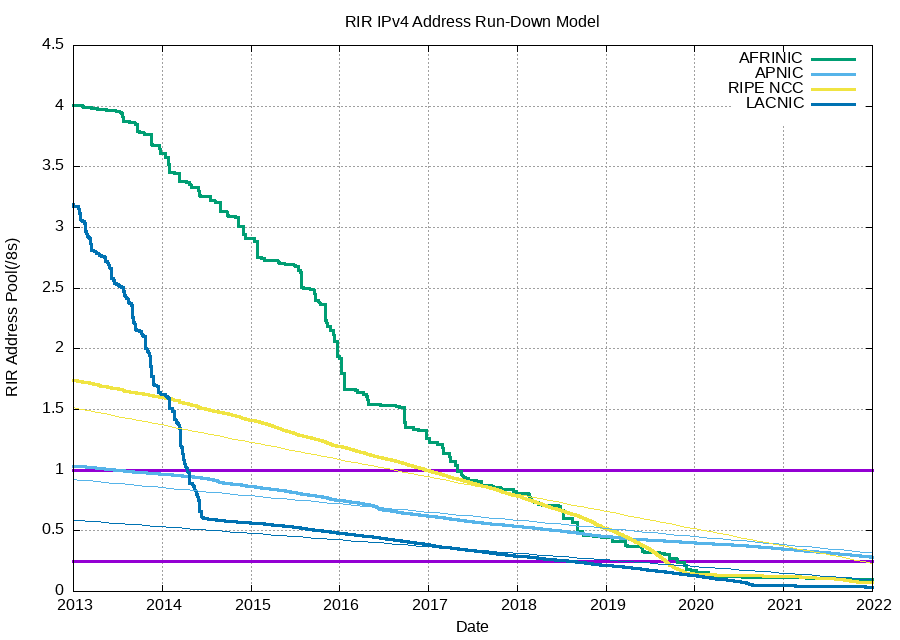
The point is, as the RIPE NCC have been saying for 5 years now, that we *are*
out of IPv4, except for /22’s which are intended give a new LIR enough address
space to host public facing services along with a certain level of
customer-base with NAT/CGN. The existing policy gives some level of guarantee
of /22’s being available for a certain period of time.  As for how much time
that is, Geoff Huston’s projection at
http://www.potaroo.net/tools/ipv4/plotend.png is quite widely cited, and
indicates 6 more years at current burn rate (i.e. complete run-out around
2022).

I would probably support Randy’s /24 proposal, if it were framed around a
certain trigger point, i.e. the remaining pool hitting a certain level, maybe a
/10’s worth left, such that /24’s were available further out. It will be
interest though to see where the market rate for v4 addresses is by then,
especially if IPv6 has a much more significant share of the overall traffic.

Tim