I use a simple thought process to decide where my neighbor statement should
go. The neighbor command actually sets up the BGP TCP session. So, on the
given router, if the peer is reachable via global routing table, then
neighbor statement goes under global bgp process. If the peer is reachable
in a VRF, then apply the statement under the VRF.
Now, for specific capabilities you want to enable for the peer, activate
the peer for those address families( ipv4, ipv6, vpnv4, vpnv6, mdt.....).

Tony,
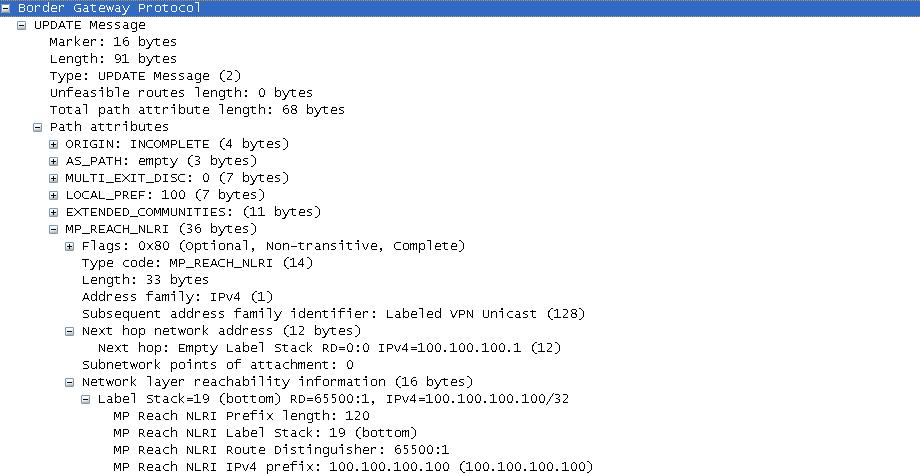
Yes. this is a capture of vpnv4 speakers exchanging label for
100.100.100.100  as 19 - in control plane.

Regards,
Karthik


On Thu, Mar 28, 2013 at 8:14 PM, Tony Singh <[email protected]> wrote:

> Bob nicely put...
>
> The important thing to distinguish as this is a real confusing topic
> for me is knowing the difference between the control-plane vs
> data-plane
>
> the control-plane is where the vpnv4 speakers will exchange the NLRI
> which would include the RD and the RT as an extended community but the
> data-plane cannot use this information when making a packet forwarding
> decision therefore the vpnv4 speakers add the vpn label for a customer
> prefix (called the inner label) to uniquely identify the customer
> prefix for delivery.....this is a separate process from the (outer
> label) mpls transport label to get to PE in the first place (ldp/tdp
> ospf/is-is derived)
>
> here is a good visual for control-plane NLRI that vpnv4 speakers would
> pass to each other, I also note here that label 19 is showing can
> someone confirm that vpnv4 speakers also pass the inner label to each
> other via NLRI control-plane?
>
>
> http://4.bp.blogspot.com/_n3Sbk_2ZV-g/TCTtlR2wekI/AAAAAAAAAcY/P_W77wIYxGA/s1600/2.JPG
>
>
> BR
>
> Tony
>
>
> On 28 March 2013 13:59, Bob McCouch <[email protected]> wrote:
> > Are you saying that using the following as an example:
> >
> > router bgp 1
> >  bgp router-id 1.1.1.1
> >  no bgp default ipv4-unicast
> >  neighbor 1.1.1.2 remote-as 100
> >  !
> >  address-family ipv4
> >  exit-address-family
> >  !
> >  address-family vpnv4
> >   neighbor 1.1.1.2 activate
> >   neighbor 1.1.1.2 send-community extended
> >  exit-address-family
> >  !
> >  address-family ipv4 vrf BLUE
> >   neighbor 2.2.2.2 remote-as 200
> >   neighbor 2.2.2.2 activate
> >  exit-address-family
> >
> > You configured your neighbor like 2.2.2.2 and the solution you were
> looking
> > at had the neighbor configured like 1.1.1.2?
> >
> > The first question is: Did your solution work? If I understand what you
> did
> > right, I'd imagine it did not work.
> >
> > The neighbor 1.1.1.2 in my example that is configured under the routing
> > process and activated under the VPNv4 address family would be for another
> > MPLS PE peer that you're exchanging VPN labels with (another PE router
> > elsewhere in the MPLS network). That peering would not exchange 32-bit
> IPv4
> > prefixes, but 96-bit VPNv4 prefixes that include the RD for uniqueness,
> > along with extended community values to indicate the label used for that
> > VPN path.
> >
> > The example neighbor 2.2.2.2 in the example above would be the CE peer.
> > This neighbor is configured *only* under the IPv4 VRF address family (not
> > at the routing process level) and is how the PE builds a BGP peering with
> > the CE router *within* the VRF. The peer router in this case would be
> > running "normal" BGP and totally unaware of the MPLS label exchange going
> > on behind the scenes.
> >
> > The VPNv4 address family is a special case for BGP and it's what makes
> MPLS
> > L3VPN work. The IPv4 VRF address family configuration under BGP is pretty
> > much the same as any other PE-CE routing protocol configuration like if
> you
> > did an address family under RIP or EIGRP to use those as the PE-CE
> protocol.
> >
> > Does that help?
> >
> > Bob
> > CCIE #38296
> >
> >
> > On Mon, Mar 25, 2013 at 8:15 AM, Houssam Chahine
> > <[email protected]>wrote:
> >
> >> Greetings,
> >>
> >> I have a small question about address family.
> >>
> >> In Lab 3 Vol2, the peering is configured under the router process and
> >> activated under vpnv4 address family.
> >>
> >> What i did was configuring the peering under the ipv4 vrf address
> family.
> >>
> >> I would like to know what is the difference between configuring the
> >> neighbor statement under the router process and under the address
> family.
> >> Furthermore is what i did correct or wrong.
> >>
> >> Thank you all in advance.
> >> _______________________________________________
> >> For more information regarding industry leading CCIE Lab training,
> please
> >> visit www.ipexpert.com
> >>
> >> Are you a CCNP or CCIE and looking for a job? Check out
> >> www.PlatinumPlacement.com
> >>
> >> http://onlinestudylist.com/mailman/listinfo/ccie_rs
> >>
> > _______________________________________________
> > For more information regarding industry leading CCIE Lab training,
> please visit www.ipexpert.com
> >
> > Are you a CCNP or CCIE and looking for a job? Check out
> www.PlatinumPlacement.com
> >
> > http://onlinestudylist.com/mailman/listinfo/ccie_rs
> _______________________________________________
> For more information regarding industry leading CCIE Lab training, please
> visit www.ipexpert.com
>
> Are you a CCNP or CCIE and looking for a job? Check out
> www.PlatinumPlacement.com
>
> http://onlinestudylist.com/mailman/listinfo/ccie_rs
>


--
http://about.me/karthik_sagar
_______________________________________________
For more information regarding industry leading CCIE Lab training, please visit
www.ipexpert.com

Are you a CCNP or CCIE and looking for a job? Check out
www.PlatinumPlacement.com

http://onlinestudylist.com/mailman/listinfo/ccie_rs