On Mon, 2008-12-22 at 13:53 -0700, John Denker wrote:
> On 12/21/2008 09:59 AM, Ron Jensen wrote:
>
>
> > .... Given the data available in the configuration
> > file, how do we create values for K and a for all engines from the
> > smallest engines, like the Rotax582 in the Dragonfly to the Wasp R-5800s
> > in the DC6?
>
> This is newly discussed at
>   http://www.av8n.com/fly/engine.htm
>
> I added a passage that says:
>      The area a and the factor K enter only via the combination K a,
>      so we don’t need to know a if we are willing to adjust K. In
>      practice, we adjust K a to get a plausible MAP under known
>      conditions. Real World data indicates that a ΔP of 1.5 inHg is
>      reasonable, corresponding to a MAP of 28.4 inHg (at sea level,
>      full throttle, max revs).
>
> Currently FGPiston uses several parameters, including rated power,
> rated revs, BSFC ... and it has been proposed to add a hard-to-guess
> Gagg-Farrar loss parameter "C".  IMHO adding this easy-to-determine
> K (and thereby making "C" unnecessary) does not seem like an extravagant
> increase in complexity.
I'm not against adding parameters to the configuration, however:
- we need a way to estimate reasonable defaults for unspecified values.
- the parameter should be generally available or calculable for most
  engines.

I realize the Gagg-Farrar constant I suggested doesn't meet these
requirements.

I'd really like to add the Bore, stroke, compression ratio and change
the power equations over to something based on mean effective pressures
and the otto cycle calculations, like
http://mit.edu/16.unified/www/FALL/thermodynamics/notes/node26.html
and calculate BMEP = IMEP - MMEP - PMEP - CMEP -AMEP

http://books.google.com/books?id=E_Tne3AKZVoC&pg=PA313&lpg=PA313

I'm not sure if this level of complexity should spawn a spin-off into a
separate engine model or not (FGAdvancedPiston?)


=====
Looking at equation (2.3) for throttle area in:
http://minds.wisconsin.edu/bitstream/handle/1793/7592/arias05.pdf?sequence=1

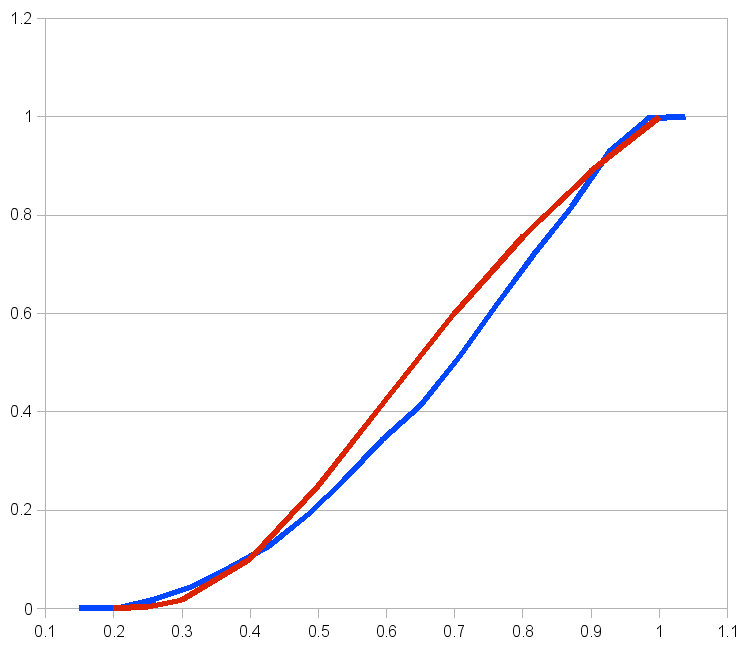
I derived a curve matching formula
  throttle_area = pow(ThrottleAngle, 1/ThrottleAngle)

The results are here:
http://www.jentronics.com/fgfs/temp/FGPiston/throttlechart.png

Blue line is from fig 2.2 in the referenced paper, red line is my
equation.  Reasonable fit without 9 calls to cos(), two calls to asin()
and two square roots.


I couldn't get John's formula for manifold pressure to work for me
http://www.av8n.com/fly/engine.htm#eq-map-udot My lack of higher maths
I'm sure, but I fell back to curve fitting again:

    map_coefficient = pow ((throttle_area *
MaxManifoldPressure_Percent),RPM/MaxRPM);
    MAP = p_amb * map_coefficient;

Where MaxManifoldPresure_Percent is the configured maxmp divided by
standard pressure.  In the case of John's number above it would be
  28.4 inHg / 29.92 inHg = 0.95


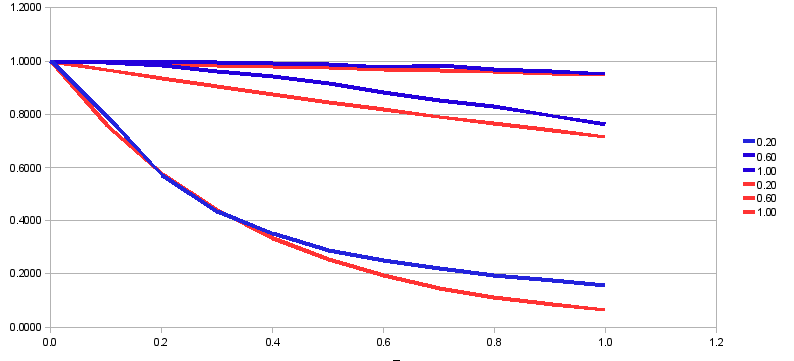
I got a better fit, and better performance by changing the throttle area
calculation to
  throttle_area = pow(ThrottleAngle, 0.33333/ThrottleAngle)

The results are here:
http://www.jentronics.com/fgfs/temp/FGPiston/mapchart.png

I'll have a patch to change the map calculations in a day or two.


> =========
>
> Perhaps I'll be ridiculed again for saying so, but I still think
> the shaft power is an increasing function of revs, throughout the
> revs band (*) right up to redline and presumably beyond.

For some engines, sure. For others not.  The code needs to be able to
handle both conditions, this model isn't just for lycoming 320 engines.
Its supposed to handle boosted engines, too, although currently the
supercharger model is rather naive. We also need to consider engines
with much higher RPMs and geared propellers.

> Perhaps
> I should mention that Lycoming thinks so too.  I finally got some
> Lycoming factory data:
>   http://www.av8n.com/fly/engine.htm#fig-o320-power
> and overlaid it on the model:
>   http://www.av8n.com/fly/engine.htm#fig-x2x-5
>
> Y'all can judge the goodness-of-fit for yourselves.
>
> I don't think the current FGPiston model would do a very good job
> of fitting this RW data.

I'll have to test it and see where its at :).  I know currently with the
modified Garr-Farrar parameter it matches the Rotax 912 power curve
nicely for all data points in the DA20-A1 POH upto 10,000 ft.  It begins
to fall off a bit too much above that.

Thanks,

Ron

>
> (*) Note I am still talking about a Real World Lycoming O-320
> under standard sea-level full-throttle conditions.


------------------------------------------------------------------------------
_______________________________________________
Flightgear-devel mailing list
[email protected]
https://lists.sourceforge.net/lists/listinfo/flightgear-devel