The Consequences of American Retreat from the Middle East
*by Efraim InbarBESA Center Perspectives
<http://besacenter.org/perspectives-papers/consequences-of-american-retreat-from-the-middle-east/>February
24, 2016*

*http://www.meforum.org/5870/american-retreat-from-the-middle-east
<http://www.meforum.org/5870/american-retreat-from-the-middle-east>*


[image: Description: http://www.meforum.org/pics/large/2401.jpg]

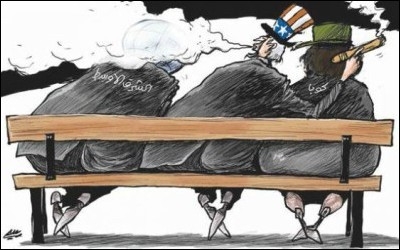
*A cartoon in Al-Sharq al-Awsat depicts President Obama befriending Cuba
while blowing smoke in the Middle East (whatever that means).*

The US, under President Barack Obama, has signaled its intent to reduce its
presence in the Middle East. The US fought two unsuccessful wars in the
region – a frustrating lesson about the limits of its power. At the same
time, US dependency upon Middle Eastern energy has been reduced thanks to
domestic progress in fracking technology. Moreover, Washington has decided
to "pivot" to China, an emerging global challenger, and also to cut defense
expenditures, leaving fewer military assets available for projecting power
in the Middle East. (For a while during President Obama's tenure, the US
had no aircraft carriers in the eastern Mediterranean or in the Gulf at
all, an unprecedented situation.) In addition, the American campaign
against ISIS has been extremely limited, and has met with little success.

Unfortunately, this disengagement signals both fatigue and weakness.

*American retreat from the Middle East signals both fatigue and weakness.*

Washington also has desisted from confronting Iran and has gone to great
lengths to accommodate it. President Obama's contention is that by
completing a nuclear deal with Iran, he resolved one of the outstanding
security issues in the region before leaving office. However the deal
legitimizes a large nuclear infrastructure in Iran, and ignores the
cardinal national security interests of at least two US allies: Israel and
Saudi Arabia. The subsequent removal of international economic sanctions –
with no reciprocal requirement for any change in Iranian regional policy –
positions Iran to reap great financial benefits at no cost. President
Obama's Iran policy has occasioned a dramatic change in the regional
balance of power, yet Washington appears largely unperturbed.

Whereas US policy on Iran has been guided primarily by wishful thinking,
the apprehensions of regional actors with regard to Iran's hegemonic
ambitions have multiplied in response to the nuclear deal. While Washington
claims to be confident that Iran will play "a responsible regional role,"
leaders in Ankara, Cairo, Jerusalem, and Riyadh see Iran as almost entirely
unaltered from its pre-deal state in any meaningful political sense, with
the potential to produce nuclear bombs in a short time.

The gravest consequence of the US policy of disengagement from the region
is the increased probability of nuclear proliferation. Powers contending
for regional leadership, such as Egypt, Turkey, and Saudi Arabia will not
stand idly by in the nuclear arena, particularly as the US is no longer
seen as a reliable security provider. US attempts to convince regional
powers to rely on an American nuclear umbrella in an attempt to prevent
nuclear proliferation are likely to fail. The emergence of a multi-polar
nuclear Middle East, which is a plausible consequence of the American
nuclear accommodation with Iran, will be a strategic nightmare for everyone.

*The gravest consequence of US disengagement is the increased likelihood of
regional nuclear proliferation.*

An emboldened Iran, which traditionally acts through proxies rather than
through military conquest, might intensify its campaign to subvert Saudi
Arabia, possibly by playing the Shiite card in the Shiite-majority and
oil-rich Eastern province. The loss of that province would considerably
weaken the Saudi state and might even bring about its disintegration.

Iran could use subversion, terrorist attacks, and intimidation of the Gulf
states to evict the thinning American presence completely from the Gulf. In
the absence of American determination and ability to project force, Iranian
superior power might "Finlandize" the Gulf countries. We could also see
also the Finlandization of the Caspian basin, where Iran shares the coast
with important energy producers like Azerbaijan and Turkmenistan. The
Caspian basin and the Persian Gulf form an "energy ellipse" that contains a
large part of the world's energy resources.

Azerbaijan and Turkmenistan are very fearful of growing Iranian influence.
Those countries, which adopted a pro-Western foreign policy orientation
after the dissolution of the Soviet Union, might decide to return to the
Russian orbit, because Russia appears at present to be a more reliable ally
than the US.

Russia is fully alive to the potential for a reassertion of a Russian role
in the region in the wake of American retreat. To that end, it has taken
the major step of intervening militarily in Syria to assure the survival of
Assad's regime. The Syrian littoral is a vital base for enhanced Russian
naval presence in the eastern Mediterranean, and this preceded Russian air
participation in the Syrian civil war. In addition, Russia wants to protect
energy prospects that depend on Assad's survival. It already has signed
exploration contracts with the Assad regime with regard to the recent gas
discoveries in the Levant basin.

Syria has been an ally of Iran since 1979 – the longest alliance in the
Middle East. The preservation of the Assad regime is critical to Iranian
interests because Damascus is a linchpin to its proxy, the Hezbollah in
Lebanon. Russia's efforts on Assad's behalf thus directly serve the
interests of the Iranian regime. If successful, those efforts will further
Iranian influence in the region.

*With American credibility waning, traditional U.S. allies are beginning to
hedge their bets.*

Outside Syria, we may see Iran join Russia in supporting Kurdish political
ambitions in order to weaken Turkey, Iran's rival for regional leadership.
The Kurds are a thorn in Turkey's side. Iran and Turkey are supporting
opposing sides in the civil war in Syria, where the Kurds are carving out
autonomous regions. Depending on how the war transpires, Kurdish national
dreams might benefit from the power vacuum created by the disruption of the
Arab statist structure and the American exit from the region.

As to Egypt, American reluctance to support the al-Sisi regime plays into
Russian hands. The Russians are selling weapons to Egypt, negotiating port
rights in Alexandria, and supplying Egypt with nuclear reactors. In Iraq
too, we see the harbingers of a Russian presence in coordination with Iran,
as American influence in that state continues to wane.

The rise of a more aggressive Iran – a direct consequence of the US retreat
– may bring about greater tacit cooperation among Egypt, Jordan, Saudi
Arabia and Israel. The big question is whether Turkey will join such an
anti-Iranian alignment.

US weakness in the region inevitably will have ripple effects in other
parts of the globe. American credibility is now subject to question, and
allies elsewhere may determine that it would be wise to hedge their bets.
Greater challenges await the US beyond the Middle East


__._,_.___
------------------------------
Posted by: "Beowulf" <[email protected]>
------------------------------


Visit Your Group
<https://groups.yahoo.com/neo/groups/grendelreport/info;_ylc=X3oDMTJmdmx0OGtjBF9TAzk3MzU5NzE0BGdycElkAzIwMTk0ODA2BGdycHNwSWQDMTcwNTMyMzY2NwRzZWMDdnRsBHNsawN2Z2hwBHN0aW1lAzE0NTY0NDI1NzU->


[image: Yahoo! Groups]
<https://groups.yahoo.com/neo;_ylc=X3oDMTJlaXNkcmNpBF9TAzk3NDc2NTkwBGdycElkAzIwMTk0ODA2BGdycHNwSWQDMTcwNTMyMzY2NwRzZWMDZnRyBHNsawNnZnAEc3RpbWUDMTQ1NjQ0MjU3NQ-->
• Privacy <https://info.yahoo.com/privacy/us/yahoo/groups/details.html> •
Unsubscribe <[email protected]?subject=Unsubscribe>
• Terms of Use <https://info.yahoo.com/legal/us/yahoo/utos/terms/>

__,_._,___

--
--
Thanks for being part of "PoliticalForum" at Google Groups.
For options & help see http://groups.google.com/group/PoliticalForum

* Visit our other community at http://www.PoliticalForum.com/
* It's active and moderated. Register and vote in our polls.
* Read the latest breaking news, and more.

---
You received this message because you are subscribed to the Google Groups
"PoliticalForum" group.
To unsubscribe from this group and stop receiving emails from it, send an email
to [email protected].
For more options, visit https://groups.google.com/d/optout.