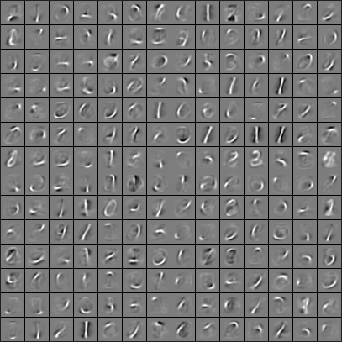
Actually I couldn't find the code but I found something better, the assignment
notes:
https://github.com/SaveTheRbtz/ml-class/blob/master/ex4.pdf

If you ran more iterations it would only get better. Looking back this was a
very good class.

Vlad
On Apr 6, 2012, at 06:54 , Vlad Niculae wrote:

>
> On Apr 6, 2012, at 02:56 , Andreas Mueller wrote:
>
>> On 04/05/2012 11:17 PM, Vlad Niculae wrote:
>>> I would like to see a reproduction of the standard neural net digits
>>> example:
>>>
>>> http://ufldl.stanford.edu/wiki/images/8/84/SelfTaughtFeatures.png
>>>
>> That looks like the weights of an autoencoder, right?
>> Autoencoders are not part of the plan as far as I was concerned.
>> I don't think filters in an MLP will look like this "magically" unless you
>> tune your regularization quite carefully.
>
> I remember doing the online machine learning class last year and just by
> training a neural net with one hidden layer for digit classification and
> visualizing the hidden layer, you would get something very similar to that, I
> was quite surprised. I'm curious now, I'll look for that code.
>
>>
>> ------------------------------------------------------------------------------
>> For Developers, A Lot Can Happen In A Second.
>> Boundary is the first to Know...and Tell You.
>> Monitor Your Applications in Ultra-Fine Resolution. Try it FREE!
>> http://p.sf.net/sfu/Boundary-d2dvs2
>> _______________________________________________
>> Scikit-learn-general mailing list
>> [email protected]
>> https://lists.sourceforge.net/lists/listinfo/scikit-learn-general
>


------------------------------------------------------------------------------
For Developers, A Lot Can Happen In A Second.
Boundary is the first to Know...and Tell You.
Monitor Your Applications in Ultra-Fine Resolution. Try it FREE!
http://p.sf.net/sfu/Boundary-d2dvs2
_______________________________________________
Scikit-learn-general mailing list
[email protected]
https://lists.sourceforge.net/lists/listinfo/scikit-learn-general