Hi Luigi,

I am not sure if I understand your question, but let me try to answer.
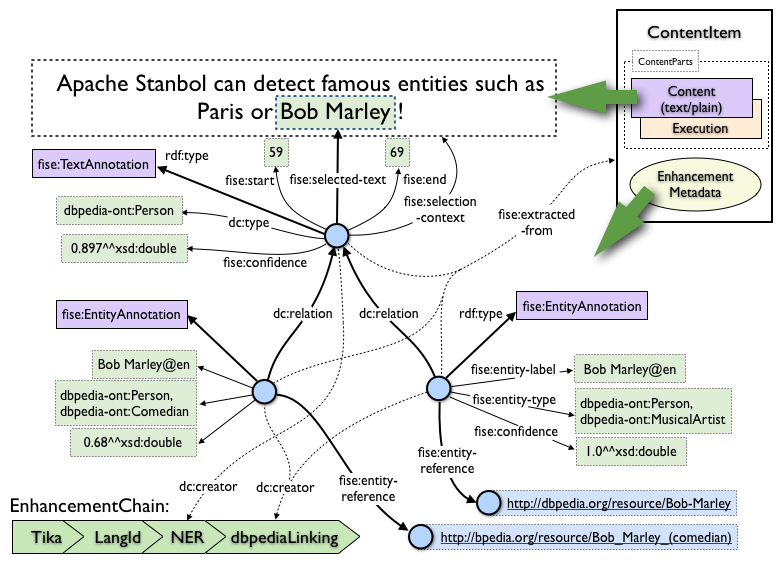
Please note [1] when reading through this mail.

fise:EntityAnnotation use the fise:entity-reference property to link
to the URI of the suggested Entity. If your question was about what
happens if there are several fise:EntityAnnotation's referring to the
same Entity (same value for the fise:entity-reference) than the answer
is - it depends on the EnhancementEngine (and the situation)

fise:EntityAnnotation may have multiple dc:relation properties
pointing to several fise:TextAnnotaions - in this case this means that
an Entity is suggested for several mentions within the analyzed
content.

However EnhancementEngines may also decide to create multiple
fise:EnityAnnotation instances all pointing to the same entity. This
is typically the case for disambiguation Engines (e.g. the
disambiguation-mlt engine) as those will want to note different
fise:confidence values for the different mentions linked with the same
Entity.

The Stanbol Enhancer does not add any relations between entities. If
you see relations "<entity1> <owl:sameAs> <entity2>" than it means
that (1) dereferencing of linked Entities is enabled and (2) those
triples where already present in the knowledge base where the Entity
do come from.

Hope this answers your question
best
Rupert

[1]
http://stanbol.apache.org/docs/trunk/components/enhancer/enhancementstructure.png


On Mon, Jun 10, 2013 at 7:36 PM, Luigi Selmi <[email protected]> wrote:
> Hi all,
>
> in the documentation is not clear which properties are attached to an
> enhancement created by a linking engine after two URIs have been found to
> represent the same entity. Which are the FISE properties used to state that
>
> <entity1> <owl:sameAs> <entity2>
>
> where <entity1> and <entity2> are referenced by <enhancement1> and
> <enhancement2> ?
>
> Following the way in which enhancements are created in Stanbol a linking
> engine should create a new enhancement, say <enhancement3> with its
> confidence value that should state in some value the fact above but I
> couldn't find any clear statement about this in the documentation. Anyone
> knows how a linking engine works for this ? Thanks in advance.
>
>
> Luigi


--
| Rupert Westenthaler             [email protected]
| Bodenlehenstraße 11                             ++43-699-11108907
| A-5500 Bischofshofen