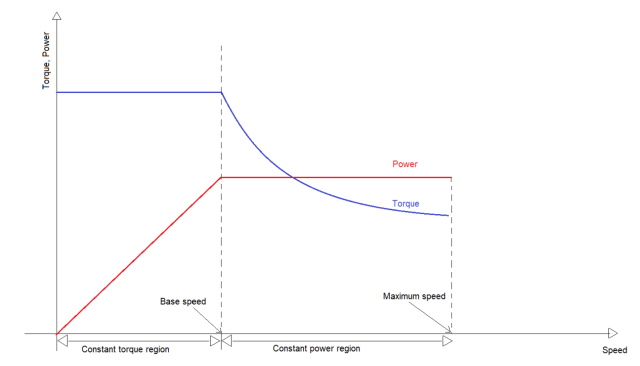
Sigh ...

" Perhaps you can find some and post those that do show flat torque up to a
'corner speed'?"  ... all ... every single one,  when connected to a
current limited driver.
On Sun, 6 Feb 2022 at 00:45, John Dammeyer <[email protected]> wrote:

> No.  The motors are designed to handle N amperes although they get quite
> warm that should be a 24/7 rating. Because they get so warm many drivers
> back the current off when the motors have been idle for a period of time.
>
> Let's take a step backwards with a long explanation.   When I first sized
> the motor for the knee mill I tested how much torque was required to
> overcome 'static' friction by attaching a bar and adding weight until it
> started turning.  The 'kinetic' friction is always less so as a rule of
> thumb using twice that experimentally determined torque value was a good
> starting point.
>
> But you can also use math if you know the weight of the table you are
> lifting.  I didn't but if I guess at 325 lbs with a 1" lead 4 TPI ACME
> leadscrew with Bronze nut
> https://daycounter.com/Calculators/Lead-Screw-Force-Torque-Calculator.phtml
> I get pretty close to the value I determined experimentally which is 600
> oz-in
>
> So choosing a 600 oz-in motor for roughly 600 oz-in torque determined
> experimentally looked like it would work.  Then looking at the torque curve
> I determined that to get that 600 oz-in torque at the desired speed would
> require a 3:1 reduction belt drive to get the 600 oz-in at target speed.
>  I used a Gecko Drive with a 60VDC power supply and a motor with 6.5A,
> 2.2mH rating.  The calculator here
> https://daycounter.com/Calculators/Stepper-Motor-Calculator.phtml
> shows max 10.5 RPS or 630 RPM and therefore with 3:1 reduction I'd be
> looking at 210 RPM into the lead screw drive.
>
> With a 4 TPI drive that means 52 ipm of table motion.  In reality the best
> I got was 15 ipm before the motor locked up.   Click on the torque curve
> and at 630RPM it's about 1.5NM which is 33% of the 4.5NM rating (640 oz-in).
>
> https://www.automationtechnologiesinc.com/products-page/nema-34/nema-34-640-oz-in-stepper-motor-kl34h280-45-8b-dual-shaft
>
> Long story short is that I updated to a 1200 oz-in motor and had reliable
> motion with a Gecko Drive and 60VDC at 25 ipm from LCNC or MACH3.  This
> moved the torque up but not really the top speed since now this motor has
> 6mH rather than 2.2mH with a 6A drive rating.  I might have been better to
> have changed the reduction belt drive to 2:1 or less.
>
> Back to that pesky power rating.  At 60V the motor calculator suggests
> it's drawing 380W.  Change the voltage to 120VDC and with the same current
> we get twice the RPM and twice the power 750W.  So then theoretically I
> should be able to get 50 ipm reliably if I had a driver that could handle
> 120VDC and if the motor winding insulation was rated for that voltage.
>
> Instead I ball-parked an AC Servo motor, 750W, 3000 RPM, 3.5NM (495 oz-in)
> and max 2000 RPM as the solution.  This drive runs off 220VAC and is rated
> at 3A with a peak torque of 10.5NM.  With 3:1 and that 495 oz-in torque
> value all the way up to 2000 RPM (667 shaft RPM or 167 ipm) I can
> comfortably run this motor at 150 ipm without it ever faulting.  That's 6x
> the stepper motor speed.
>
> What that suggests is what everyone already knows is that stepper torque
> falls off badly at higher RPM even with a higher voltage but they are
> really good at low speeds.  Change things to get more torque and if the
> inductance goes up the torque at low RPM is there but not at the high RPM.
> Unless your driver and motor can handle a correspondingly higher voltage.
>
> But look around and most drivers for steppers are in the 24V to 80V range
> so with steppers,  motor power in watts means nothing if you can't get the
> voltage up.   Now if you go 1:1 then 0.25"/200 results in a resolution of
> 0.00125".  Torque falls off to 50% with half stepping and micro-stepping
> results in a 70.7% reduction in max torque.  And Micro-stepping also can
> require as many as 4 steps before static torque is overcome and the motor
> shaft turning.  That's just due to the nature of the current waveform so
> for accuracy you must design for full step resolution.
>
> John
>
>
> > -----Original Message-----
> > From: Thaddeus Waldner [mailto:[email protected]]
> > Sent: February-05-22 12:40 PM
> > To: Enhanced Machine Controller (EMC)
> > Subject: Re: [Emc-users] What Would You Suggest?
> >
> > I believe the flat part of the curve is defined by the motor thermal
> limits. Is this correct?
> >
> > > On Feb 5, 2022, at 11:44 AM, John Dammeyer <[email protected]>
> wrote:
> > >
> > > ?All fine and good but doesn't help anyone choose a stepper motor.
> For example:
> > > https://www.geckodrive.com/support/step-motor-basics.html
> > > tries to explain corner speed but fakes the curves by showing that the
> torque of a stepper motor is constant up to a certain speed.
> > I've yet to see any curves of real motors that look like that.
> > >
> > > Perhaps you can find some and post those that do show flat torque up
> to a 'corner speed'?
> > >
> > > In either case that doesn't really help anyone choose a motor so that
> Gecko article and corner speed are effectively techo-babble
> > framed in a way to help them sell their drivers which are limited to
> 80VDC.
> > >
> > > Similarly the stepper motor suppliers provide 1/2 step curves leaving
> out the resonance point so unless you stay below this 'corner
> > frequency' and never reach that point the torque curves are somewhat
> obscure.
> > >
> > > Perhaps explain how _you_ choose a stepper motor for a given axis?
> What process do you go through to do this?  That might help
> > more.
> > >
> > > John
> > >
> > >
> > >
> > >> From: Robin Szemeti via Emc-users [mailto:
> [email protected]]
> > >>
> > >> "comment about corner frequency with stepper motors _might_ well be
> valid
> > >> as long as the maximum current for each step is reached before or at
> the
> > >> end of the ste"
> > >>
> > >> Yes, that is exactly what the corne frequency is ... the step
> frequency at
> > >> which the current no longer reaches the desired value before the end
> of the
> > >> step. It's obviously dependent on inductance and maximum available
> drive
> > >> voltage.
> > >>
> > >>> On Sat, 5 Feb 2022 at 11:50, Robin Szemeti <[email protected]>
> wrote:
> > >>>
> > >>> John,
> > >>>
> > >>> You are fundamentally incorrect when you state " the torque of the
> motor
> > >>> to drop off the faster it goes" .. although the back EMF is correct,
> with a
> > >>> modern current limited drive, the torque is flat until the corner
> > >>> frequency, then drops off  ... up to the corner frequency the torque
> is
> > >>> constant with a good current-limited drive, above the corner
> frequency the
> > >>> torque drops off, power is constant.  You are perhaps confusing the
> raw
> > >>> torque/speed curve of a motor fed from a constant voltage source,
> which is
> > >>> useful but is not how they are typically used in practice.
> > >>>
> > >>>
> > >>>
> https://res.cloudinary.com/engineering-com/image/upload/w_640,h_640,c_limit,q_auto,f_auto/image002_bezhrr.jpg
> > >>>
> > >>>> On Sat, 5 Feb 2022 at 09:00, John Dammeyer <[email protected]>
> wrote:
> > >>>
> > >>>> Hi Chris,
> > >>>> My issue is that a comment about corner frequency with stepper
> motors
> > >>>> _might_ well be valid as long as the maximum current for each step
> is
> > >>>> reached before or at the end of the step.  But the motor is turning
> pretty
> > >>>> slowly there compared to how they are used in real life.
> > >>>>
> > >>>> However the comment about corner frequency with respect to steppers
> > >>>> perhaps is only backed by alternative facts?
> > >>>>
> > >>>> I must admit I've not investigated in detail the closed loop
> steppers.
> > >>>> The price of an industrial version I worked with was more than the
> price of
> > >>>> an AC servo and at higher speeds I could stop the pulley with my
> fingers.
> > >>>> Yes. It faulted.  But that isn't really the point.  The DC and AC
> servos at
> > >>>> higher speeds just work better.
> > >>>>
> > >>>> Stepper motors work great at low speeds usually directly coupled.
> > >>>> Contrary to popular belief the micro-stepping doesn't improve
> resolution
> > >>>> but gets rid of resonance and gives the appearance of better
> resolution.
> > >>>> But it doesn't change the fact that the current still has to
> reverse every
> > >>>> full step.  I believe that in fact Gecko drives improve high speed
> torque
> > >>>> by switching back to full step mode above the resonance velocity.
> > >>>>
> > >>>> Now instead of 0.707 x max current in both windings (at the most)
> we're
> > >>>> back to 100% in both with an increase in torque.  Absolutely
> nothing to do
> > >>>> with corner frequencies whatever they might be or how they are
> determined.
> > >>>>
> > >>>> John
> > >>>>
> > >>>>
> > >>>>
> > >>>>
> > >>>>
> > >>>>> From: Chris Albertson [mailto:[email protected]]
> > >>>>>
> > >>>>> John,
> > >>>>>
> > >>>>> You described it correctly.  But I think what Robin meant by
> "Corner
> > >>>>> Frequency" might be the peak of the power vs. RPM graph.
> Basically, the
> > >>>>> frequency where power output starts to fall with RPM.
> > >>>>>
> > >>>>> But now it can get worse, or really better but more complex.   We
> have
> > >>>>> these so-called "closed loop stepper drivers and also a few people
> are
> > >>>>> running the steppers as if they were many-pole BLDC analog
> (continuous,
> > >>>>> non-stepping) mortors
> > >>>>>
> > >>>>> On Fri, Feb 4, 2022 at 2:39 PM John Dammeyer <
> [email protected]>
> > >>>> wrote:
> > >>>>>
> > >>>>>> I disagree.  The physics of the motor, which include inductance
> along
> > >>>> with
> > >>>>>> the generated back emf from the motor spinning in the magnetic
> field,
> > >>>> is
> > >>>>>> what cause the torque of the motor to drop off the faster it goes.
> > >>>>>>
> > >>>>>> The problem is to spin a stepper motor you have to not just
> change to
> > >>>> a
> > >>>>>> new winding like a DC motor does but completely reverse the
> direction
> > >>>> of
> > >>>>>> the current through the winding.  In order to do that you have to
> > >>>> deal with
> > >>>>>> the collapsing magnetic field and counter the resulting generated
> > >>>> voltage
> > >>>>>> which is based on the inductance of the windings.
> > >>>>>>
> > >>>>>> That's why the winding voltage of a stepper motor might be only
> 2V to
> > >>>> get
> > >>>>>> the rated 3A but you need 48V to make it turn quickly.  And
> because
> > >>>> of  the
> > >>>>>> inductance and collapsing field,  time is required to change the
> > >>>> direction
> > >>>>>> of the current through the winding.  If that time is longer than
> the
> > >>>> next
> > >>>>>> direction change then you never reach max current through the
> > >>>> windings and
> > >>>>>> you don't develop full torque.  That's why a stepper motor with a
> 24V
> > >>>> power
> > >>>>>> supply has the same holding torque as one with a 48V power supply.
> > >>>> The
> > >>>>>> current limiting of the drive holds the winding current at 3A.
> But
> > >>>> run it
> > >>>>>> at 24V or at 48V you get a totally different torque curve.
> > >>>>>>
> > >>>>>> If you are going to mention something called the corner frequency
> of a
> > >>>>>> stepper motor+drive please show us the graphs and
> specifications.  I
> > >>>>>> haven't been able to find that rating on any stepper motor.
> > >>>>>>
> > >>>>>> Perhaps you can point it for this one?
> > >>>>>> http://www.automationtechnologiesinc.com/download/9259/
> > >>>>>>
> > >>>>>> And explain how you determined that corner frequency?
> > >>>>>> John
> > >>>>>>
> > >>>>>>
> > >>>>>>
> > >>>>>>
> > >>>>>>
> > >>>>>>
> > >>>>>>
> > >>>>>>> -----Original Message-----
> > >>>>>>> From: Robin Szemeti via Emc-users [mailto:
> > >>>>>> [email protected]]
> > >>>>>>> Sent: February-04-22 2:01 PM
> > >>>>>>> To: Enhanced Machine Controller (EMC)
> > >>>>>>> Cc: Robin Szemeti
> > >>>>>>> Subject: Re: [Emc-users] What Would You Suggest?
> > >>>>>>>
> > >>>>>>> What people continually get totally wrong with steppers is
> failing
> > >>>> to
> > >>>>>>> understand that the maximum power is delivered at the corner
> > >>>> frequency,
> > >>>>>> and
> > >>>>>>> power output is constant above that.
> > >>>>>>>
> > >>>>>>> If you have an application that needs to move at say 2m a minute
> > >>>> and your
> > >>>>>>> stepper stalls, there seems to be some crazy logic that says to
> > >>>> people
> > >>>>>> "Oh,
> > >>>>>>> the stepper stalled because it was going too fast, I need to
> change
> > >>>> the
> > >>>>>>> gearing so the motor spins more slowly" .. which is of course ass
> > >>>>>> backwards.
> > >>>>>>>
> > >>>>>>> The stepper stalled because the power output of the motor was
> less
> > >>>> than
> > >>>>>> the
> > >>>>>>> power requirement of the machine ... to increase the power output
> > >>>> of the
> > >>>>>>> motor, you need to spin it faster, not slower.  Steppers motors
> are
> > >>>>>> capable
> > >>>>>>> of excellent performance but they do need to be used correctly
> ...
> > >>>> sadly,
> > >>>>>>> in most amateur applications they are not.
> > >>>>>>>
> > >>>>>>> If the corner frequency with your drive and voltage is at around
> > >>>> 2000
> > >>>>>> steps
> > >>>>>>> per second and you are only ever delivering 1000 steps per
> second,
> > >>>> you
> > >>>>>> can
> > >>>>>>> never got more than half the mechanical power out that the motor
> is
> > >>>>>> capable
> > >>>>>>> of.
> > >>>>>>>
> > >>>>>>> On Fri, 4 Feb 2022 at 17:13, John Dammeyer <
> [email protected]>
> > >>>>>> wrote:
> > >>>>>>>
> > >>>>>>>>
> > >>>>>>>>
> > >>>>>>>>> From: Kenneth Lerman [mailto:[email protected]]
> > >>>>>>>>> The longitudinal travel is just over a foot, and it takes about
> > >>>> 3-1/2
> > >>>>>>>> turns
> > >>>>>>>>> of the crank to go that distance. I'm thinking around  a second
> > >>>> per
> > >>>>>> turn
> > >>>>>>>>> would be about the maximum. So, that's 60 RPM. I'm thinking of
> > >>>> a 1:6
> > >>>>>>>> ratio
> > >>>>>>>>> on the timing belt pulleys, so that's 360 RPM at the stepper
> > >>>> which is
> > >>>>>>>>> pretty slow. A full stepping rate would be 200 * 360/60 => 200
> > >>>> * 6
> > >>>>>> which
> > >>>>>>>> is
> > >>>>>>>>> only 1200 steps per second.
> > >>>>>>>>
> > >>>>>>>> You won't want to run full step.  A minimum should be 8
> > >>>>>> micro-steps/step
> > >>>>>>>> to avoid resonance and loss of position or lockup.   I'd measure
> > >>>> the
> > >>>>>> torque
> > >>>>>>>> required to move the table by attaching a lever to the hand
> wheel
> > >>>> that
> > >>>>>> is
> > >>>>>>>> say 1' long.  Set it horizontal and start hanging weight onto
> the
> > >>>> end
> > >>>>>> to
> > >>>>>>>> get ft-lbs or ft-in until it turns. That's the torque required
> to
> > >>>>>> overcome
> > >>>>>>>> static friction.  Double that to choose your motor.
> > >>>>>>>>
> > >>>>>>>> Say that is 1 ft-lb or 192 oz-in.    If you choose 3:1 for your
> > >>>>>> reduction
> > >>>>>>>> ratio you get 600 oz-in.  Look at the motor torque curve (they
> > >>>> are all
> > >>>>>>>> different and if the supplier can't give you that buy one
> > >>>> somewhere
> > >>>>>> else)
> > >>>>>>>> and see where the torque drops below 400 oz-in.  Say that's 180
> > >>>> RPM.
> > >>>>>>>> That's 3 RPS which multiplied by 2000 steps per rev for
> > >>>> micro-stepping
> > >>>>>> is
> > >>>>>>>> 6000 steps/second which achieves your 1 RPS on the handle.
> > >>>>>>>>
> > >>>>>>>> Or if you find it's 2 ft-lb or 400 oz-in choose a much larger
> > >>>> motor
> > >>>>>> like
> > >>>>>>>> 1200 oz-in
> > >>>>>>>> http://www.automationtechnologiesinc.com/download/9259/
> > >>>>>>>> Notice the curve at 3000 half steps per second is about 3.2NM.
> > >>>> That's
> > >>>>>>>> 12,000 steps per second (7.5RPS)  with 8 micro-steps per step
> well
> > >>>>>> within
> > >>>>>>>> the reach of even a parallel port controller and 450 oz-in.
> > >>>> That's
> > >>>>>> well
> > >>>>>>>> above the 1 RPS you need and even just 3:1 still gives you 1600
> > >>>> oz-in.
> > >>>>>>>>
> > >>>>>>>> My two cents...
> > >>>>>>>> John Dammeyer
> > >>>>>>>>>
> > >>>>>>>>> An alternative would be to provide more gearing, but I don't
> > >>>> think
> > >>>>>> it's
> > >>>>>>>>> practical to get more than about a six to one ratio in a single
> > >>>> belt
> > >>>>>>>>> reduction and I'd like to avoid mechanical complexity if I can.
> > >>>>>>>>>
> > >>>>>>>>> Thoughts?
> > >>>>>>>>>
> > >>>>>>>>> Ken
> > >>>>>>>>>
> > >>>>>>>>> Kenneth Lerman
> > >>>>>>>>> 55 Main Street
> > >>>>>>>>> Newtown, CT 06470
> > >>>>>>>>>
> > >>>>>>>>>
> > >>>>>>>>>
> > >>>>>>>>> On Fri, Feb 4, 2022 at 7:13 AM Chris Albertson <
> > >>>>>>>> [email protected]>
> > >>>>>>>>> wrote:
> > >>>>>>>>>
> > >>>>>>>>>> If looking for lowest cost solution you can us the old "Atom"
> > >>>>>> computer
> > >>>>>>>> to
> > >>>>>>>>>> control the grinder as long as you do not  need to run the
> > >>>> mill and
> > >>>>>>>>>> grider at the same time.  Get an Eiternet interface Mesa card
> > >>>> for
> > >>>>>> the
> > >>>>>>>> new
> > >>>>>>>>>> machine,  You need two config files, just load the one for the
> > >>>>>> mill or
> > >>>>>>>> the
> > >>>>>>>>>> one for the grinder.
> > >>>>>>>>>>
> > >>>>>>>>>> Then someday you buy a second computer you only have to move
> > >>>> the
> > >>>>>>>> Ethernet
> > >>>>>>>>>> cable over.   The best option is a newer version of the
> > >>>> Atom.  They
> > >>>>>>>> seem to
> > >>>>>>>>>> sell for just under $200.   Finally Newegg.com always has many
> > >>>>>> used oe
> > >>>>>>>>>> refurb PCs   Used PCs sourced locally can be a cheap as "free"
> > >>>>>>>>>>
> > >>>>>>>>>> But 9ld PCs tend to burn up a lot of power.  I am trying to
> > >>>> get
> > >>>>>> mone
> > >>>>>>>> to do
> > >>>>>>>>>> "wake on LAN" so it can not use power until I need to log
> > >>>> onto it
> > >>>>>>>>>>
> > >>>>>>>>>> On Thu, Feb 3, 2022 at 6:52 PM Kenneth Lerman <
> > >>>> [email protected]>
> > >>>>>>>> wrote:
> > >>>>>>>>>>
> > >>>>>>>>>>> I'm considering converting a surface grinder to CNC. To
> > >>>> start,
> > >>>>>> I'll
> > >>>>>>>>>>> probably just convert the longitudinal and transverse axes.
> > >>>>>>>>>>>
> > >>>>>>>>>>> I'll go with steppers for this -- I'm thinking NEMA-42
> > >>>> motors.
> > >>>>>>>>>>>
> > >>>>>>>>>>> My current Bridgeport clone uses servos and Jon Elson's
> > >>>> hardware
> > >>>>>> on a
> > >>>>>>>>>>> little Intel Atom Box. I'm thinking of using a Rpi for
> > >>>> this. It
> > >>>>>> will
> > >>>>>>>>>> need a
> > >>>>>>>>>>> minimal display/control panel when completed, but initially
> > >>>> will
> > >>>>>>>> need a
> > >>>>>>>>>>> display with touchscreen or mouse and possibly a keyboard.
> > >>>> In the
> > >>>>>>>> long
> > >>>>>>>>>> run,
> > >>>>>>>>>>> some buttons. and perhaps an mpg might be useful.
> > >>>>>>>>>>>
> > >>>>>>>>>>> I'd like to use a raw Rpi without adding special hardware
> > >>>>>> directly.
> > >>>>>>>> That
> > >>>>>>>>>>> probably means using a USB or ethernet interface to control
> > >>>> the
> > >>>>>>>> steppers.
> > >>>>>>>>>>> I'm thinking of using Mesa hardware.
> > >>>>>>>>>>>
> > >>>>>>>>>>> Can someone suggest the most cost effective way to do this?
> > >>>>>>>> (Although I
> > >>>>>>>>>>> have to admit, that after buying the timing belts and
> > >>>> pulleys,
> > >>>>>> the
> > >>>>>>>>>>> steppers, power supply, stepper drivers, ..., it's too late
> > >>>> to be
> > >>>>>>>> really
> > >>>>>>>>>>> cost effective.). And the surface grinder only cost me $300.
> > >>>>>>>>>>>
> > >>>>>>>>>>> Thanks,
> > >>>>>>>>>>> Ken
> > >>>>>>>>>>>
> > >>>>>>>>>>>
> > >>>>>>>>>>>
> > >>>>>>>>>>> Kenneth Lerman
> > >>>>>>>>>>> 55 Main Street
> > >>>>>>>>>>> Newtown, CT 06470
> > >>>>>>>>>>>
> > >>>>>>>>>>> _______________________________________________
> > >>>>>>>>>>> Emc-users mailing list
> > >>>>>>>>>>> [email protected]
> > >>>>>>>>>>> https://lists.sourceforge.net/lists/listinfo/emc-users
> > >>>>>>>>>>>
> > >>>>>>>>>>
> > >>>>>>>>>>
> > >>>>>>>>>> --
> > >>>>>>>>>>
> > >>>>>>>>>> Chris Albertson
> > >>>>>>>>>> Redondo Beach, California
> > >>>>>>>>>>
> > >>>>>>>>>> _______________________________________________
> > >>>>>>>>>> Emc-users mailing list
> > >>>>>>>>>> [email protected]
> > >>>>>>>>>> https://lists.sourceforge.net/lists/listinfo/emc-users
> > >>>>>>>>>>
> > >>>>>>>>>
> > >>>>>>>>> _______________________________________________
> > >>>>>>>>> Emc-users mailing list
> > >>>>>>>>> [email protected]
> > >>>>>>>>> https://lists.sourceforge.net/lists/listinfo/emc-users
> > >>>>>>>>
> > >>>>>>>>
> > >>>>>>>>
> > >>>>>>>> _______________________________________________
> > >>>>>>>> Emc-users mailing list
> > >>>>>>>> [email protected]
> > >>>>>>>> https://lists.sourceforge.net/lists/listinfo/emc-users
> > >>>>>>>>
> > >>>>>>>
> > >>>>>>> _______________________________________________
> > >>>>>>> Emc-users mailing list
> > >>>>>>> [email protected]
> > >>>>>>> https://lists.sourceforge.net/lists/listinfo/emc-users
> > >>>>>>
> > >>>>>>
> > >>>>>>
> > >>>>>> _______________________________________________
> > >>>>>> Emc-users mailing list
> > >>>>>> [email protected]
> > >>>>>> https://lists.sourceforge.net/lists/listinfo/emc-users
> > >>>>>>
> > >>>>>
> > >>>>>
> > >>>>> --
> > >>>>>
> > >>>>> Chris Albertson
> > >>>>> Redondo Beach, California
> > >>>>>
> > >>>>> _______________________________________________
> > >>>>> Emc-users mailing list
> > >>>>> [email protected]
> > >>>>> https://lists.sourceforge.net/lists/listinfo/emc-users
> > >>>>
> > >>>>
> > >>>>
> > >>>> _______________________________________________
> > >>>> Emc-users mailing list
> > >>>> [email protected]
> > >>>> https://lists.sourceforge.net/lists/listinfo/emc-users
> > >>>>
> > >>>
> > >>
> > >> _______________________________________________
> > >> Emc-users mailing list
> > >> [email protected]
> > >> https://lists.sourceforge.net/lists/listinfo/emc-users
> > >
> > >
> > >
> > > _______________________________________________
> > > Emc-users mailing list
> > > [email protected]
> > > https://lists.sourceforge.net/lists/listinfo/emc-users
> >
> >
> > _______________________________________________
> > Emc-users mailing list
> > [email protected]
> > https://lists.sourceforge.net/lists/listinfo/emc-users
>
>
>
> _______________________________________________
> Emc-users mailing list
> [email protected]
> https://lists.sourceforge.net/lists/listinfo/emc-users
>

_______________________________________________
Emc-users mailing list
[email protected]
https://lists.sourceforge.net/lists/listinfo/emc-users