Wow - so much to comment on.

My 1st thought from your original post was Xfce. I know you said no Ubuntu
- but 12.04 as xubuntu has done an excellent job of putting a package
together. I too am avoiding Unity and Gnome 3. I preferred Gnome 2, in part
because there are several Gnome utilities that are my favs. KDE has gotten
past the self-inflicted wounds of KDE 4. Xfce also shot themselves in the
foot and moved backwards when the went from 3 to 4 about 3 year ago. Those
wounds have also healed. Now Gnome is bleeding, imo, and to the casual
viewer it might seem terminal, but time heals all things.
Vector does a nice job with xfce and slackware. And, they have a good
community. But, the community is small, and in my experience slack is
behind the curve in repositories and development. Problems, and resolving
them on the command line, are pretty much a given.

OpenSuse is an excellent distro, imo. In my experience, they come in #2 in
the "available support" category - ubuntu being #1 by so far that no one
else is really close. But the opensuse community has tools that other do
not. They have done a good job expanding their offerings to include Gnome,
but when you see their KDE desktop, you know that is where their heart is.
OpenSuse also uses rpms, which is something of a standard in some circles.
There can be technical reasons to prefer rpms.

Mint is very nice, but it is for newbs and people who "just want it to
work". They do a good enough job of it, but the inherent delay in their
repositories behind Ubuntu, and the fact that Ubuntu does such a good job
now of including the proprietary side, means, to me, there is no point in
going to Mint.

Fedora is slick and smooth and nicely done - but they are, by design and
purpose, on the experimental ragged edge. Red Hat states that publicly. So
sometimes things break.

Debian has some of everything - but it has the snarkiest, most
bloodthirsty, ugliest forum dwellers in the Linux universe.

But, ubuntu (and xubuntu) is on all my machines now for a couple of
reasons. It has the best support in the linux world. Bar none.
User-generated support is easy and quick to find. Company-generated support
is plentiful, well documented and easy to find. It does what I need done,
with a minimum amount of fuss. It has long-term-support releases - so I am
not being pressured to change to a new version all the time. It has a good
choice between up-to-date vs too-bleeding-edge-to-run or
so-old-my-granny-installed-it-in-1996. I hear what you are saying about the
ubuntu=linux bit, but that isn't a bad thing, imo. There is still a wide
world of choice out there for those enthusiasts who love to tinker - but
for the user who wants a system they can "just use", ubuntu and derivatives
win, hands down. It's like the auto world before Henry Ford. There were
literally hundreds of brands. Ford built something the common man could
use. From what I see, Ubuntu has done the same for the linux world.

Sorry, I digressed a bit - xfce - definitely a good choice - a solid
desktop - much faster than Gnome - solidly built - should provide something
to fit every one of your requirements. Like you said - you are familiar
with Mandriva, so why reinvent the wheel? Sounds like you've found an
answer!

On Sunday, June 5, 2011 1:46:49 PM UTC-4, Network Ninja wrote:
>
> How may times have we heard, "which distribution should I choose?" Well, I
> have that question now, but it will be asked in the way I think I think it
> should always be asked.
>
> I have a Dell Inspiron 1521 laptop. I've run Mandriva on it for years,
> dual booting with Windows. Recently, Mandriva has become a bit slow on it.
> I still use it on my desktop and home server. So I would like some
> suggestions on what else to try. Here is my criteria:
>
>    - Laptop power options must work with minimal or no configuration
>    (hibernate and standby)
>    - Would prefer KDE, but willing to try out other GUIs
>    - Would prefer the GUI to be installed by default, instead of
>    installing manually.
>    - A GUI-based software installer is preferred, but willing to do CLI.
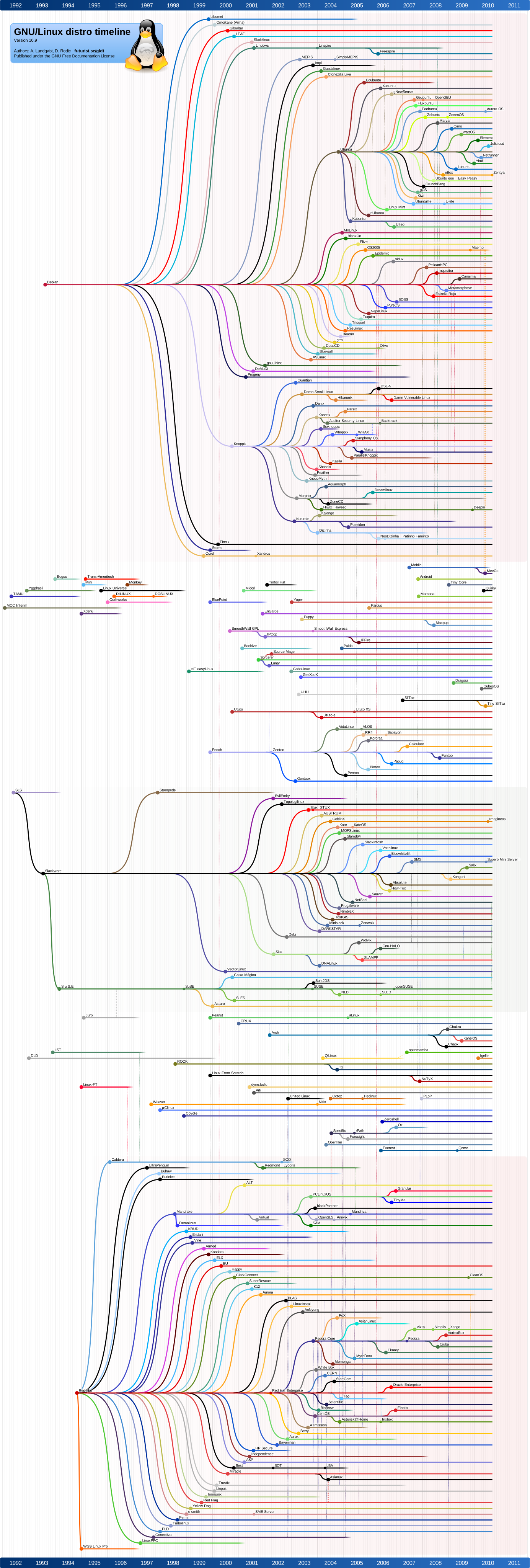
>    - Not Ubuntu or a derivative (see here
>    <http://upload.wikimedia.org/wikipedia/commons/9/9a/Gldt1009.svg>to
>    eliminate choices). I want to avoid the Linux=Ubuntu stigma.
>    - Must be a home-use style distro, not an enterprise-style like
>    RedHat.
>    - Must be a distro you would be proud to show off to non-Linux users.
>
> I use my laptop for web surfing while traveling, and some document
> editing. I have tried Arch and would have stuck with it, but the laptop
> power functions wouldn't work even after 2 days of working on it. I tried
> Linux Mint, but it sucked dry my laptop battery fast. I attempted to try
> PCLinuxOS just a few days ago, but the Live DVD would not boot after Grub
> regardless of the numerous kernel options I put in.
>
> Jeremiah E. Bess
> Network Ninja, Penguin Geek, Father of four
>

--
You received this message because you are subscribed to the Linux Users Group.
To post a message, send email to [email protected]
To unsubscribe, send email to [email protected]
For more options, visit our group at
http://groups.google.com/group/linuxusersgroup
References can be found at: http://goo.gl/anqri
Please remember to abide by our list rules (http://tinyurl.com/LUG-Rules or
http://cdn.fsdev.net/List-Rules.pdf)