A new version is up : http://lenr.qumbu.com/rossi_ecat_steam_v410B.php
I've rewritten it distinguishing FLUID from LIQUID, and replaced Watts by "W".
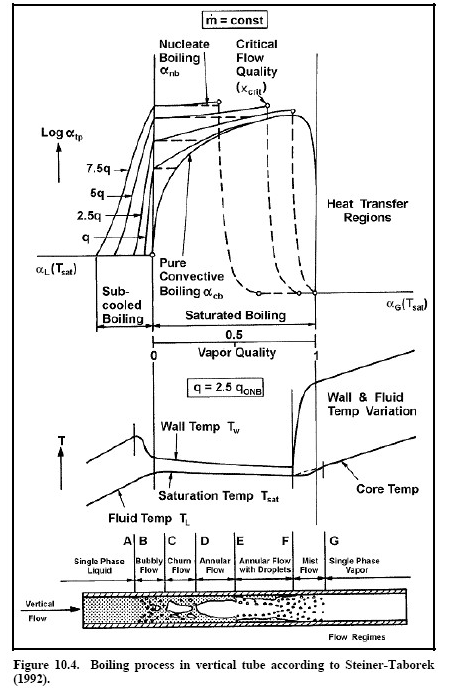
And I found a new diagram for the Drypout, which is explicitly scaled
to the flow pattern diagram:
http://lenr.qumbu.com/steampics/110816_steam_0014.png

At 11:05 AM 8/17/2011, Abd ul-Rahman Lomax wrote:
In particular,
<http://newenergytimes.com/v2/news/2011/37/3714appendixelectriconly.shtml>Appendix
9: NASA Electrical-Power-Only Steam Analysis reviews the
performance of the eCat in relation to an Temperature-Entropy
diagram, and states that the Steam quality could be any value
between 0 and 1, so that the total output power could be anywhere
between 770 watts (NO excess energy), to slightly above Rossi's
claimed value of 4900 Watts
"0 and 1" is a rough summary. In fact, 1 (i.e, 100% vapor) is
extremely unlikely. Most boilers operate at around 95%, normal
boilers won't go below about 90% worst-case.
I've found specific quotes on that for kettle boilers. And for
tube-boilers nukes it is essential to AVOID dryout, because that
leads to BURNOUT.
However, it's quite possible to design a device that will
essentially atomize the liquid, making as low as 5% or so possible,
and 0% is also possible (but it would be on a knife-edge; like 100%,
the "steam" -- hot water at boiling temperature -- would not be
temperature stabilized.
I'll take on your bet that a 5% Dry fully-atomized stream is
possible. One pint of beer/glass of wine ?
At a specific steam quality a "Dryout" occurs : there is no more
liquid water in the output. Any remaining water will then be
carried as droplets in the water vapour. This "Dryout Point" is
estimated by the author to be between 75% dry and 80% dry.
Seems right to me. That's a misnomer. The steam is not dry at that
point. Rather, liquid water is being carried by the flow as suspended droplets.
I've clarified everything (distinguishing between fluid and drops) :
the Dryout happens when there is no fluid water touch the wall of the tube.
Because the measure of wetness is by mass, traditionally, it's
possible for quite wet steam, under some conditions, to be carrying
a lot of water, depending on velocity, turbulence, etc. I've
speculated that one could be making, with the Rossi E-cat design,
steam as low as 5% quality.
One way to describe what the author is calling "dryout" is "fog."
How heavy a fog could be made at the boiling point? In these
devices, if there is high vaporization, the steam velocity is quite
high, and could keep relatively large droplets or relatively dense
fog suspended. Is there experimental data on this? Where?
See above. I've got some leads, but I'm going to finish this part first.
If the eCat is operating with a steam quality BELOW the dryout
point then liquid water will eventually fill the chimney and flow
out of the outlet hose. If the eCat has steam quality ABOVE the
dryout point, then the chimney will empty, and there will be no
liquid water in the outlet hose.
That's, again, quite misleading and incorrect. The steam cools in
the outlet hose, and liquid water being carried by the steam is
still liquid water. It's just suspended, that's all. And as the
steam cools in the hose, steam will (it must!) condense, and some of
this will amalgamate as water.
There will be some condensation in the hose. I think the cooling rate
was estimated to be 80W/meter (too lazy to scroll back in my inbox).
In the Krivit demo there was some water in the hose, which Rossi
flushed out. In the Lewan case the hose went to a bucket.
April 28 : Duration: 2 hours 58 minutes was steam-producing
Flow Rate: 3.8 L/Hr

That's 11 litres or 3 Gallons. I think he'd have noticed that.
> During the April 28 test, we also checked the steam flow through
the outlet hose regularly. Some steam was reasonably being condensed
back into water in the three-meter-long tube that was exposed to air
and was thus at a slightly lower temperature, and a small amount of
water was observed coming out of the hose.
> The amount of water coming out before boiling was clearly larger,
and this was initially measured.
So the eCat STARTED full and then emptied.
It has been asserted that the chimney was dry, specifically by
Galantini, using "eyeballing." That could be quite misleading. There
is pressure in the chimney, raising the boiling point by perhaps a
degree C. If there is a thin film of water on a probe, and the probe
has been allowed to adjust to the internal temperature, both the
probe and adhering water will be above the ambient boiling point,
i.e, when the probe is withdrawn, the water would immediately
vaporize when the pressure is relieved. There would be much more
definitive ways of ruling out liquid water overflow, but they were not used.
The bottom line: there is absolutely inadequate data to come to firm
conclusions on the Rossi demonstration results. Because there are
some indications that some level of fraud or deception (or allowance
of mistaken assumptions) has taken place, such as adjustment of
input power without discloser of the changes, the demonstrations
must be taken as *competely unreliable.* That's unfortunate, but
that's the way it is.
That may be so : as Levi said, it's below the level of scientific
proof, but I don't think it's totally invalidated. In particular,
Krivit's #3 doesn't PROVE that it's fake.
The author believes that the experiments show that the chimney is
NOT full of water, and that significant amounts of liquid water are
NOT in the outlet stream.
Authors may believe what they like, but we have extremely little
experimental data to rely upon, essentialy anecdotal reports, where
unknown caution was exercised.
I was just clarifying my opinion vs the technical stuff.
Lewan didn't see 11 litres of water, therefore it was not
overflowing, therefore the eCat is running ABOVE the dryout point,
therefore the Steam quality is above (est) 75%, therefore the Total
power is above 4300W
The MINIMUM steam quality is thus ABOVE the dryout point, which
means that the steam quality is above 75% Dry, and the total power
is over 4300 watts, much larger than the electrical input of 770 Watts.
The data to back this up isn't even cited. Not great.
If you mean my numbers -- Given 75% dry I just read off the wattage
on the Nasa diagram. Steam quality on the T-h diagram is linear
between points B and C. I grew up with REAL instruments, where one
learns to read a scale to about 5% accuracy between tick marks.
If you mean the occurance of dryout -- It's in the links. See Wolverine Ch 10.
Note 1 : this is a working draft. Some of these calculations have
been "eyeballed", and will be replaced with more accurate numbers.
Check back frequently for updates.
Note 2 : when researching "dryout" be sure to distinguish between
"local dryout" (Leidenfrost), and "total dryout", when there is no more water.
If this is a standard term, great. If not, Bad Idea.
Local dryout includes partial dryout both through leidenfrost and due
to the pooling of water due to gravity.
The exact terms used are not consistent in the literature.
All I'm saying here is that if you find a reference to dryout at
(say) 20% -- I'll bet it's local and not total.